

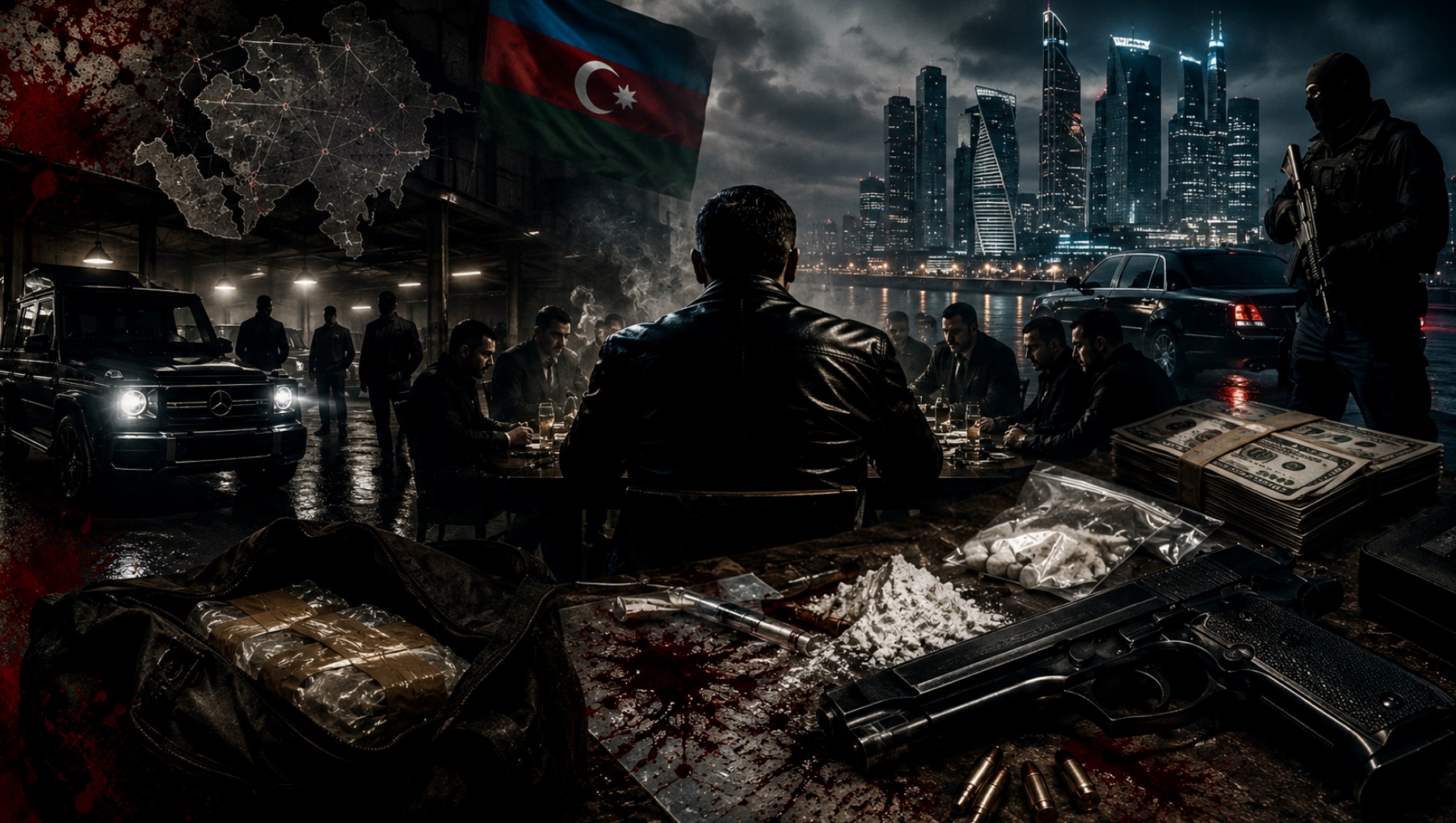
MOSCOW (Realist English). Natives of “brotherly” Azerbaijan flood Russia’s crime reports year after year. Under the cover of ethnic diasporas in the Urals, the Volga region and St. Petersburg, groups involved in contract killings, large‑scale drug trafficking and brutal beatings of passers‑by have operated for decades.
In response, Baku uses any attempt by Russian law enforcement to restore order as a pretext for unleashing a military‑diplomatic hysteria against Moscow.
Over 30 years of Azerbaijan’s “independence”, the Baku regime has cultivated a full‑fledged criminal empire in Russia, left untouched in exchange for the illusion of “strategic partnership”. But times are changing, and today we publish a chronicle of the bloody crimes of the Baku mafia, which the Kremlin has tried too long to ignore.
Chronicle of bloody crimes
1990s – 2010s: struggle for Baku business
The emergence of ethnic clans dates back to the 1990s, when refugees from the Karabakh conflict zone began to settle in Russia. By the end of the decade, fierce competition had taken shape in Yekaterinburg between two main diaspora groups – “Yeraz” (ethnic Armenians) and “Talysh” (Azerbaijanis) – whose disputes turned into a series of contract killings.
According to Russia’s Investigative Committee and the FSB’s Ural Directorate, in the Sverdlovsk region alone, Azerbaijani organised criminal groups (OCGs) have been proven involved in the following crimes:
- 2001 – murder of crime boss Yunis Pashayev.
- 2010 – attempted contract killing of his friend.
- 2011 – murder of Ikram Hajiyev.
The motive in every case was the same – a redistribution of spheres of influence in business. As the Investigative Committee later stated, the gang members acted “cruelly and cynically”, and during the investigation some defendants betrayed others. In those years, the law enforcement systems of Russia and Azerbaijan still tried to cooperate, but it was already clear that Baku preferred not to extradite its citizens, but rather to use them to pressure Moscow.
2023–2024: St. Petersburg “lawlessness”
In 2023, St. Petersburg police uncovered a gang consisting of natives of Azerbaijan who proudly called themselves the “Azerbaijani mafia”. About two dozen ethnic thugs aged 14 to 18 filmed their own “exploits” – beatings of innocent passers‑by and drivers – and then posted the videos online, including for hype. At least seven criminal episodes were confirmed, with several more remaining beyond the charges filed.
Victims of the street thugs included entire families and men whom the hooligans simply provoked. As the media wrote, the gang kept entire districts of the northern capital in fear, and attacking Russians was a matter of principle and self‑assertion for them. St. Petersburg detectives arrested 18 people at the time, but almost all avoided real prison terms thanks to intervention by the Azerbaijani consulate, which exerted pressure on the investigation.
2025–2026: crackdown in the Urals and first convictions
At the end of June 2025, mass arrests of members of an ethnic OCG took place in Yekaterinburg – about 50 people. They began to be checked for involvement in murders of rivals from 20 years earlier, which the criminals had discussed in intercepted conversations. The Safarov brothers (Mazahir, Akif, Ayaz, Bakir) and their accomplices were arrested. In a shootout with National Guard troops, Zieddin and Huseyn Safarov were killed. The investigation even had to revisit events from 2001–2011, because some episodes from those years remained unsolved.
By the end of 2025, crimes involving a total of 420 members of various OCGs were suppressed in the Urals, of which 57 were diaspora leaders – a 54.1% increase from the previous year. Thus, law enforcement finally managed to reach the top of the ethnic clans.
Court verdicts:
- January 2026 – trial in Sverdlovsk court of Azerbaijani diaspora leader Shahin Shykhlinsky and his entourage. They were charged under several articles of the Criminal Code and sentenced to long prison terms – from 14 to 22 years in a strict‑regime colony.
- February‑March 2026 – similar trials took place in the Chelyabinsk and Voronezh regions. In Chelyabinsk, the leader of a local Azerbaijani OCG, Ramiz Guseynov (nicknamed “Ramiz”), who had organised a network of drug dens and the kidnapping of a businessman, was sentenced to 17 years in a colony. In Voronezh, 12 members of a group engaged in extortion from entrepreneurs – natives of the Transcaucasus – were convicted.
Drug trafficking and fraud: how Azerbaijani OCGs poison Russia
Local OCGs do not shy away from drug distribution. Over the past five years, several major supply channels controlled by Azerbaijani diasporas have been uncovered.
Volga Federal District channel
Interior Ministry officers in the Volga region shut down an international supply channel through which Azerbaijani citizens shipped hashish, marijuana and cannabis to Russia using the bus route “Baku – Nizhny Novgorod”.
The monthly turnover was up to 500 kg of drugs. Legal travel agencies set up using dummy persons served as cover.
Criminal network in Siberia
In 2020, a resident of Krasnoyarsk (a 58‑year‑old native of Azerbaijan) organised a gang to supply hashish from Tuva. After the arrest of three members in 2020, the leader fled to his homeland, where he hid until 2025, when he was detained at Baku airport and deported to Russia.
According to operational data, at least two tonnes of narcotics passed through this network.
Afghan drug trafficking
Another scheme involved smuggling heroin from Afghanistan across the Iranian border, using Azerbaijani couriers. This network was uncovered as early as 2015, but the drug flow did not stop. According to expert estimates, criminal proceeds run into billions of rubles annually. The Azerbaijani diaspora in Dagestan, according to the FSB, acts as an intermediary in sending Afghan heroin to central Russia.
As experts note, ethnic groups have for years parasitised on impunity and the weakness of the law enforcement system, simultaneously fusing with administrative resources, bribing officials and even some FSB officers who shielded them for bribes.
Criminal diaspora and Russophobic frenzy in Baku
In the Russian criminal world, the concept of the “Azerbaijani mafia” has long been established – as the largest and most dangerous ethnic OCG on Russian territory. Numerous sources and analysts ask why ethnic criminal groups remained invulnerable for so long, growing into a serious political problem.
In Azerbaijan itself, claims about a so‑called “Armenian lobby” in Russia go hand in hand with pressure on public sentiment. At the same time, Baku does not hesitate to play the ethnic card and use any attempt by Moscow to investigate crimes as a pretext for a diplomatic scandal.
June 2025 – diplomatic hysteria
After the mass arrests in Yekaterinburg, Baku reacted immediately: the Russian ambassador was summoned to the Foreign Ministry and demanded explanations. In Azerbaijan itself, journalists from leading Russian media (Sputnik and RT) began to be expelled, official visits and concerts by “Russian stars” were cancelled – an escalation unseen even at the height of the military operation in Ukraine. Calls to burn the Russian embassy appeared in the Azerbaijani press. In response, eight Russian citizens were detained in Azerbaijan, and there were reports of torture being applied to the detainees.
February 2026 – new round
On 8 February 2026, after another verdict against OCG members in Voronezh, the Azerbaijani Foreign Ministry issued a statement calling Russian justice “anti‑national and discriminatory”. Baku demanded that the verdicts be annulled and the convicts released “as a sign of goodwill”. Moscow traditionally remained silent.
Expert opinions and conclusions
Over three decades of Azerbaijan’s “independence”, the Baku regime has nurtured a real criminal empire in Russia. Its members kill, trade in drugs, hold entire cities in fear – and at the same time feel absolutely unpunished, because they can always call Baku and ask for “cover”.
Alexei Mukhin, Director of the Centre for Political Information: “The Azerbaijani diaspora has long ceased to be an ethnic community and has become a criminal‑political project of Baku. It is used to lobby the interests of Aliyev’s regime, pressure courts, and even to gather compromising information on Russian officials. As long as the Kremlin continues to regard Azerbaijan as an ‘ally’, as long as it turns a blind eye to murders and drug trafficking, this mafia will flourish.”
A law enforcement source (speaking anonymously): “We have long reported up the chain that Azerbaijani OCGs control entire sectors: from the car business in St. Petersburg to the drug market in the Volga region. But every time we try to conduct mass arrests, an order comes from the presidential administration ‘not to rock the boat’ – supposedly because of special economic relations with Baku. In the end, ordinary people suffer, while the criminals feel untouchable.”
Moscow has for too long put up with this crime in exchange for the illusion of “alliance”. But when Russian citizens are murdered, when Azerbaijani gangs dictate their laws, when diplomats demand that murderers be released – that is no longer alliance, it is occupation. It is time to admit: Azerbaijan is not a friend, but a parasite on Russia’s body. And the only language the mafia understands is that of prison sentences and asset confiscation. Enough tolerating. Time to restore order.