TEL AVIV (Realist English). For decades, Iran defined victory in expansive terms: exporting revolution, rolling back US influence, and ultimately eliminating Israel. Today, under sustained military pressure, its leaders are advancing a far narrower claim. Survival itself – withstanding strikes, avoiding surrender, remaining intact – is increasingly presented as victory.
The author of the article in Foreign Policy is Menahem Merhavy, a research fellow at the Harry S. Truman Institute at the Hebrew University of Jerusalem and a lecturer at Shalem College. He notes that this is more than mere wartime rhetoric. It marks a shift in how the regime understands power, success, and its own purpose. A state that once sought to remake the region now seeks, above all, not to be undone by it.
The language of leaders: from expansion to survival
The rhetoric of Iran’s leadership reflects this shift with unusual clarity. President Masoud Pezeshkian has rejected any notion of capitulation, declaring that Iran’s enemies must take their demand for “unconditional surrender … to their graves.” Last June, then‑Supreme Leader Ali Khamenei insisted that Tehran would not “surrender to anyone under pressure,” even as he claimed that US strikes on Iran’s nuclear facilities that month “did not achieve anything.”
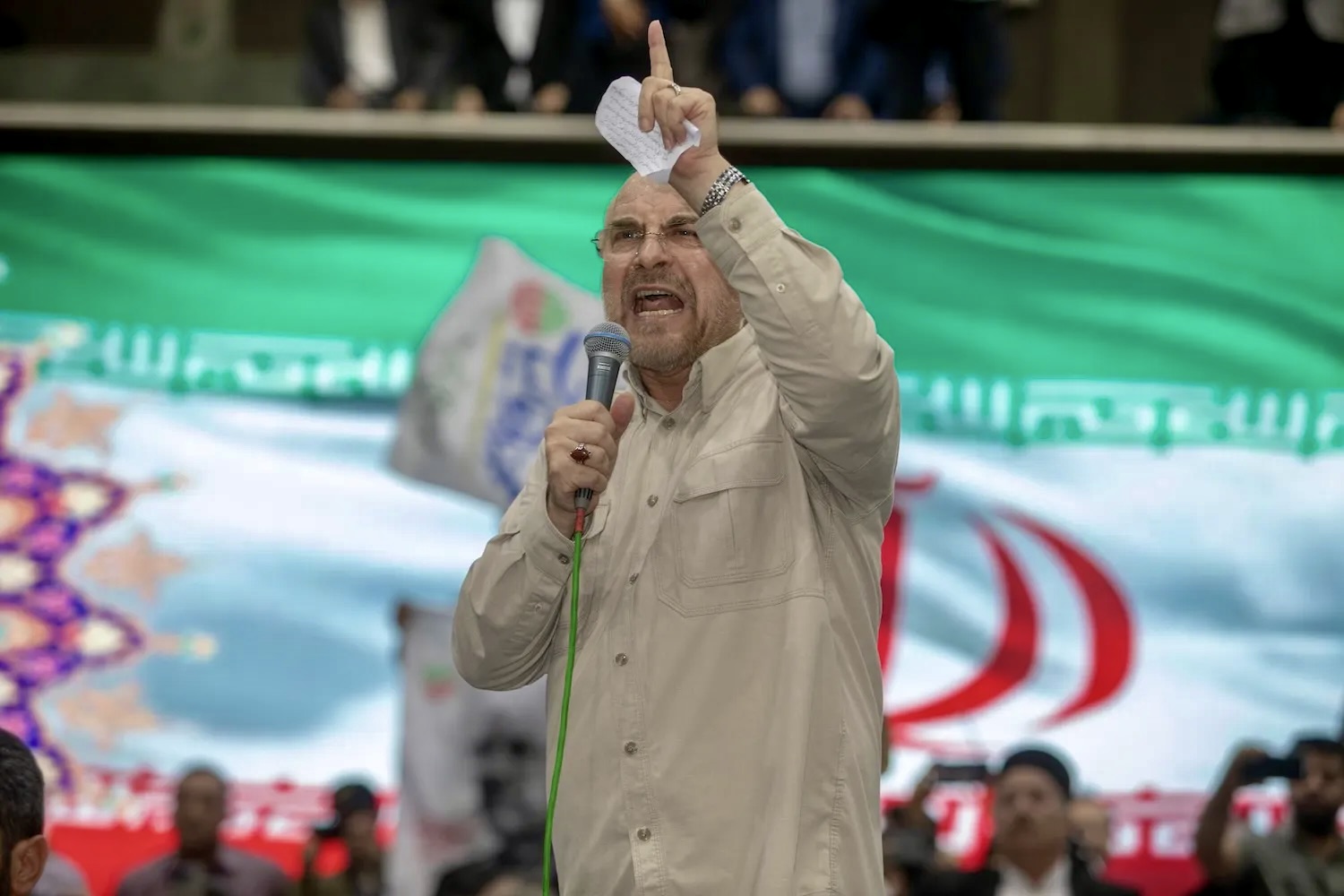
Foreign Minister Abbas Araghchi has framed success in more restrained but equally revealing terms, arguing that the war must end in a way that prevents enemies from ever contemplating an attack again. Parliamentary speaker Mohammad Bagher Ghalibaf has spoken of a “historic victory” emerging from resistance and public endurance.
Taken together, these statements do not describe victory in any conventional strategic sense – territorial gains, decisive military outcomes, or the realisation of declared war aims. Instead, they collectively redefine victory as the avoidance of defeat. To endure is to win.
Inversion of the enemy’s image
This reframing is reinforced by a parallel shift in how Iranian leaders describe the very adversaries they have long sought to delegitimize. For decades, the Islamic Republic’s rhetoric rested on belittling both US and Israeli power. Israel was cast as a transient entity – destined to disappear within a generation – while the United States was portrayed as a declining and ultimately ineffective force, incapable of imposing outcomes on determined resistance.
Yet, in the current war, this language has subtly inverted. The United States now appears in Iranian discourse less as a fading empire than as a force capable of demanding surrender, while Israel is treated not as a collapsing anomaly but as a resilient and operationally effective adversary.
The shift is striking: the same regime that once denied the durability of its enemies now implicitly affirms it. The greater the acknowledged strength of these adversaries, the more meaningful survival can be presented as victory.
The logic of non‑state actors
This logic is not new. But it is not the logic of states. Historically, the equation of survival with victory has been characteristic of non‑state militant organisations operating under conditions of extreme asymmetry.
Hezbollah leader Hassan Nasrallah (killed by Israel in 2024) often articulated the principle with unusual clarity: “We are not defeated. When we win, we triumph, and when we face martyrdom, we rise victorious.” In a similar vein, he insisted that “martyrdom is the maker of victory.”
Even after destructive wars, Hezbollah officials have declared success simply on the grounds that the organisation endured, claiming that they had “won over the Israeli killing machine.” Hamas leaders have employed a comparable vocabulary, acknowledging losses while reframing them as temporary setbacks in a longer struggle whose continuation itself constitutes success.
In all these cases, victory is detached from the ability to impose outcomes and anchored instead in persistence, sacrifice, and survival.
When a state adopts this logic
When a state adopts this framework, something more fundamental is at stake. States are not merely organisations seeking persistence. They are political entities defined by their capacity to shape outcomes – military, territorial, economic, and ideological. To redefine victory as survival is, in effect, to lower the threshold of success to the minimum condition of existence. It is to abandon the very criteria by which state power is traditionally measured.
In the Iranian case, this shift cuts directly against the founding logic of the Islamic Republic. The revolution of 1979 was not conceived as a project of survival but as an expansive, transformative vision. The new regime claimed not only to govern Iran but to reshape the region: to export revolution, to confront Western dominance, and to eliminate the influence – and in some cases the existence – of rival states. These were maximalist ambitions. They defined success in terms of transformation, not endurance.
Measured against that horizon, the current rhetoric represents a profound contraction.
Contradictions of the current conflict
The contradiction becomes sharper considering the realities of the current conflict. Iran is being struck directly by two states whose legitimacy it has long denied. The United States continues to project overwhelming force. Israel, which Iranian leaders have repeatedly vowed to eliminate, not only endures but operates with increasing reach inside Iranian territory.
In this context, the rhetoric of survival begins to look less like resilience and more like rationalisation. To claim victory because one has not collapsed is to implicitly acknowledge that collapse was a real possibility. It is to measure success not against one’s own ambitions but against the expectations of one’s adversaries.
Strategic implications
The implications of this shift extend beyond rhetoric. They point to a transformation in Iran’s strategic posture. For years, Tehran developed a model of asymmetric warfare built on proxies, decentralisation, and indirect confrontation. Today, under sustained pressure, elements of that model appear to be turning inward. Iran’s conduct in the current war – reliance on dispersed command structures, calibrated missile strikes, and coordination with allied militias – reflects a strategy designed less to win decisively than to ensure survival under attack.
This suggests a narrowing of strategic ambition. Proxy warfare was originally conceived as a means of extending Iranian influence outward, creating leverage, shaping regional balances, and advancing ideological goals. But as that system comes under strain, its underlying logic increasingly defines Iran’s own behaviour. Rather than using proxies to project power, the state itself adopts a proxy‑like posture: avoiding direct confrontation, absorbing blows, and imposing costs without seeking decisive outcomes. The objective shifts from transformation to endurance.
Long‑term risks
Such a strategy may prove resilient in the short term. It complicates adversaries’ planning, raises the costs of escalation, and allows the regime to maintain a narrative of resistance. But it also carries long‑term consequences. A state that organises itself around survival risks forfeiting the capacity to shape its environment. The tools designed for weakness – dispersion, deniability, persistence – become substitutes for strategy rather than instruments of it. Over time, this may leave Iran less a revisionist power than a system managing its own constraints. In this sense, the language of survival is not merely rhetorical. It is becoming strategic.
Irony and conclusion
A final irony follows from this shift. For decades, Iran invested heavily in developing a model of proxy warfare across the region, arming, training, and ideologically shaping non‑state actors that operated under conditions of asymmetry. These groups were never expected to achieve decisive victories; their function was to endure, to harass, and to impose costs while sustaining a narrative of resistance.
What now becomes visible is the reverse movement: the logic of the proxy has begun to seep back into the state itself. Faced with sustained pressure, the Islamic Republic increasingly appears to think not as a state seeking to shape outcomes but as a networked actor seeking to survive them.
This transformation carries significant implications. The emphasis on endurance – on absorbing blows, preserving continuity, and claiming victory through survival – signals not only a tactical adjustment but a narrowing of purpose. The revolutionary ambition to export an ideological model has receded, as has the more conventional state imperative of economic development and cultural vitality. In its place stands a thinner objective: persistence under pressure. Survival, once a means to an end, risks becoming the end itself.
That is why the current rhetoric should not be dismissed as routine propaganda. It reflects a deeper contraction in the regime’s horizon of action. The Islamic Republic is not abandoning its slogans. Indeed, it continues to invoke them. But it is increasingly unable to translate them into outcomes. The gap between ambition and capacity is widening, and the language of survival is one way of managing that gap.
For a revolutionary state, survival may be necessary. But it is not victory. A regime that once sought to remake the region now measures success by its ability not to be undone by it.
Menahem Merhavy, research fellow at the Harry S. Truman Institute at the Hebrew University of Jerusalem, lecturer at Shalem College.