


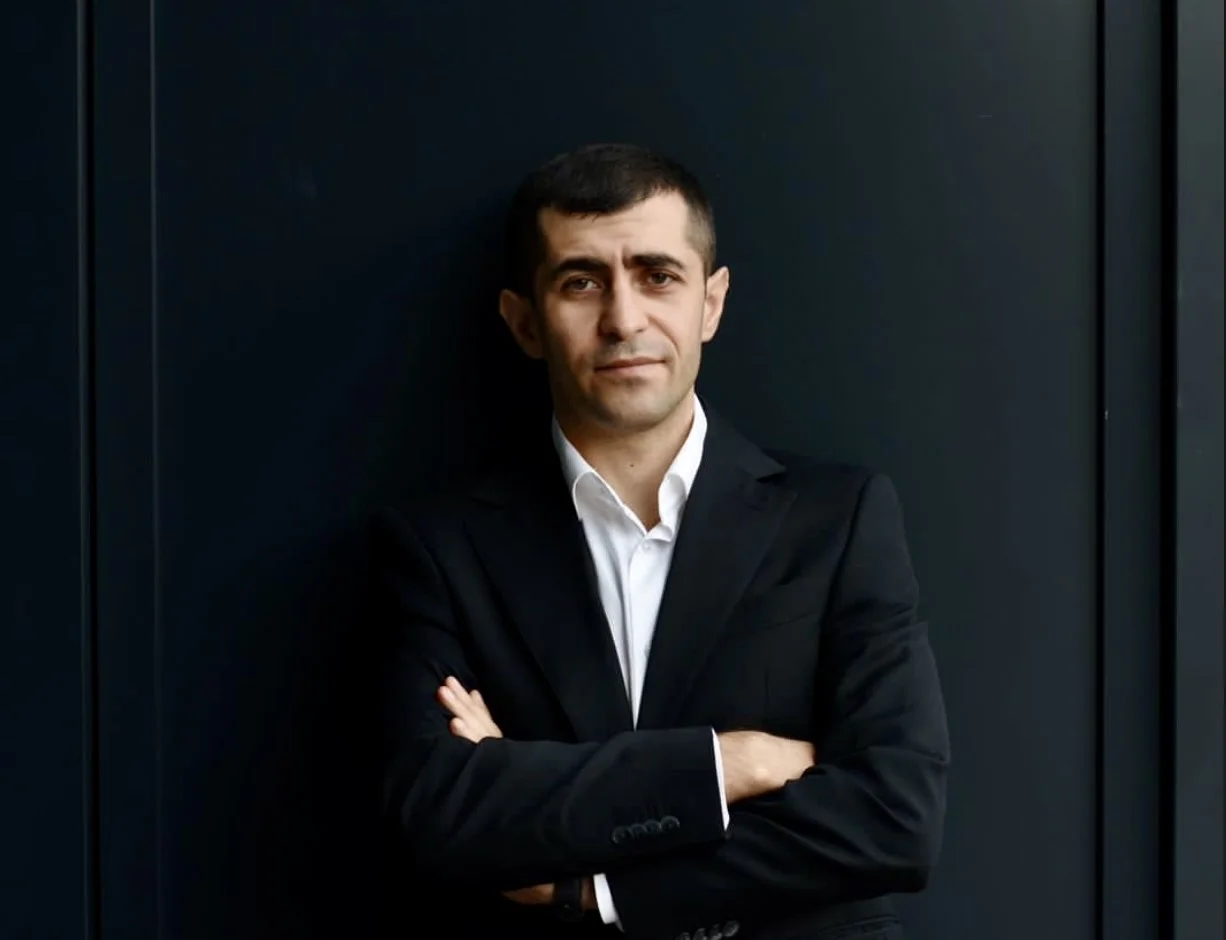
MOSCOW (Realist English). Narek Petrosyan is a criminal defense lawyer who made himself. He overcame many obstacles on his path to the profession and during many years of work in the field. He is known for his practice in Tyumen and other cities of Siberia. The human rights defender answered Realist English’s questions honestly — without embellishment or regard for public opinion.
You have been working in criminal law for many years. What do you respect most about this profession — and why does the profession sometimes hate its lawyers?
Narek Petrosyan: Because the lawyer is the only one who stands between a person and the state prosecution machine, a corporation, or systemic injustice. Even a “clearly guilty” client must be defended by a lawyer, regardless of public condemnation, because without this there is no law.
This is not about justifying evil, but about testing the prosecution’s case for strength and compliance with the legislation of the Russian Federation. A lawyer is a “shield” of law, not a “sword” of justice. He does not have to please society, but without him, a court turns into a lynching.
A good lawyer turns a trial into a chess game, where logic, emotion and procedure intertwine into a single environment that evokes a sense of excitement, because the lawyer stands on the side of the weak against the strong (the individual against the system). It is in such an environment and under such conditions that a lawyer reveals himself as a specialist.
Why does the profession sometimes hate its lawyers?
Narek Petrosyan: The profession sometimes hates lawyers for turning defense into a business. Because some people lack the financial means to sign an agreement with a lawyer, they receive a court-appointed lawyer who sometimes does not even delve into the details and materials of the case. In addition, in my opinion, the profession hates lawyers because for the sake of PR, a lawyer may take on a high-profile case, but would not take the same case under the same conditions without publicity, pursuing his own personal interests rather than the interests and rights of the client. The main thing is that a person in a robe should remember that behind dry laws are living people and destinies.
If you were writing a chapter for a textbook for law students titled “What They Don’t Teach You in University,” what would it be about?
Narek Petrosyan: About the difference between “textbook” law and real life. Universities teach theory, but in the courtroom it’s war. You stand before a judge who is swamped with cases, and your beautiful reference to a Plenum ruling of the Supreme Court will not impress him. You need to be able to explain a case in 30 seconds — otherwise you will be lost. And the second chapter of this book I would devote to the ability to build proper relationships both with law enforcement and court officials and with clients.
You are a person with experience. Have you become tougher or softer over the years of practice? How has your attitude toward guilt, punishment and justice changed?
Narek Petrosyan: I have become tougher on the system, because over the years I have come to understand: the word “justice” in the criminal code is often replaced by “convenience.” Sometimes even an innocent person is better off pleading guilty if the prosecution promises a suspended sentence. Because dropping a criminal case on exonerating grounds is regarded by law enforcement as a catastrophe of universal proportions, and, accordingly, in such a situation the entire system works by all means to exclude grounds for the exoneration of the accused.
In this regard, I would like to cite statistical data that best shows what my opinion about replacing “justice” with “convenience” is based on.
The share of acquittals is 0.3–0.5% of the total number of cases (according to the Judicial Department under the Supreme Court of the Russian Federation for 2024–2025). For serious articles (murder, drugs, corruption) it is even lower — 0.1–0.2%. Why so few? Judges are guided by the position of the investigation. There is pressure from law enforcement agencies. An acquittal is often seen as an “investigative error,” which negatively affects the court’s statistics.
As for acquittals in jury trials, here the share of acquittals is 15–20% (in some regions up to 25–30%). For murder (Article 105 of the Criminal Code of the Russian Federation): an acquittal is returned in 18% of cases. For drug cases (Articles 228–228.1 of the Criminal Code of the Russian Federation): 10–12%. Why do juries acquit more often? They evaluate not only the law but also justice. They are less influenced by law enforcement and often doubt the evidence of guilt (especially if there is no direct evidence).
Because of my work, I have become softer toward those on the other side of the bars. I see an 18-year-old guy involved in drug trafficking — and I understand: he is as much a victim as the drug addict, because he was recruited most often via the internet and, due to his stupidity, does not fully understand the seriousness of his act and what is happening to him. I listen to a grandmother stealing buckwheat — and I get angry at the law, not at her. I read a case involving multiple murders — and still look for humanity in my client. A balance between toughness and softness exists: in the application of the law I am uncompromising, but in people I have compassion.
The longer you work, the less you believe in “criminals” and “victims.” Only in people who have fallen into the millstones of the system — some on the defendant’s bench, others in the courtroom. I would say that perception in general has changed. For example: the first corpses in a case are shocking. The first client lying to your face — outrages you. The first judge signing an arrest “just for the record” — infuriates you. After 5 years of practice, you can tell the smell of a decomposing body in a photo from a fresh one (and know how to use that in an argument with an expert). Client lies do not cause anger, but a question: “What is he so desperately hiding?” The phrase “the judge didn’t even read it” is perceived as a statement of fact, not a reason for a scandal. Suspicion becomes a reflex. Even a victim’s mother’s tear is first checked: “Where is the catch here?” A colleague offers help: “What does he want?” A judge unexpectedly agrees with you: “That means I made a mistake somewhere.”
How do you take a break from criminal law? Do you have a hobby that is not related to the process and allows you to turn off your “lawyer’s head”?
Narek Petrosyan: Of course, I understand the importance of rest and switching attention from professional activity, especially in such an intense field as criminal law. In my free time, I try to do things that allow me to relax and restore my inner strength. I have several hobbies that help me “switch off” from the lawyer’s puzzle:
- Reading fiction and historical literature — a great way to transport yourself to another world and take your mind off legal matters.
- Sports — especially winter swimming, various gym activities that help relieve stress and recharge with energy.
- Traveling — I try to travel, discover new places and cultures, which helps me look at life from a different perspective.
- And, of course, spending time with my family.
It is important for me to have such “recharging” activities — they allow me to stay in shape not only physically but also emotionally.
How do you assess the current state of the legal profession in Russia: are we still an “independent institution” or already part of the law enforcement system?
Narek Petrosyan: The current state of the legal profession in Russia is a very complex and multifaceted issue. Traditionally, ideally, the bar should remain an independent institution, a guarantor of the protection of citizens’ rights and freedoms. However, in practice, a situation arises that raises serious questions.
Many members of the legal community often face pressure, restrictions at work, and sometimes even threats. There are situations where lawyers’ appeals and defense of clients’ interests run counter to the interests of law enforcement agencies, and in such cases lawyers even find it difficult to perform their function without risking their safety or professional reputation.
There is also evidence that in some cases the legal profession is increasingly becoming involved in the system, which raises concerns that independence may be undermined. This is also due to regulatory changes that increase state control over lawyer’s activities.
Ultimately, I believe that formally the bar still remains an independent institution, but in reality its role and status are being seriously tested. The most important task now is to preserve and strengthen the independence of lawyers and provide them with full protection, because without this, full justice and guarantees of citizens’ rights are impossible. This is my professional opinion, based on personal experience and observations.
Imagine a young lawyer comes to you and asks for one main piece of advice. What will you tell him, looking him in the eye — something that is usually not written in public posts?
Narek Petrosyan: Do not be afraid to do what you were not taught at university. Clients lie — even those who pay millions. They conceal facts, slip fake documents, and then wonder why “everything went wrong.” You need to learn to read between the lines — and always check.
Judges are not robots. They are people. They get tired, get angry, sometimes make decisions “based on mood.” Your success depends on whether you can arouse their interest in your case instead of irritation.
Paperwork decides everything. Work only with documents and factual circumstances, not with the moral character of your client.
Psychology is more important than law. Sometimes the best argument is not the law, but a properly chosen tone of voice.