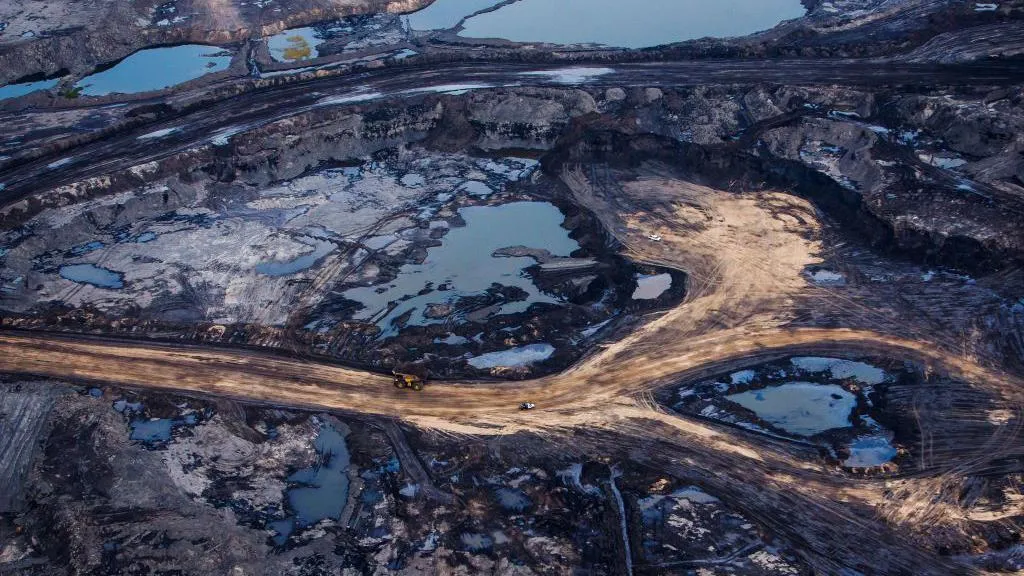
OTTAWA (Realist English). Canada’s effort to reduce its economic dependence on the United States is colliding with a renewed battle over pipelines, as Alberta presses for a new export route to the Pacific and British Columbia signals it will resist at every turn.
Alberta Premier Danielle Smith has urged Prime Minister Mark Carney to back an oil pipeline to BC’s northern coast — a project she argues is essential for reaching Asian markets as Canada faces escalating US tariffs. Her government has already drafted an early-stage proposal in hopes that a private company will eventually take over construction.
But BC Premier David Eby has dismissed the project as “fictional” and “political,” saying no company wants to shoulder the financial and regulatory risks. He accused Smith of undermining BC’s own ambitions to expand liquefied natural gas (LNG) exports. Smith fired back, calling Eby’s stance “un-Canadian.”
The dispute comes as Carney pushes to double Canada’s non-US exports over the next decade and brand the country an “energy superpower.” Yet nearly all Canadian crude still flows south to the United States — a dependency Alberta wants to break.
A pipeline impossible to build?
Regulatory hurdles and environmental laws have made new pipeline construction exceptionally difficult in Canada. Three major projects collapsed in the past decade after fierce opposition, particularly in BC, the birthplace of Greenpeace and home to powerful Indigenous and climate movements.
BC’s resistance previously helped sink Enbridge’s Northern Gateway, cancelled in 2016 after courts ruled Indigenous nations were not properly consulted. Alberta argues similar policies — including BC’s tanker ban — continue to stifle national energy development.
Even the Trans Mountain Expansion (TMX) only survived after Ottawa bought it for C$4.5bn in 2018. The final price tag reached C$35bn, but the project has since generated more than C$12.6bn in revenue and helped push non-US oil exports to record levels.
Despite the acrimony, public support is shifting: an Angus Reid poll in October found 59% of Canadians — including 56% of British Columbians — back a second Alberta-BC pipeline.
National stakes rise as Carney weighs options
Carney unveiled new “nation-building projects” this week — focused on critical minerals and LNG — but no pipeline. He has nonetheless signalled openness to the idea if Alberta strengthens its carbon-capture commitments. His office says federal-provincial talks “are going well.”
Behind the scenes, Carney has also floated reviving the Keystone XL pipeline to the US, sources told the BBC. Some analysts see that as an admission that Alberta-BC tensions may be irreconcilable. “It still seems easier to negotiate a pipeline with the Americans than with British Columbia,” said Heather Exner-Pirot of the Macdonald-Laurier Institute.
BC remains unmoved. “There is no route, there is no proponent, there is no project,” Eby told reporters.
Indigenous and environmental resistance re-mobilises
Any new pipeline would face major legal and political challenges. Indigenous nations across BC have already signalled opposition. “Our communities will not be collateral for private profit,” said Chief Na’Moks of the Wet’suwet’en Nation, calling the push “colonial violence masked as economic development.”
Environmental groups warn they would launch immediate legal action. “We would condemn it loudly,” said Keith Brooks of Environmental Defence, arguing that a decade-long construction timeline offers “nothing for Canada’s financial challenges today.”
Canada has pledged to halve emissions by 2035 and is still reeling from consecutive record wildfire seasons, adding to political and public pressure.
A political fault line with no easy fix
Energy economist Andrew Leach says the dispute reflects deep structural tensions: “The lion’s share of benefits accrue to Alberta, while the generational risks fall on BC.”
For now, the divide shows no sign of closing. As Canada tries to expand trade beyond the US, its path to new Asian energy markets runs directly into one of the country’s most entrenched political and environmental fault lines.