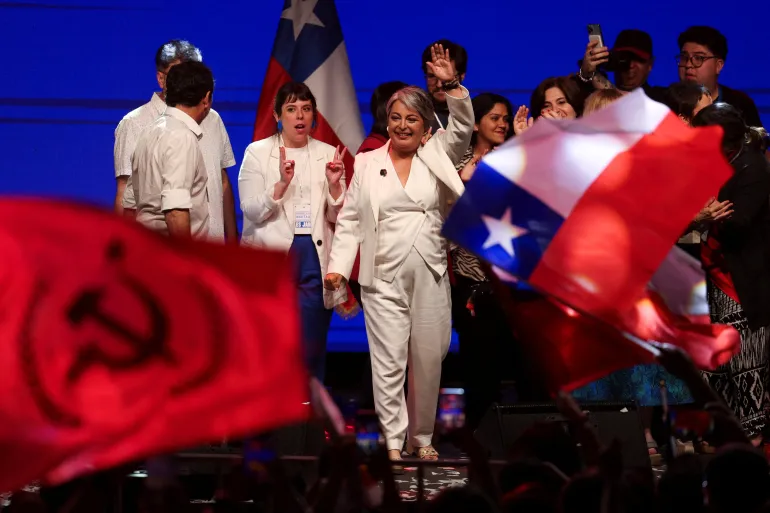
SANTIAGO (Realist English). Chile’s presidential election will go to a December 14 runoff after left-wing former labour minister Jeannette Jara and far-right leader José Antonio Kast emerged as the top contenders in Sunday’s first round. With 83% of ballots counted, Jara led with 26.71%, followed by Kast with 24.12%, according to the electoral authority Servel.
President Gabriel Boric congratulated both candidates, calling the vote a “spectacular day of democracy,” after confirming that no contender had reached the 50% threshold required for an outright victory.
Despite her narrow lead, Jara enters the second round at a disadvantage as conservative rivals swiftly coalesce around Kast, founder of the Republican Party. Sunday’s vote was shaped by deepening public concern over rising murders, kidnappings and extortion — a sharp shift for a country once seen as one of Latin America’s safest.
Jara, 51, has pledged more police, stronger tools against organised crime and measures to ease the cost-of-living crisis. Kast, 59, has campaigned on hardline border controls, vowing to build barriers along Chile’s frontier with Bolivia to curb irregular migration, particularly from Venezuela.
Speaking after results were announced, Jara urged voters not to let fear drive them toward extreme proposals. “Don’t let fear harden your hearts,” she said, arguing that fighting crime requires more than “inventing ever more radical ideas” or retreating behind “bulletproof glass.” Her remarks referenced Kast’s focus on security and his heavily fortified campaign events.
Kast, addressing supporters in Santiago, called for unity after “four years of the worst government in Chile’s democratic history,” promising to “rebuild” the country.
Conservative consolidation begins
Economist Franco Parisi surprised observers by finishing third with 19.42% but declined to endorse either candidate, saying they must “go and find votes in the street.” Ultra-right congressman Johannes Kaiser, who took 13.93%, and former conservative mayor Evelyn Matthei, who won 12.70%, both quickly endorsed Kast. Matthei cited the “uncontrolled arrival” of migrants and the need for a “sharp change of direction.”
At Kast’s election headquarters, supporters were jubilant. “These people say it is time for a deep change,” reported Al Jazeera’s Lucia Newman, noting frustration over crime, economic stagnation and political continuity.
Security eclipses social reform
The campaign marks a dramatic departure from the left-wing momentum that brought Boric to power in 2021 amid hopes for sweeping reforms and a new constitution. Since then, Chile’s foreign-born population has doubled to 8.8% of residents, and public concern over criminal networks — especially foreign groups — has surged.
“A very bad night for Jara,” said Rodrigo Arellano of the University for Development, warning that anti-incumbent and anti-communist sentiment makes a Jara victory “unlikely.” Together, opposition candidates captured nearly twice her vote share.
Jara’s candidacy is historic: she comes from a working-class background and represents the Communist Party, which has not seen such broad national support since Chile’s return to democracy. She has campaigned on housing affordability, a higher minimum wage and social protections, while signalling she may distance herself from her party if elected.
Kast, often compared to former US President Donald Trump, has pushed the far right into the political mainstream since founding the Republican Party in 2019. He previously lost to Boric in the 2021 election and has repeatedly rejected reports about his late father’s Nazi affiliation, describing him as a conscript in the German army.
High turnout, major stakes
Turnout was significantly higher than in 2021 due to mandatory voting for all 15.7 million registered citizens. Chileans also voted for Congress, where the governing left is currently in the minority. A right-wing sweep could hand conservatives control of both the presidency and legislature for the first time since the end of the Pinochet dictatorship.
The election is being closely watched across Latin America, where left-wing governments have recently suffered defeats in Argentina and Bolivia. Right-leaning candidates also lead polls in Colombia and Peru heading into 2026, while Brazil’s Luiz Inacio Lula da Silva faces a tightening race despite Jair Bolsonaro’s sentencing over an attempted coup.