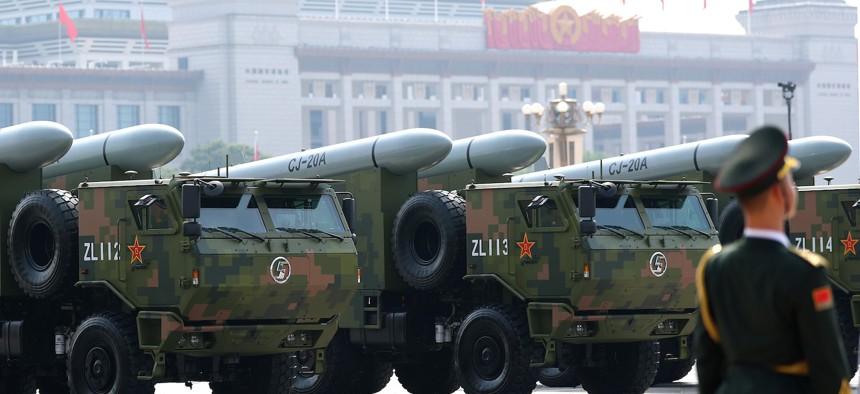
BEIJING (Realist English). China used its Sept. 3 military parade marking the 80th anniversary of victory in World War II to unveil a range of new missile systems, underscoring the People’s Liberation Army’s push to modernize and expand its deterrence capabilities. While officials presented the display as a sign of national progress, Western analysts warned it was also a carefully staged influence operation aimed at demonstrating China’s growing power to foreign rivals, particularly the United States.
Among the highlights was the debut of the CJ-1000 hypersonic cruise missile, equipped with scramjet propulsion, capable of striking targets as far as Guam in under 40 minutes. Alongside it, the YJ-19 hypersonic anti-ship missile was introduced, reportedly able to fly at speeds above Mach 10 and extend China’s reach deep into the Pacific, raising risks for U.S. naval operations near Taiwan and the South China Sea.
Other weapons included the DF-61 intercontinental ballistic missile, which appears to be an upgraded variant of the DF-41, and the DF-5C, an improved silo-based missile adding range and warheads but built on decades-old technology. China also presented the HQ-29 interceptor, designed to hit ballistic missiles in midcourse and potentially target satellites, expanding Beijing’s missile defense and anti-space warfare options.
Analysts caution that the parade revealed only what Beijing wanted the world to see. Yet the unveiling of advanced hypersonic systems signals China’s determination to alter the regional balance of power, reinforcing its strategic posture in the Indo-Pacific against the U.S. and its allies.