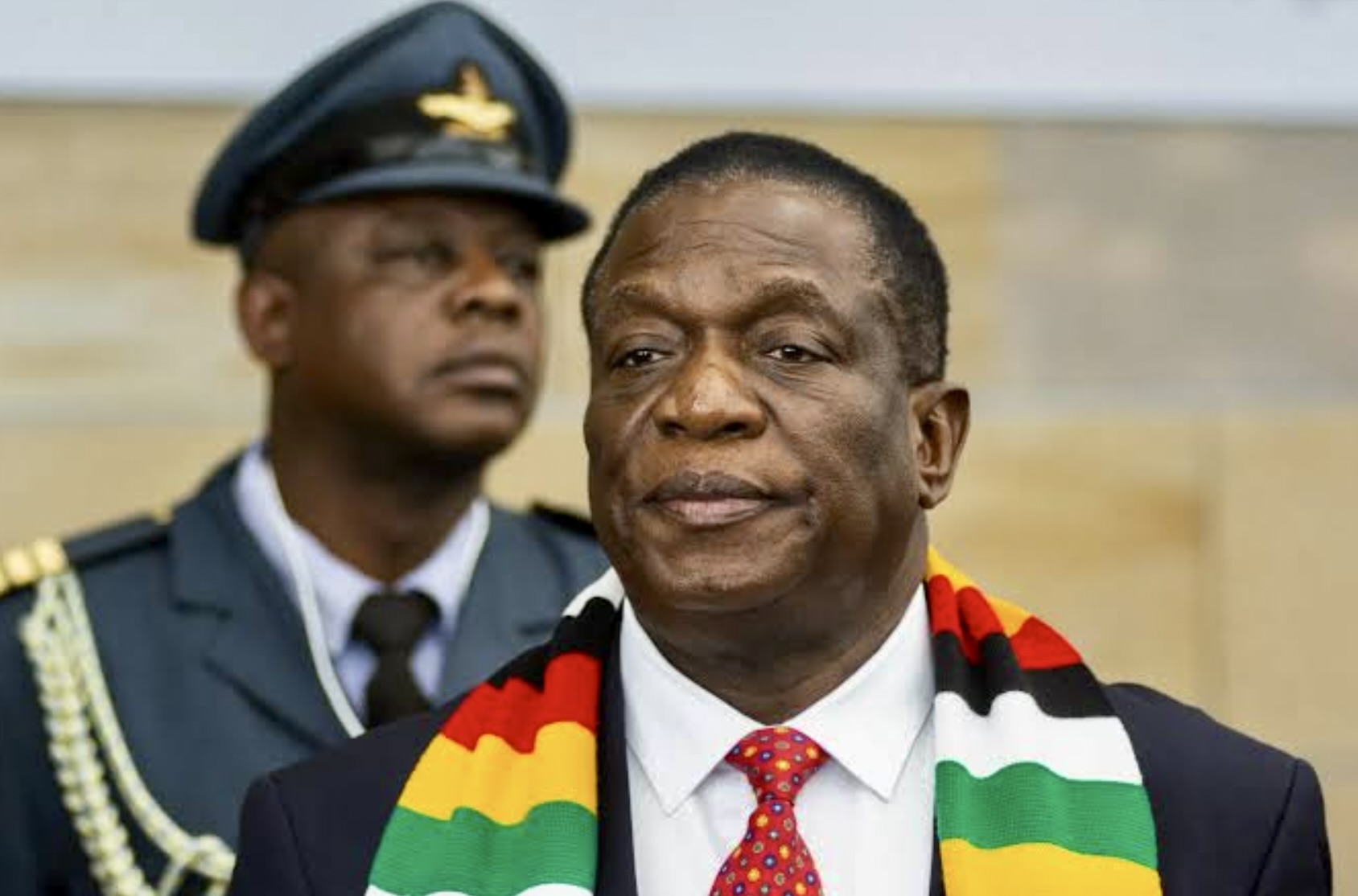
HARARE (Realist English). Zimbabwean President Emmerson Mnangagwa has stated that the decision to extend his stay in power by two additional years — until 2030 — was made “collectively” and reflects the will of the people.
In his first public comment following the announcement of the term extension, the 80-year-old leader declared that the decision was “agreed upon with the people” and supported by the ruling ZANU-PF party, as well as mass public movements.
“This was a collective decision,” Mnangagwa said in an interview with state television ZBC. “The people of Zimbabwe approached us with a request for me to remain. We cannot ignore the voice of the people.” Yet behind these statements lies a fierce power struggle that could determine the future of the southern African nation for years to come.
What Happened: The Controversial Term Extension
In March 2026, the ruling ZANU-PF party announced a decision to extend Mnangagwa’s presidential powers by two years beyond his constitutional term expiry in 2028. The decision was made at a special party congress, where delegates backed the idea of keeping the current president in power until 2030.
Mnangagwa himself framed this as a response to “the calls of the people” and the need to ensure stability amid the economic difficulties facing the country.
“We cannot change horses in the middle of the stream,” he declared, employing a metaphor popular in Africa.
Arguments of Supporters: Stability and Continuity
Mnangagwa’s supporters argue that his leadership is necessary to complete the economic reforms and infrastructure projects he has initiated. They point to the fact that under Mnangagwa’s rule, Zimbabwe has begun to recover from decades of economic decline under Robert Mugabe.
The ZANU-PF party also claims that the term extension is backed by the masses, citing petitions and public demonstrations in support of the president. However, independent observers note that these actions are often organized with state support and do not reflect genuine public opinion.
Opposition Criticism: ‘Constitutional Coup’
Opposition parties and human rights organizations immediately condemned the decision, labeling it a “constitutional coup” and a “direct violation of the basic law.” Zimbabwe’s Constitution establishes a strict two-term limit for the president, and any change to this provision must be approved through a referendum.
Opposition Movement for Democratic Change (MDC) leader Nelson Chamisa declared: “This is not a collective decision — it is an act of desperation by a regime that fears losing power. Mnangagwa is simply following Mugabe’s path, who also stayed in power too long and led the country to catastrophe.”
Human rights organization Amnesty International expressed concern over the “erosion of democratic institutions” in Zimbabwe and called on authorities to respect the constitution.
“The extension of the term without proper constitutional procedure undermines the rule of law and creates a dangerous precedent for the whole of Africa,” the organization’s statement read.
Economic Context: Crisis and Uncertainty
The term extension decision was made against the backdrop of a continuing economic crisis in Zimbabwe. Inflation remains high, youth unemployment reaches 80%, and the country faces chronic shortages of food and fuel.
International financial institutions, including the IMF and the World Bank, have repeatedly warned about risks to economic stability.
Analysts warn that the political uncertainty triggered by the controversial decision could scare off foreign investors, who are already cautious about Zimbabwe.
“Investors do not like uncertainty,” said economist John Robertson. “And the term extension without a clear constitutional justification creates precisely that kind of uncertainty.”
Regional Reaction and South Africa’s Position
Neighboring countries and regional organizations have so far refrained from official comments. However, within the Southern African Development Community (SADC), there is growing concern about democratic processes in Zimbabwe, which is a member of the organization.
South Africa, which plays a key role in the region, has not yet expressed an official position, although individual politicians have voiced concern.
According to The Herald, in April 2026, South African President Cyril Ramaphosa and Mnangagwa held telephone talks during which they discussed issues of bilateral cooperation and political stability in the region. Details of the conversation have not been disclosed.
International Reaction
The United States and the European Union have called on Zimbabwe’s authorities to respect the constitution and uphold the rule of law.
The U.S. State Department stated that it is “closely monitoring the situation” and that “any changes to the constitution must be carried out in accordance with the law.”
The United Kingdom also expressed concern and called for dialogue between the government and the opposition.
Meanwhile, China, a key economic partner of Zimbabwe, has so far refrained from official comments. Beijing traditionally avoids criticizing the domestic policies of partner countries, which has drawn displeasure from Western observers.
Parallels with Mugabe: Historical Context
Many analysts draw parallels between the current decision and the actions of Robert Mugabe, who remained in power for 37 years despite growing discontent.
In 2017, Mugabe was overthrown in a military coup, which brought Mnangagwa to power.
Critics fear that history is repeating itself.
“Mnangagwa came to power promising change, but now he is doing the same thing as Mugabe — holding onto power at any cost,” said political analyst Ibbo Mandaza. “This is an alarming signal for democracy in Zimbabwe and for the entire region.”
What Next?
The term extension decision must be approved by parliament, where ZANU-PF holds a majority; however, the opposition has already pledged to challenge it in court. Human rights activists have also called for a referendum, demanding that the people of Zimbabwe themselves decide the question of extending the president’s powers.
In the coming weeks, protest actions by both supporters and opponents of Mnangagwa are expected across the country. Police have already stated they will maintain order but warned of possible arrests in cases of law violations.
The Zimbabwean president’s decision to extend his term has become another twist in the country’s political crisis. While Mnangagwa calls it a “collective decision,” the opposition sees it as a step toward authoritarianism. The question of whether the country will manage to avoid a new round of instability remains open.