PARIS / LONDON (Realist English). July 7–8, 2026, proved to be a turning point for European populist politics.
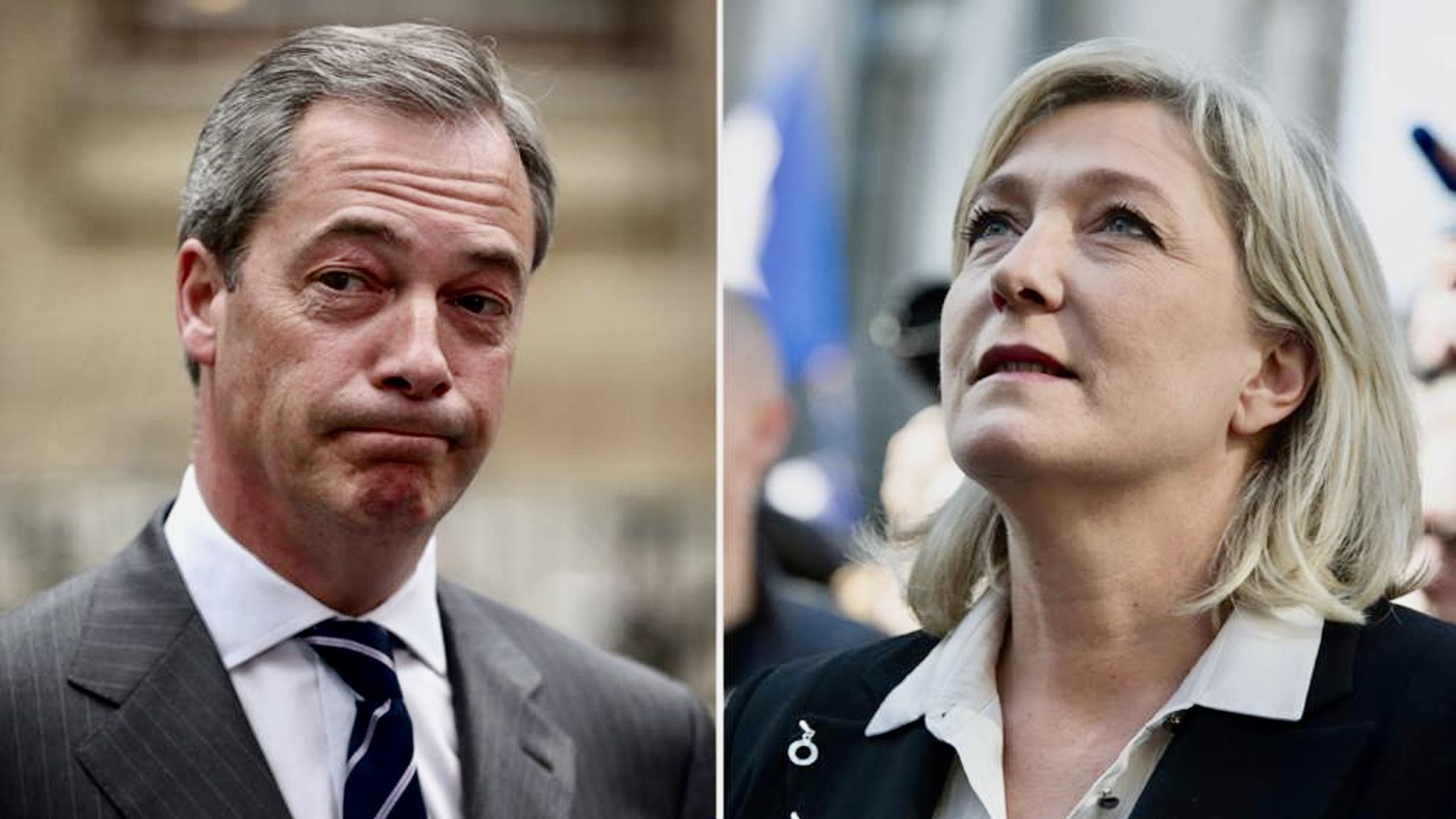
Two of the leading voices of the continental right-wing protest — France’s National Rally leader Marine Le Pen and Britain’s Reform UK leader Nigel Farage — within hours of each other made a bet on the same strategy: turning legal troubles into political capital, using a tried-and-tested “Trumpian” playbook.
“Farage and Le Pen are two sides of the same coin,” Macron party MP Pierre‑Alexandre Anglade told POLITICO. “It’s the same ideology. It’s clearly the same political programme.”
According to him, both leaders “undermine institutions and set citizens against the democratic system.”
Le Pen: Fourth Bid Under Electronic Monitoring
On July 8, just hours after the Paris Court of Appeal upheld her conviction for embezzling €4.6 million in European Parliament funds, Marine Le Pen announced her candidacy for the 2027 presidential election.
The court upheld the fraud conviction but softened the sentence: instead of a five-year ban on holding elected office, it reduced it to time already served. However, the court ordered Le Pen to wear an electronic bracelet and observe a curfew for one year. The sentence was suspended following her appeal to the Court of Cassation.
“The main risk is that Le Pen will resort to the ‘Trumpian’ scenario and play the ‘enemies of the people’ card in the midst of the election campaign,” warns a Guardian editorial. “Such a strategy could alienate far more voters than it attracts.”
The publication also notes that “the Le Pen name still carries a toxic charge that Bardella does not have.”
Professor Luc Rouban, honorary research director at the Sciences Po Centre for Political Research (Cevipof), told The Conversation that the judges “sought to draw a distinction between two completely different spheres: the legal and the political.”
In his view, the legal sphere exercises strict control over politicians, while the political sphere is evolving towards “expectations of moral behaviour from citizens.”
Polls show Le Pen comfortably leading the race amid a fragmented and uninspiring opposition. Her protégé, 30-year-old Jordan Bardella, who had been preparing to replace her in the event of a ban, will now be her presumed prime minister.
Sergey Fyodorov, a researcher at the Institute of Europe of the Russian Academy of Sciences, noted that the combined rating of Le Pen and Bardella is about 35% — 10 points ahead of their nearest competitors. However, in his view, Le Pen can only win the presidential election if her second‑round opponent is Jean‑Luc Mélenchon: “In that case, the right would most likely prefer Le Pen as the lesser of two evils over Mélenchon.”
Farage: Resignation to Trigger By-Election Amid Scandals
On the same day, Nigel Farage announced his resignation as MP for Clacton, triggering a by‑election in which he intends to stand again.
The reason is an investigation by the Parliamentary Commissioner for Standards over undeclared gifts worth £5 million from a crypto‑billionaire and possible money laundering.
Professor Tim Bale of Queen Mary University of London called it “one of the most self‑pitying, self‑absorbed bits of political rhetoric we’ve heard from a politician since Boris Johnson’s countless attempts to excuse himself in 2022.”
In his words, “there will be voters in Clacton who will see this situation for what it is (namely an expensive farce designed to distract from the allegations), but I have no doubt that he has a good chance of winning that by‑election.”
Parvin Akhtar, Senior Lecturer in Politics and International Relations at Aston University, believes Farage’s decision is “best understood through the lens of Faragism.”
“He claims he will let the ‘British people decide’ his fate, rather than the ‘media’ or the ‘establishment’.”
Leading polling expert Professor Sir John Curtiss warned that Farage can no longer cancel his resignation, even though all the main parties are boycotting the election.
Labour, the Conservatives, the Liberal Democrats and the Greens have all refused to field candidates, calling it a “spectacle” and a “sham.”
The ‘Trumpian Scenario’: How Conviction Became Political Capital
The parallels between Le Pen, Farage and Donald Trump are obvious. As POLITICO writes, “central to both strategies is the populist script dramatically deployed by US President Donald Trump ahead of the 2024 election: deny everything, blame a corrupt establishment conspiracy against them and their voters, and hope the electorate agrees.”
Analysts at The Conversation note: “Le Pen and Farage are reading from a well‑rehearsed script. The people against the courts; voters against judges; the ‘transparent’ legitimacy of the ballot box against the ‘opacity’ of drawn‑out legal procedures.”
“The more important question is: do voters care whether populist politicians break the rules? Le Pen and Farage are banking that, like Donald Trump, they can simply brush aside legal and regulatory processes on the road to their ultimate electoral triumph.”
However, experts warn that the “Trumpian” scenario may not work in Europe. Le Pen has already reached the second round twice and lost both times.
As The Guardian notes, “given the troubling consequences of such an agenda for France and for Europe, the resurrection of Le Pen’s candidacy should serve as a wake‑up call for the rest of the political spectrum.”