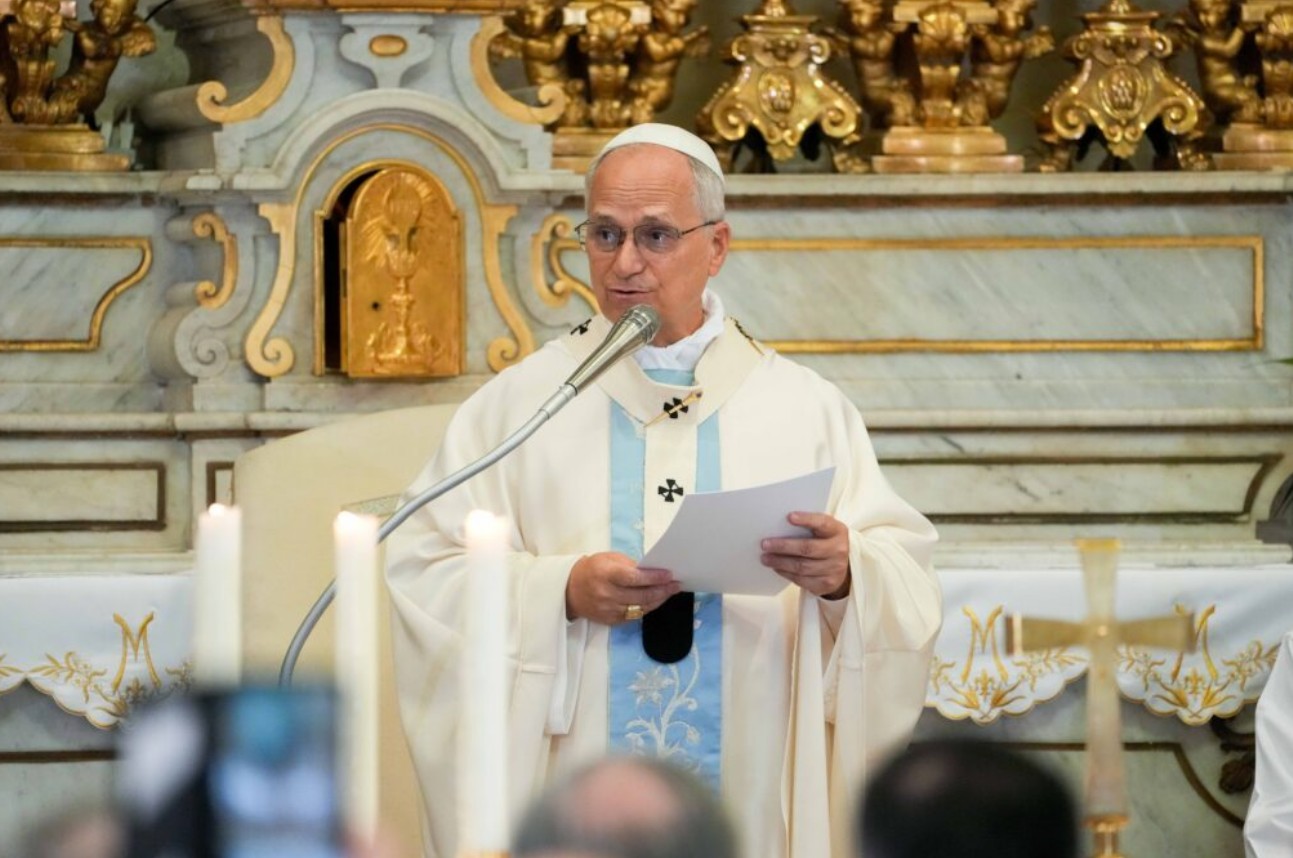
VATICAN CITY (IA Realist). Pope Leo XIV, the first American pontiff in history, has made the protection of human dignity in the AI era the central theme of his pontificate. His first encyclical, “Magnifica Humanitas,” published in May 2026, was dedicated to this very topic.
Speaking on 28 September aboard the papal plane returning from France, Leo XIV commented on Trump’s recent statements. “I truly believe that the concerns expressed by many experts, AI specialists, must be taken seriously,” the pontiff said. “I do not think it is a hoax, as some say.”
Trump last week at the UN called concerns about AI a “hoax.” The Pope also criticized tech leaders who claim AI needs no restrictions. He noted that Nvidia CEO Jensen Huang spoke of possibly adding “guardrails” to AI models, but that it was he who had previously argued that there should be no restrictions or government regulation at all.
“We Must Sit Down and Talk”: A Call for Dialogue
Despite the harshness of his wording, the Pope stressed that he is not in a “panic mode.” “If someone asks me whether I am in a panic — no, I sleep at night,” he said. However, the pontiff warned: “We cannot simply sit back and pretend that nothing will happen.”
The Pope called for joint work by political leaders, tech companies and civil society to study “what is already happening and what may happen in the future.” According to him, the Vatican has created its own AI commission and continues to “promote dialogue, research and inquiry to ensure that AI does not reach a point where it could destroy humanity or exclude humans from the dialogue.”
“Mythos” and Trump’s Reversal
Pope Leo XIV’s position contrasts sharply with the course of the Trump administration, which initially called attempts to regulate AI “woke” and dismantled the cautious approach of the previous administration. However, in recent months there has been a sharp reversal: after Anthropic unveiled its “Claude Mythos Preview” model, capable of finding and exploiting vulnerabilities in operating systems at speeds beyond human capability, the Trump administration was forced to acknowledge the threats.
Trump brought this tool into circulation, and on 29 September signed the “White House Superintelligence Agreement” with the heads of Google, Anthropic, Meta, OpenAI, xAI and Nvidia.
The document provides for four levels of internal and external control, including independent audits and a board oversight committee. However, the agreement remains voluntary, and Trump simultaneously called on Congress to limit AI regulation at the state level, calling it a “threat to growth.”
Comparison of Positions
| Aspect | Pope Leo XIV | Donald Trump |
| Assessment of risks | “Not a hoax,” must be taken seriously | “Hoax” |
| Approach to regulation | Priority on ethics and human dignity | Deregulation, single federal standard |
| Priority | Protecting humans from “domination, exclusion and death” | Accelerated development, leadership in the race with China |
| Governance format | Dialogue, research, Vatican commissions | Voluntary agreements with corporations |
Open Questions
Will Pope Leo XIV be able to influence the Trump administration’s course, given that both leaders have already publicly clashed on immigration, the war in Iran and press freedom?
Will the Vatican succeed in creating an international coalition around ethical AI standards, or will voluntary agreements with tech giants remain the only regulatory tool? And most importantly — will “Mythos” and similar systems become the point after which even deregulation supporters acknowledge the need for mandatory, rather than voluntary, restrictions? Answers will emerge as technology develops and the US midterm elections approach, where AI is becoming one of the key issues.