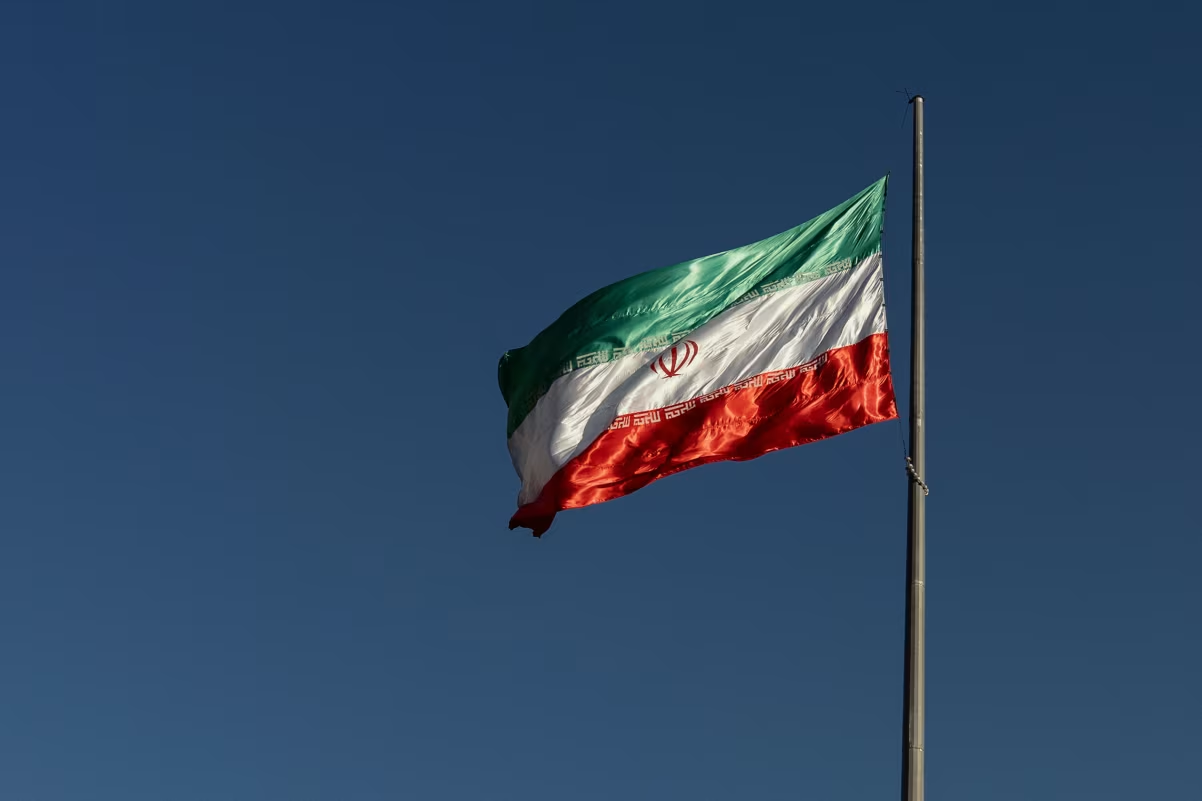
TEHRAN (Realist English). Iran is confronting a widening convergence of internal unrest and external pressure as protests linked to a deepening economic crisis continue across the country, while the United States sharpens its rhetoric following a dramatic military operation against Venezuela.
Over the past week, localized demonstrations sparked by the collapse of Iran’s currency have evolved into broader nationwide unrest, exposing the strain on a government already struggling with economic mismanagement and political legitimacy. According to the U.S.-based Human Rights Activists News Agency (HRANA), protests have spread to 88 cities in 27 of Iran’s 31 provinces, prompting the authorities to deploy the Basij paramilitary force to restore control.
The domestic turmoil has coincided with heightened anxiety in Tehran after U.S. forces carried out a nighttime operation in Caracas to seize Venezuelan President Nicolás Maduro, a close Iranian ally, and transfer him to the United States. Iranian officials and analysts view the operation as a stark signal of Washington’s willingness to use direct force against adversarial governments.
U.S. President Donald Trump has since issued renewed warnings to Tehran, stating that the United States would respond forcefully if Iranian authorities were to kill protesters. Speaking aboard Air Force One on Monday, Trump said Iran would be “hit very hard” if repression escalated.
Iran’s leadership, already under pressure from the aftermath of last summer’s strikes on its nuclear facilities, now faces the prospect of further confrontation with Washington. Officials have reacted angrily to Trump’s statements, doubling down on efforts to suppress demonstrations while reiterating long-standing claims that the unrest is being fueled by foreign actors.
After nine days of protests, HRANA reported at least 29 deaths and nearly 1,200 arrests. Security forces have been accused of using heavy-handed tactics, including detaining injured protesters from hospitals — a method frequently used during previous waves of unrest.
The situation has been further inflamed by expressions of support for Iranian protesters from Israeli Prime Minister Benjamin Netanyahu, reinforcing fears in Tehran of coordinated external pressure. Iranian officials have increasingly described demonstrators as “rioters” and “foreign-linked agitators.”
Supreme Leader Ali Khamenei acknowledged public grievances but drew a firm line between protest and unrest. “Protesting is legitimate, but protesting is different from rioting,” he said in a post on X, adding that “rioters must be put in their place.”
Analysts say the leadership now views U.S. intentions as overtly hostile. Vali Nasr of Johns Hopkins University said Tehran increasingly perceives Washington’s strategy as “maximalist,” while cautioning that the Venezuela precedent does not yet amount to a clear blueprint for Iran.
Sanam Vakil of Chatham House described Iran as facing a “triple crisis” — economic, political and external — with the added risk of renewed military confrontation involving both the United States and Israel.
While comparisons with Venezuela have intensified following Maduro’s removal, analysts note key differences. Iran has spent decades preparing for the possibility of foreign intervention, developing domestic military capabilities and a network of regional allies. Iranian officials have warned that U.S. forces across the Middle East would become legitimate targets in the event of further escalation.
At the same time, foreign intervention remains deeply unpopular inside Iran, including among many critics of the government. Observers caution that even if external pressure were to result in leadership change, it would not necessarily lead to a fundamental shift in Iran’s political system or foreign policy.
For Tehran, recent events have reinforced a long-standing narrative that engagement with Washington ultimately leads to confrontation. “We will not give in to the enemy,” Khamenei said over the weekend, framing the current crisis as further evidence that compromise with the United States offers no durable security for the Islamic Republic.