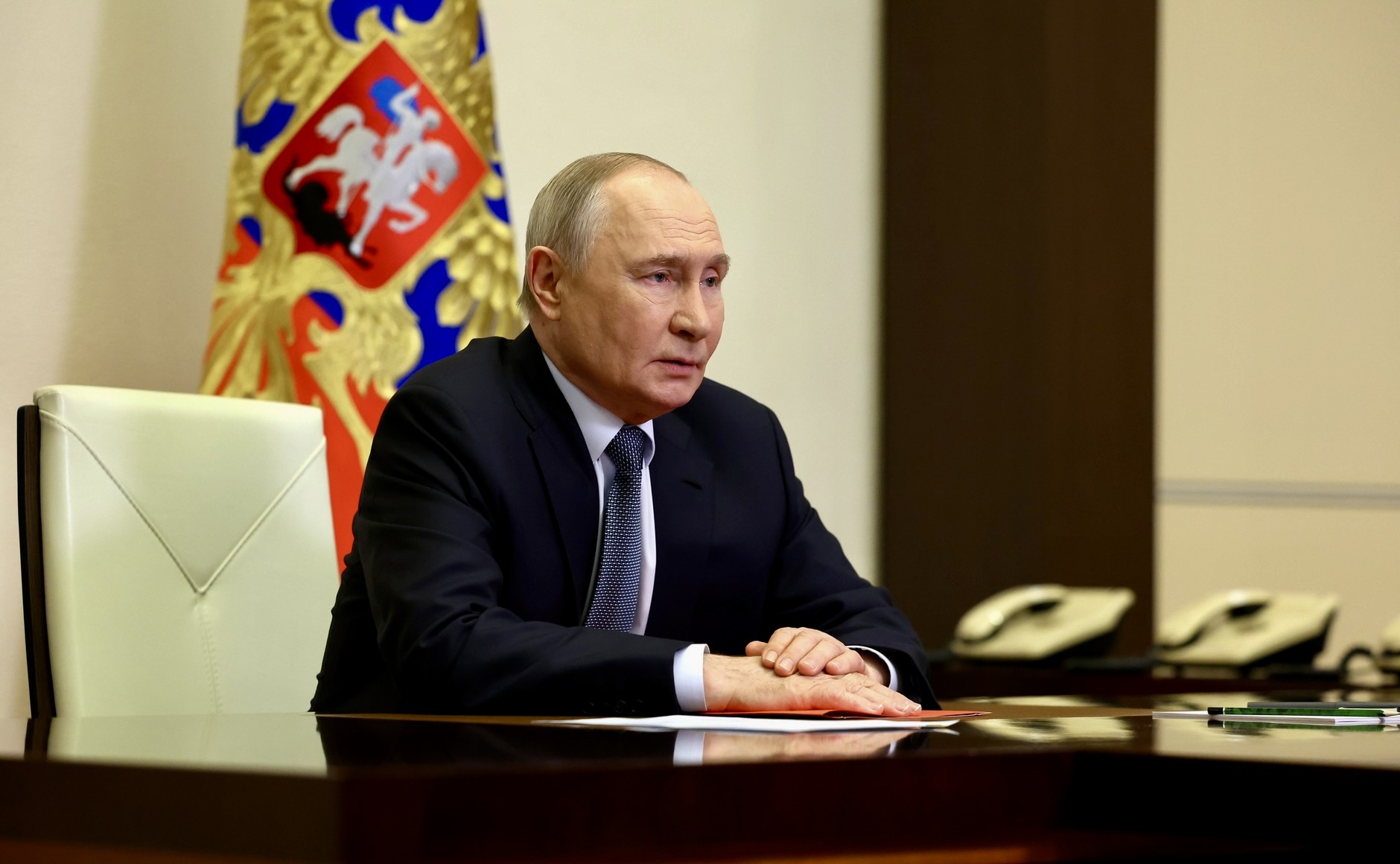
MOSCOW (Realist English). Russian President Vladimir Putin held an operational meeting with permanent members of the Security Council via videoconference on April 17. The main topic was interaction with the CIS countries.
The meeting was attended by State Duma Chairman Vyacheslav Volodin, Head of the Presidential Administration Anton Vaino, Security Council Secretary Sergei Shoigu, Presidential Aide Nikolai Patrushev, Interior Minister Vladimir Kolokoltsev, Foreign Minister Sergei Lavrov, Director of the Federal Security Service Alexander Bortnikov, and Director of the Foreign Intelligence Service Sergei Naryshkin.
Opening the meeting, Putin noted Russia’s special attitude toward the CIS countries “if only for historical reasons, and also because of the very large volume of work, including in the sphere of economic interaction.” The president stressed that over the decades, special ties have developed in the humanitarian sphere, including numerous mixed marriages and mutual cultural interests.
Putin instructed Foreign Minister Lavrov to begin the discussion, after which he suggested that colleagues add their own considerations on relevant areas.
Central Asia: trade turnover approaches $50 billion
In parallel, on April 17, Moscow hosted the ninth meeting of heads of foreign affairs agencies in the “Central Asia – Russia” format. The meeting was attended by the foreign ministers of Kazakhstan, Kyrgyzstan, Tajikistan, Uzbekistan, and the Deputy Foreign Minister of Turkmenistan.
Speaking to his colleagues, Lavrov stated that the six‑party dialogue mechanism is developing “successfully, dynamically, and with benefit for all participants.” He recalled that in October 2025, the second “Central Asia – Russia” summit took place in Dushanbe, where the leaders approved a Joint Action Plan for 2025–2027.
According to the minister, the preparation of specific projects is underway within six‑party working groups established by the relevant ministries and agencies. Despite geopolitical turbulence, Russia’s trade turnover with Central Asian countries remains stably high: in 2025, it showed another increase and approached the $50 billion mark.
Lavrov particularly noted the creation of the International Organisation for the Russian Language on the initiative of President of Kazakhstan Kassym-Jomart Tokayev. “The Russian language remains a language of communication not only between Russia and the Central Asian states, but also between the peoples of the entire post‑Soviet space,” the foreign minister emphasised.
According to the results of 2025, Russia’s total trade turnover with the five countries of Central Asia (Kazakhstan, Kyrgyzstan, Tajikistan, Turkmenistan, Uzbekistan) approached $50 billion. This figure confirms steady growth: compared to $45 billion in 2024 and $44 billion in 2023. The region has become one of Russia’s main foreign trade partners, showing growth despite sanctions pressure and problems in other trade flows.
Trade turnover breaks records
A key trend has been the transformation of Central Asia into a transit hub for Russian exports. In the first quarter of 2026, the total volume of freight road transport from Russia fell by 16%, but shipments to Uzbekistan soared by 82%, and to Tajikistan by 34%. This indicates a reorientation of flows through the southern corridor. In parallel, the North–South International Transport Corridor (ITC) is actively developing: in 2025, regular container services across the Caspian Sea were launched. This route could become key for diversifying logistics to circumvent Western sanctions.
Exports of Russian petroleum products to the region grew by 15.5% in 2025, reaching 7.275 million tonnes. Russia maintains dominance in the fuel markets of Uzbekistan, Kyrgyzstan, and Tajikistan. To institutionalise cooperation, a decision was made to create a six‑party working group on energy at the level of deputy ministers. This should ensure systematic implementation of plans in the fuel and energy sector.
In some countries (for example, Kazakhstan), a “structural deterioration” of trade with Russia is recorded, and Russia is facing increased competition in key markets, including from China, which is displacing Russia from the region’s energy market. A separate problem remains adaptation to Western sanctions, which requires all countries in the region to find new logistics solutions and currency mechanisms.
Thus, Central Asia’s economy is becoming for Russia not just a sales market, but a crucial link in building new logistics and ensuring economic stability.
Financial and migration aspects
Money transfers from Russia remain critically important for the economies of Central Asia, especially for Tajikistan and Kyrgyzstan. To ensure these flows, alternative payment channels are being actively developed, the use of national currencies in mutual settlements is growing, and Russian banks are increasing cross‑border transfers manifold. For example, retail transfers by VTB clients abroad grew 5.8 times in 2025, reaching 13 million transactions.
At the same time, Russia’s migration policy is tightening. Since January 2025, the period of temporary stay for citizens of visa‑free countries has been reduced from 180 to 90 days per year. This has led to a decrease in the number of foreign citizens in Russia — to 5.7 million by the beginning of 2026. In parallel, the government is working on mechanisms to attract labour from India and Africa to fill the workforce deficit, which could reduce dependence on migrants from Central Asia.
Security and escalation in the Middle East
Participants in the “Central Asia – Russia” meeting held an in‑depth exchange of views on the international agenda against the backdrop of unprecedented escalation in the Middle East and around Iran. Lavrov noted that the approaches of Russia and Central Asian countries to international problems are close and in most cases coincide.
The minister highly appreciated the position of Central Asian states, which, despite unprecedented pressure, remain committed to their allied obligations, contributing to the dynamic development of friendly ties both bilaterally and within multilateral formats, including the CIS, EAEU, CSTO, and SCO.
The meeting, according to the Russian Foreign Ministry, became an important stage in collective action to implement the decisions of the heads of the six states of October 9, 2025, and gave impetus to the coordination of government structures.