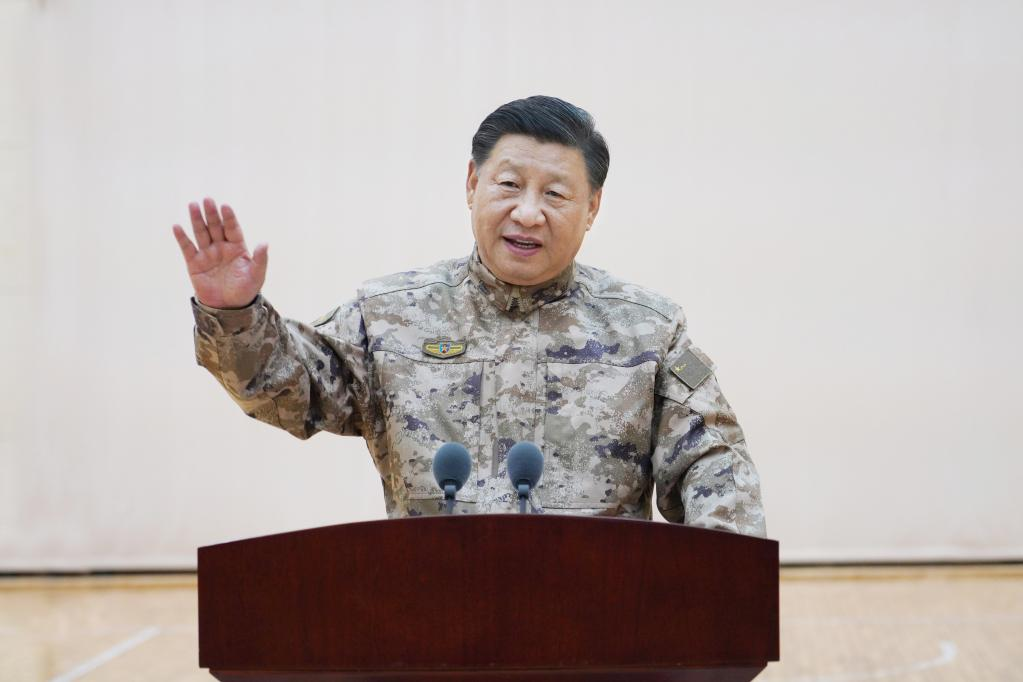
BEIJING (Realist English). President Xi Jinping’s tightening grip over China’s armed forces was on full display this autumn as an unprecedented number of senior military officials failed to appear at major Communist Party events — a sign of the deepening anti-corruption purge reshaping the People’s Liberation Army (PLA).
At the fourth plenum of the Party’s 20th Central Committee held on Oct. 20–23, more than 60% of the 42 PLA and retired officers who were expected to attend were absent. Among them were two prominent commanders:
– Admiral Hu Zhongming, head of the PLA Navy
– General Wu Yanan, commander of the Southern Theater Command, which oversees operations in the South China Sea and is expected to control China’s new aircraft carrier, Fujian
Both officers were also missing from a Nov. 5 ceremony in Hainan marking the commissioning of the Fujian, where they would normally play central roles.
At the plenum, Xi warned: “If we do not fight corruption with an iron fist, our future troubles will be endless.”
The “Fujian clique” collapses
The wave of disappearances follows the Oct. 17 expulsion of nine senior figures, including former CMC vice-chair He Weidong, former CMC member Miao Hua, and former Eastern Theater Command chief Lin Xiangyang.
All three had risen from the former 31st Group Army in Fujian province, a network sometimes referred to as the “Fujian clique” — officers whose careers advanced while Xi worked in the region.
These expulsions were intended to showcase the PLA’s ability to “purge itself” ahead of the plenum. But insiders say the investigation is widening.
According to a diplomatic source in Beijing, “in probing corruption in the Fujian clique, new names have been surfacing one after another.”
Networks tied to He and Miao under scrutiny
Nearly 60% of the absentees have ties to commands or departments once dominated by He and Miao, including:
– The Eastern Theater Command (successor to the Nanjing Military Region)
– The Lanzhou Military Region
– The Navy
– The CMC’s Political Work Department, which Miao once oversaw and where personnel appointments were particularly vulnerable to bribery
The scale of the purge is striking given Xi’s earlier trust in this group. Xi promoted Miao to the CMC in 2017 and elevated He Weidong to CMC vice-chair and Politburo member — the most senior military appointment Xi has made in recent years.
But analysts note the group’s growing influence — particularly over Taiwan-related operations — may have been seen as a potential threat to Xi’s absolute control.
Rocket Force troubles resurface
The absences also included officers with experience in the Rocket Force, which manages China’s nuclear and missile arsenal and has been plagued by repeated corruption scandals.
Xi visited a Rocket Force base in Anhui in October 2024, stressing discipline after a previous purge of top commanders. Yet successors also fell under investigation, marking the fourth major leadership purge in the Rocket Force since its establishment a decade ago.
A Japanese security official said: “For Xi, corruption in the military amounts to betrayal. The crackdown will continue.”
CMC shrinks as Xi centralizes power
The Central Military Commission, reconstituted as a seven-member body at the start of Xi’s third term in 2022, has now effectively shrunk to four members following the downfall of He Weidong, Miao Hua and former Defense Minister Li Shangfu.
Xi did not replace any of the vacant seats at the plenum — a move observers interpret as deliberate.
“A smaller CMC is easier for Xi to control,” said Lim Jae-hwan of Aoyama Gakuin University. “Real power is likely to continue concentrating directly in Xi’s hands.”