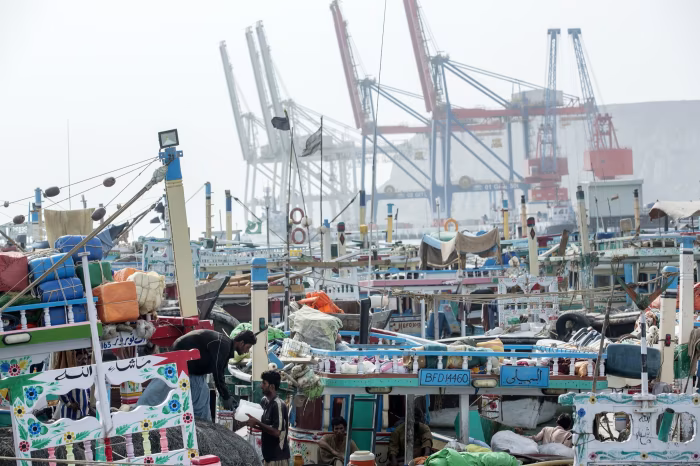
ISLAMABAD (Realist English). Advisers to Pakistan’s army chief Field Marshal Asim Munir have privately proposed that U.S. investors help develop and operate a deep-water port in the coastal town of Pasni, offering Washington a potential foothold in one of the world’s most strategic maritime zones.
The plan — reviewed by the Financial Times — envisions the fishing town becoming a terminal for exporting Pakistan’s critical minerals, including copper and antimony. Pasni lies just 70 miles from Gwadar, a China-backed port central to Beijing’s Belt and Road Initiative, and 100 miles from the Iranian border.
While not yet an official policy, the idea reflects Islamabad’s efforts to capitalize on shifting regional dynamics and rebuild its relationship with the U.S. The proposal was reportedly shared with Munir before his meeting with President Donald Trump at the White House last month. However, a senior U.S. official said the administration had not formally discussed it.
According to a draft blueprint, the Pasni project could cost up to $1.2bn, funded through a mix of Pakistani federal contributions and U.S.-supported development finance. It would also include a new railway network connecting the port to Pakistan’s mineral-rich western provinces. “Pasni’s proximity to Iran and Central Asia enhances U.S. options for trade and security,” the document said, suggesting the site could serve as a counterbalance to China’s Gwadar port.
Advisers close to Munir emphasized that the proposed terminal would not involve “direct basing,” ruling out use as a U.S. military facility. They described the initiative as part of a broader strategy to “diversify from China” while maintaining long-standing ties with Beijing.
The outreach to Washington follows a warming of relations between Munir and Trump, which diplomats have jokingly dubbed a “bromance.” Their rapport has grown since Trump claimed credit earlier this year for mediating a ceasefire that ended the worst fighting between Pakistan and India in decades — a move that Islamabad publicly praised and even nominated him for a Nobel Peace Prize.
U.S. companies have already shown interest in Pakistan’s mineral sector. Missouri-based U.S. Strategic Metals (USSM) signed a memorandum of understanding in September with Pakistan’s military engineering arm to explore cooperation on refining and processing facilities. USSM’s commercial director Mike Hollomon confirmed the company’s awareness of the Pasni proposal, calling it a “logical step” given the town’s deep-water potential and proximity to the Reko Diq copper and gold mine.
Last month, Pakistan shipped its first small consignment — less than two tonnes — of critical minerals including copper, antimony and neodymium to USSM, marking what officials called the start of “a new phase” in U.S.-Pakistan economic engagement.
Although Pakistan’s mineral industry currently contributes only about 3% of GDP and remains hampered by security challenges, experts see the proposed U.S.-backed port as part of a strategic realignment. “This is a reset with America through economic ties rather than just the traditional security ties,” said Hussain Abidi, head of the Pakistan Council of Scientific and Industrial Research.