YEREVAN (Realist English). The past week in Armenia has been marked by a sharp increase in both the foreign policy activity of the cabinet of Nikol Pashinyan and a new round of internal repression against the opposition. The prime minister continues to stubbornly lead the country down the path of European integration, causing growing discontent in Moscow, while simultaneously trying to purge the political field of competitors ahead of the June 7 parliamentary elections.
Domestic policy: ‘purge’ of the field and suppression of the opposition
Instead of focusing on solving pressing socio-economic problems, Pashinyan has devoted the last few days to tightening control over the domestic political situation. The Armenian parliament, in an expedited manner (submitted and passed in one day), approved in the first reading amendments to the Electoral Code prohibiting parties from using people’s names and toponyms (“Armenia”, “Yerevan”) in their names. Experts and the opposition are unanimous: this is a “law targeting Samvel Karapetyan“, whose “Strong Armenia” party falls directly under the ban.
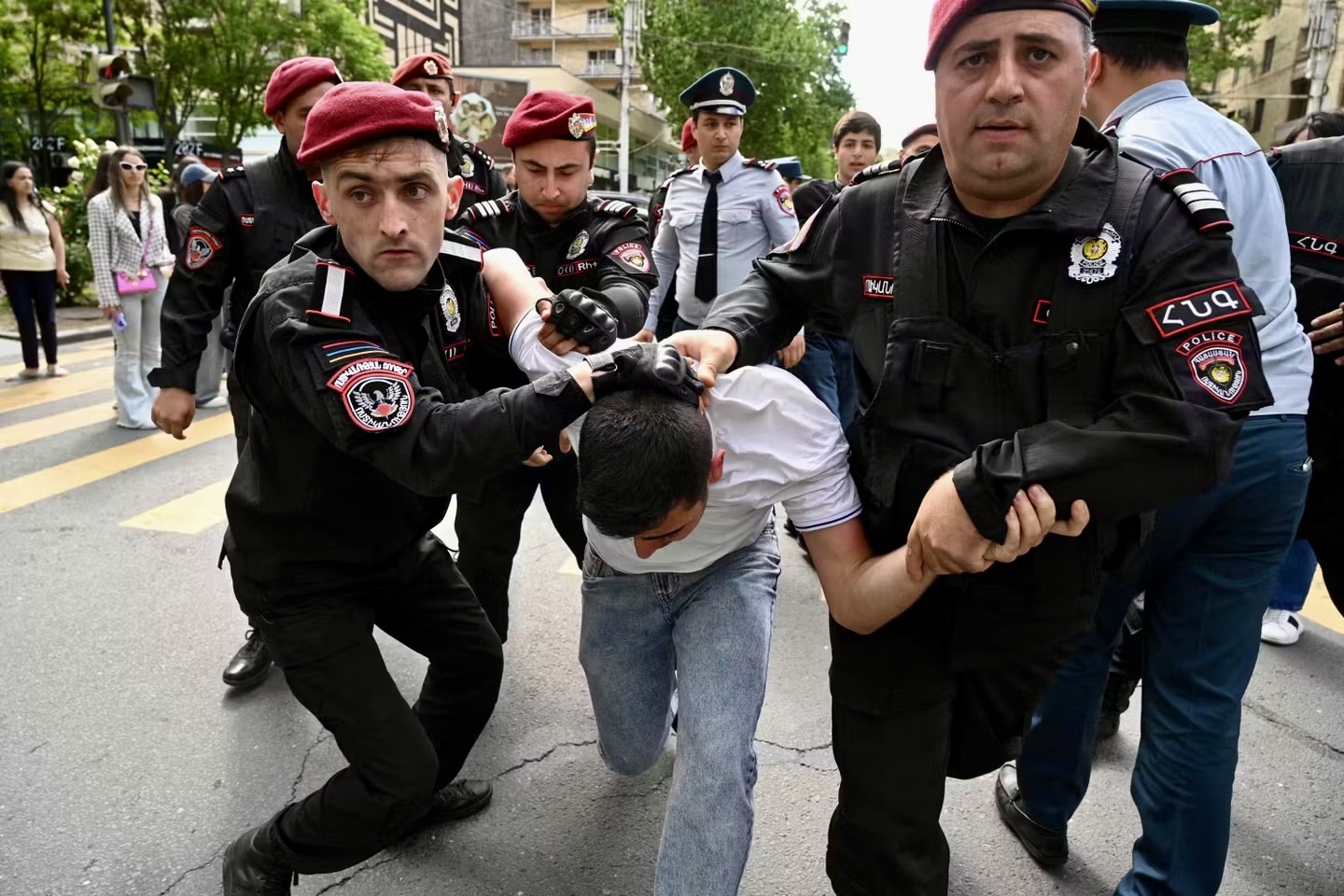
Fearing the growing popularity of a competitor, Pashinyan is openly narrowing political competition two months before the elections. On April 7, a multi‑thousand protest rally of Karapetyan’s supporters took place near the parliament building, demanding an end to political repression and not turning the Electoral Code into a tool for dealing with the disfavoured.
The Russian Foreign Ministry expressed official concern, calling for the amendments not to be used to deliberately restrict the opposition. Pashinyan ignored the warning, continuing his course of “cleansing” the political field.
In addition to administrative methods, the prime minister resorted to direct insults. On April 17, Pashinyan stated that the “Strong Armenia” party and the “Armenia” bloc should not cross the electoral threshold, because opposition deputies only come to receive a salary. Facebook users harshly criticised the prime minister, reminding him that he himself came to power at the head of the opposition. “He himself used to be in the opposition and always spoke, and they let him into parliament,” one user wrote.
At the end of the week, Pashinyan also announced the adoption of a new constitution, effectively fulfilling another demand from Baku. At the same time, he said he did not consider it appropriate to publish the document until all disagreements were fully resolved, possibly after the elections. This raises fears that the authorities intend to use the new basic law to further strengthen their positions and usurp power.
Foreign policy: anti‑Russian course and diplomatic failure
Pashinyan continues to systematically dismantle allied relations with Moscow. The new election programme of the ruling “Civil Contract” party no longer contains the concept of a “strategic alliance” with Russia. Instead, it offers “constructive transformation” and a “freezing” of participation in the CSTO. The prime minister has openly embarked on a course towards European integration, without having either a popular mandate or economic grounds.
On April 20, Pashinyan officially confirmed that his country firmly stands on the path to the EU, stating Yerevan’s readiness to carry out deep reforms to meet European criteria. This comes as the first Armenia‑EU summit is being prepared, to be held on May 4‑5 in Yerevan with the participation of Ursula von der Leyen and António Costa. For Moscow, this is a geopolitical failure: a pro‑European political space is being formed right on Russia’s doorstep.
However, as experts note, Armenia is repeating Ukraine’s mistakes in trying to sit on two chairs. If Yerevan moves further towards the EU, the door to the EAEU will close for the republic, meaning a loss of huge revenues. Armenia will have to buy energy resources at world prices, not six times cheaper as at present. Political scientist Pavel Danilin warns that the current course threatens the country with serious economic problems.
At the same time, Pashinyan is forced to make excuses to Moscow. On April 15, he accused a “citizen of 60 countries” (apparently his opponent Samvel Karapetyan) of trying to drive a wedge between Yerevan and Moscow and bring the EAEU to collapse. At the same time, he claimed that relations between Armenia and Russia are at the highest level ever, which is frankly baffling given the freezing of CSTO membership and anti‑Russian rhetoric.
Economic risks and Moscow’s response
The reality is that the Armenian economy is geared towards interaction with Russia and the EAEU, and Moscow is the key guarantor of Armenia’s security. Putin’s ultimatums that “you cannot be in the EU and the EAEU at the same time” no longer frighten Yerevan, but only push it towards a faster exit from Russian integration projects. However, the consequences of this step could be catastrophic.
In response to the pro‑Western course, Moscow is already beginning to apply economic pressure. Speaker of the Armenian Parliament Alen Simonyan stated that the country would leave the CSTO and the Eurasian Economic Union if Russia raises the price of gas. This only underlines the precariousness of the current situation: Armenia is teetering on the edge, provoking its strategic ally without having a real alternative.
Expert opinions: ‘Pashinyan is going down the wrong path’
Former Armenian Foreign Minister Vardan Oskanyan criticised Pashinyan after his meeting with Putin, saying that the Russian president’s opening remarks were a verdict on the Armenian prime minister. “The message was clear: you seem not to understand what you are doing, you are going down the wrong path, and if you continue like this, you will cause much greater damage to the Armenian people than you already have,” Oskanyan wrote.
Political scientist Pavel Danilin also believes that the confrontation with Moscow is a serious disadvantage for Pashinyan in the upcoming elections, and it cannot be ruled out that the deterioration of relations with Russia will be held against him. In Armenia, parallels are being drawn with the situation in Ukraine in 2013, pointing to the consequences of trying to sit on two chairs.
What next?
Armenia finds itself at a geopolitical crossroads. Pashinyan’s anti‑Russian rhetoric and rapprochement with the West are not supported by either economic opportunities or the support of a significant part of the population. The June 7 parliamentary elections will show how ready society is to pay for the prime minister’s ambitions, but it is already clear that the country is entering a period of deep turbulence, the consequences of which could be irreversible.