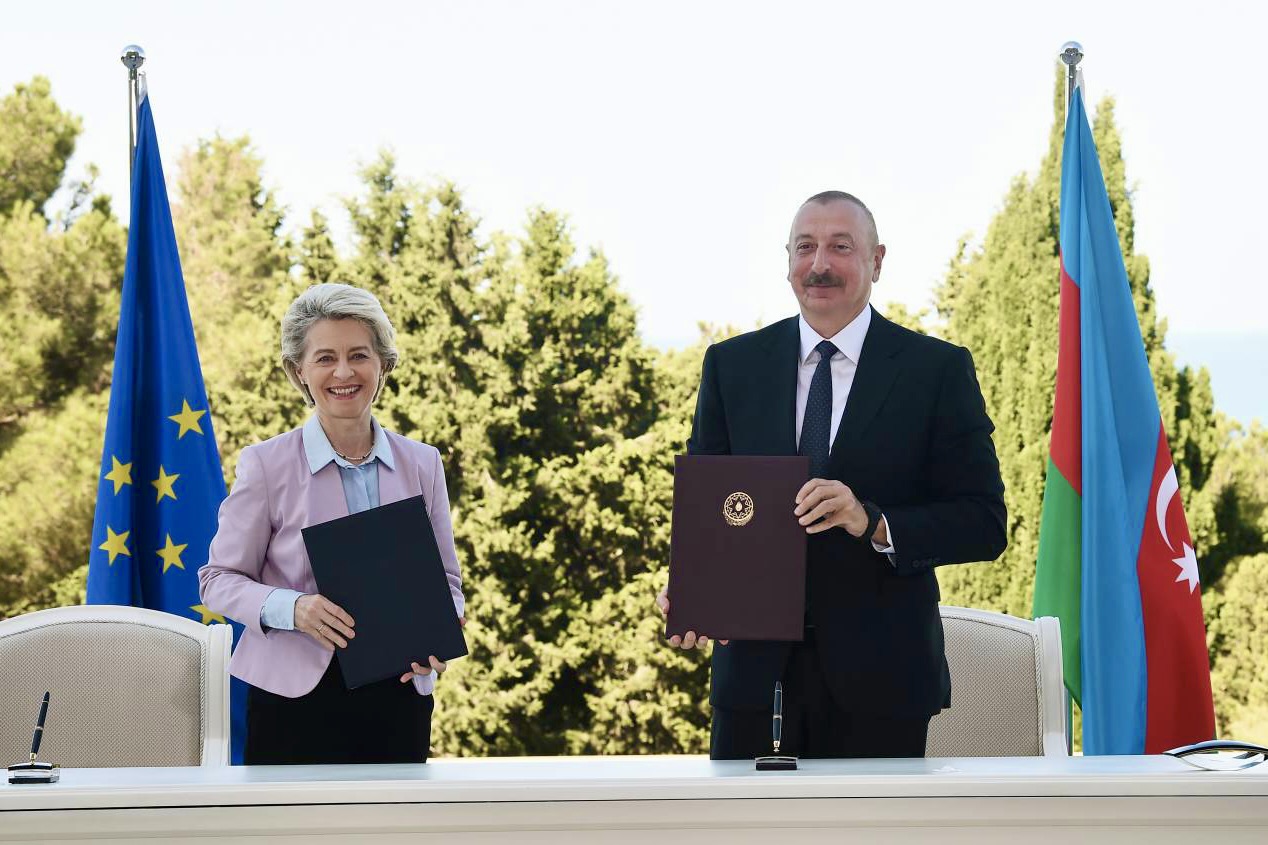
BAKU (Realist English). In early June, Azerbaijan made two moves toward the European Union: it resumed negotiations on a strategic partnership and completed the transfer of operational control of the Baku‑Supsa oil pipeline from British BP to the governments of Azerbaijan and Georgia.
Meanwhile, Moscow, which harshly criticizes Armenia for similar aspirations, maintains complete silence toward Baku.
Azerbaijan and the EU: A New Stage of Strategic Dialogue
On June 2–3, 2026, a round of negotiations took place in Baku between the Azerbaijani delegation and EU representatives on a new comprehensive agreement designed to replace the current legal framework. The parties preliminarily approved the document “EU‑Azerbaijan Partnership Priorities for 2026–2030” and officially resumed talks on strategic cooperation, which had been suspended for several years.
The EU delegation in Baku called the meeting productive. The main focus is on strengthening political dialogue, developing economic ties, and expanding cooperation in energy, transport, the digital economy, and ecology. The European Union views Azerbaijan as a key partner within the Eastern Partnership initiative and in the context of reducing dependence on Russian energy resources.
Dialogue between Baku and Brussels is not new: the country has participated in EU programs since 2009, and in 2022 a memorandum on strategic partnership in energy was signed.
Transfer of the Baku‑Supsa Pipeline Under National Control
In parallel with the political consultations, developments are unfolding in the energy sector. On June 8, 2026, British BP, which had been the operator of the Baku‑Supsa pipeline since 1999, will officially transfer management of the asset to its owners — the governments of Azerbaijan and Georgia.
The Baku‑Supsa pipeline (Western Export Pipeline) was commissioned in 1999 and became the first major Caspian oil pipeline connecting Azerbaijan to the Georgian port of Supsa on the Black Sea, bypassing Russia. Its capacity is about 100,000 barrels per day (approximately 5 million tons per year), mainly exporting Azerbaijani light crude.
The transfer of operational functions is a planned step provided for by the shareholder agreement upon the expiration of BP’s contract. SOCAR, the Azerbaijani state oil company, and Georgian partners will jointly manage the pipeline through a specially created structure. BP remains the operator of other major projects in the region, notably the Baku‑Tbilisi‑Ceyhan pipeline.
Ultimatums for Yerevan and Silence Toward Baku
While Baku negotiates with Brussels, Moscow has unleashed a wave of criticism against Armenia, which is also seeking rapprochement with the European Union.
June 2–4, 2026 became a period of unprecedented Russian pressure on Yerevan. State Duma Chairman Vyacheslav Volodin accused Prime Minister Nikol Pashinyan of using the EAEU “to move into the European Union” and threatened: if Armenia leaves the union, gas for Armenian citizens would quadruple in price, remittances from Russia (almost $4 billion per year) would be sharply reduced, and supplies of Armenian agricultural products, fish, alcohol and mineral water to the Russian Federation would cease.
Deputy Prime Minister Alexei Overchuk stated that Russia would not provide support measures to Armenia if it continues to move closer to the EU: “We cannot provide financial support to a country that sees its future in the European Union, which is preparing for war with Russia.” Foreign Ministry spokeswoman Maria Zakharova added that if Armenia abandons allied relations, Moscow will be forced to revise all provided benefits.
The reaction toward Azerbaijan is the complete opposite
Russian officials have not said a single word of criticism toward Baku. Moreover, just a month ago, Moscow supported Azerbaijan’s decision to halt interaction with the European Parliament. Zakharova then said that “this decision does not cause surprise,” calling the European Parliament a structure that “interferes in the internal affairs of sovereign states.”
⚖️ Why such double standards?
Analysts highlight several key reasons why Moscow turns a blind eye to Azerbaijan’s European integration while threatening Armenia:
- The energy factor. Azerbaijan is a major gas supplier to Europe (12–13 billion cubic meters per year). Russia has no interest in a conflict with Baku that could lead to a revision of transit routes and increased competition. Moreover, Azerbaijan is an important transit route for Russian goods heading south.
- Geopolitical loyalty. Despite talks with the EU, Azerbaijan maintains a multi‑vector foreign policy. In May 2026, Moscow supported Baku’s break with the European Parliament. Armenia, in the Kremlin’s view, is “drifting” toward NATO and the West, which is perceived as a direct threat.
- Membership in the EAEU and CSTO. Armenia is a member of the Eurasian Economic Union and the Collective Security Treaty Organization. Moscow believes that Yerevan is trying to “keep EAEU membership while moving into the EU,” which violates the union’s rules. Azerbaijan has never been part of these structures, and no such expectations exist for it.
- Economic consequences. Russia’s losses from a potential Armenian exit from the EAEU are much smaller than the potential costs of a conflict with Azerbaijan, through which important logistics routes pass.
Azerbaijan, not bound by obligations to the EAEU or CSTO, can afford any foreign policy combination — including deepening ties with the European Union and strengthening control over its export energy infrastructure. Moscow does not hinder this and even demonstratively supports some of Baku’s steps.
Armenia, on the other hand, for similar aspirations, is subjected to harsh pressure, economic threats and public humiliation by senior Russian officials. The Kremlin demands that Yerevan make a choice — and warns in advance that Armenian citizens themselves will have to pay for European integration.