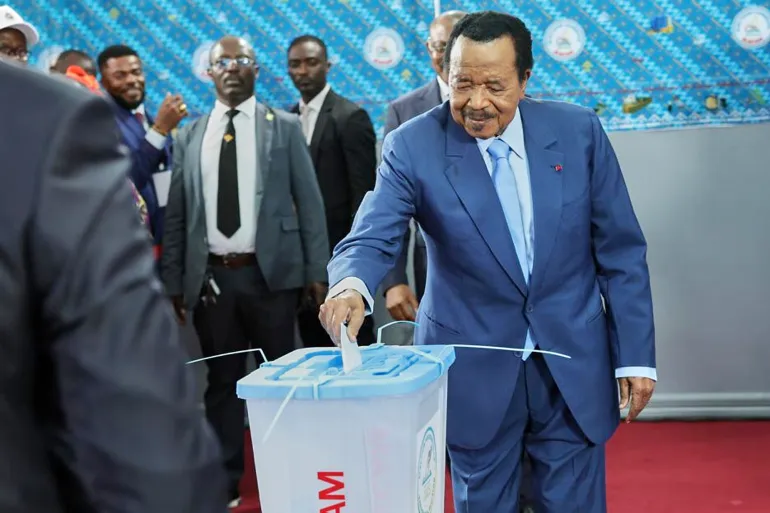
YAOUNDE (Realist English). Cameroon’s President Paul Biya, the world’s oldest sitting head of state, has been sworn in for a new seven-year term, extending his rule beyond four decades after a disputed election marred by violence and fraud allegations.
During Thursday’s ceremony before Parliament, Biya pledged to remain loyal to the Cameroonian people and to “work for a united, stable, and prosperous nation.” The capital, Yaounde, was heavily militarized ahead of the inauguration, with streets largely deserted following recent unrest.
Protests and contested results
Deadly demonstrations erupted in several cities after the October 19 election, in which former minister Issa Tchiroma Bakary claimed victory and accused the government of large-scale vote tampering. Authorities confirmed at least five deaths during the protests, while civil society groups reported significantly higher tolls.
The Constitutional Council declared Biya the winner on October 27, securing 53.66% of the vote against 35.19% for Tchiroma. Opposition groups rejected the results, calling them fraudulent.
“The will of the Cameroonian people was trampled that day. Our sovereignty was stolen in broad daylight,” Tchiroma said in a statement. “This is not democracy — it is electoral theft, a constitutional coup as blatant as it is shameful.”
A nation divided
Observers describe the political climate as deeply polarized. Munjah Vitalis Fagha, a political science lecturer at the University of Buea, told the Associated Press that Biya’s inauguration unfolded in “a tense yet controlled atmosphere, marked by divisions between the ruling elite and a disillusioned populace.”
The veteran leader’s latest term begins as Cameroon faces armed insurgencies in its Anglophone regions, an economic slowdown, and mounting frustration among the country’s youth. More than 70% of Cameroonians are under 35, meaning most have known no other leader but Biya.
Nearly half a century in power
Biya, 91, first assumed office in 1982, following the resignation of Cameroon’s founding president. A 2008 constitutional amendment abolished term limits, enabling him to seek re-election indefinitely. His health has long been the subject of speculation, as he frequently spends extended periods in Europe, delegating day-to-day governance to close aides and family members.
For many, his new term represents continuity rather than change.
“I’m tired of Biya’s rule and I no longer care what he does,” said Priscilla Ayimboh, a 40-year-old seamstress in Yaounde. “There are no roads, no water, no jobs. I wonder what will become of Cameroon in the next seven years.”
If Biya completes his current mandate, he will be nearly 100 years old when it ends — a symbol, critics say, of both his personal longevity and the enduring stagnation of Cameroonian politics.