
HASAKAH (Realist English). The overthrow of Bashar al‑Assad and the rise to power in Damascus of radical Islamist groups has not led to any improvement in the situation of Syria’s national and confessional minorities.
Kurds, Alawites, Druze, Armenians and Assyrians continue to face a policy of unification pursued by the new authorities with active Turkish support.
At the same time, the process of integrating the Kurdish autonomous region of Rojava into state structures is encountering numerous contradictions – from the status of armed formations to language rights.
This is the analysis of Stanislav Ivanov, a leading researcher at IMEMO RAS, Candidate of Historical Sciences.
New authorities – old policy: a unitary state instead of autonomy
As expected, the overthrow of Bashar al‑Assad’s Baathist nationalist regime and the seizure of power in Damascus by radical Islamist groups with the ideology of the Muslim Brotherhood (organisation banned in Russia) have not brought any substantial change in the central authorities’ policy towards their national and confessional minorities.
The country’s interim president – the leader of the umbrella Islamist group Hayat Tahrir al‑Sham (recognised as terrorist and banned in Russia), Ahmed al‑Sharaa, and his entourage have set about building a new unitary state in which there is no place for autonomous regions or federal subjects.
Arab Alawites, Arab Druze, Kurds, Assyrians and Armenians have become, in effect, second‑class people. Damascus is trying to ignore their interests and build an Arab‑Sunni state of an Islamist bent.
The Turkish footprint: Erdogan and the unitary Islamist state project
These approaches are supported and actively fuelled by the Turkish authorities, who have confidently taken Iran’s place as the main curator of the new Syria. Ankara has considerable experience in assimilating its own minorities (Armenians who survived the genocide converted to Islam and became crypto‑Armenians, Kurds were considered “mountain Turks”, and so on). It appears that Erdogan is implementing in Syria a project that had previously failed – the construction of a unitary Islamist state along the lines of the Muslim Brotherhood in Egypt under Mohammed Morsi.
The Syrian autonomous region of Rojava, with its predominantly Kurdish population, is now under threat of being eliminated. As is well known, it was created during the country’s civil war, when the central authorities withdrew their troops and administration from the northern regions to concentrate on defending Damascus and the western, southern and central areas. To protect their lands from the advancing formations of the Islamic State (banned in Russia), the residents of the northern provinces had to create self‑government bodies and militia units.
In fierce fighting, the Kurds and their allies first managed to halt the jihadist advance and then to liberate from them the entire eastern bank of the Euphrates and the capital of the Islamic Caliphate – the city of Raqqa. Bashar al‑Assad did not recognise Rojava’s autonomous status, but he also did not take active steps to incorporate it into the territories under his control. The only threat to the Kurdish provinces came from Turkish troops and their proxy Islamist forces, which regularly invaded the north of the country and occupied some of its territories (the Afrin district).
The 10 March 2026 agreement: integration on paper and difficulties on the ground
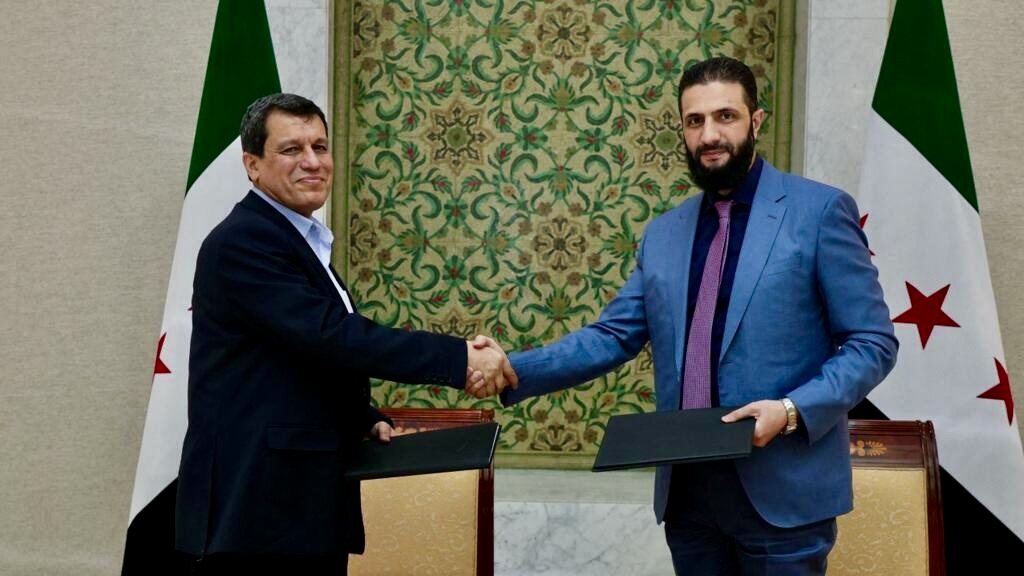
At the beginning of 2026, the new authorities in Damascus, under pressure from Ankara and with Washington’s mediation, held talks with Kurdish leaders and on 10 March 2026 reached a framework agreement on integrating the military and civilian structures of the Kurdish region (Rojava) into Syria’s state institutions. The process has begun, but it is not easy, it is dragging on, and many contentious issues are arising.
The Turkish leadership makes no secret of its interest in disarming the Kurdish militias and eliminating local self‑government bodies – as if the very existence of a Kurdish autonomy in a neighbouring country threatens Turkey’s national interests. Washington, on the other hand, is trying not to rush the process of integrating Rojava into the new Syria and proposes to resolve all issues step by step, taking Kurdish interests into account.
According to the US administration, Damascus should preserve a certain level of local self‑government and self‑sufficiency in the Kurdish region in exchange for the Kurds abandoning decentralisation of the state. The United States continues to provide assistance to Rojava and adheres to a model of maintaining a balance of forces and interests among the negotiating parties.
Administrative structure: joint governance and occupied Afrin
Rojava’s administrative‑territorial structure remains unchanged for now: Kurdish and Kurdish‑Arab areas are under local administration, and part of the administrative apparatus has been officially recognised by the interim government, as confirmed by state appointments. Joint commissions have been set up and are operating in several populated areas; representatives of Damascus have been placed in strategically important economic institutions and facilities, serving as members of the joint committees of the Integration Agreement. Thus, these entities are governed jointly by the Kurdish administration and appointed cadres from the interim government.
Turkey is currently unwilling to leave the Kurdish district of Afrin. Nevertheless, in coordination with Syria’s interim government, the Rojava authorities are facilitating the return of native Afrin residents who wish to go home despite the ongoing threat to their security. Several thousand Kurdish families from Afrin have already moved to the suburbs and rural areas of Afrin; the city itself remains occupied by Turkish troops and is de facto not controlled by the interim government.
Homes and agricultural lands previously seized by Islamist militants are being sold by the displaced persons back to their lawful owners, although under the agreement with Damascus they were supposed to be returned free of charge.
Prisoner release and integration of armed forces
One of the first steps taken by Damascus was the release of captured fighters of the Syrian Democratic Forces (SDF) and hostages taken during the fighting in Aleppo. As a result of the negotiations, 1,032 people have been freed, leaving about 300 Kurds still in captivity. The next step could be the integration of Kurdish militia units into the army being formed by the Islamists. It is proposed to create three or four motorised infantry brigades based on the SDF, stationed in the cities of Rojava – Derik, Kobani, Qamishli, Hasakah – and to appoint a number of Kurdish field commanders to leadership positions in the new army.
However, today Syria’s armed forces consist of a motley collection of Islamist militant groups and have no clear organisational structure. Some of these groups, mainly Turkish proxy forces, are hostile towards the Kurds.
Another stumbling block in the negotiations is the integration of SDF women’s formations into Syria’s armed forces. Today, over 5,000 women with combat experience and special anti‑terror training are serving in Rojava. Some of them are used to guard camps and prisons holding Islamic State prisoners and their families. The Syrian Islamists are categorically opposed to women serving in the ranks of the new army.
Ideological and linguistic contradictions
Ideological differences between Damascus and Rojava also persist. The Kurds and other minorities are democratic and tolerant towards all Syrians; the model of self‑government they have built is more secular in nature, which cannot be said of the Muslim Brotherhood that dominates Damascus.
The right to restore citizenship for hundreds of thousands of Kurds, promised back when Bashar al‑Assad was in power, has still not been implemented. Damascus sent Rojava forms with the “nationality” field pre‑filled to state that the applicant was an “Arab”. As a result of mass outrage among the local population, the forms were changed.
At present, the “Arab” nationality entry has been replaced by “Syrian” (citizen of Syria). The draft of the new constitution and the country’s name remain subjects of discussion between the centre and the region. The Kurds, Armenians, Assyrians, Turkomans and Christians are clearly unhappy with the name – the Syrian Arab Republic (SAR).
There are also serious disagreements over the status of the Kurdish language. Damascus insists on a purely optional format for teaching Kurdish in schools and universities – only two hours a week. The Kurds disagree and demand recognition of their right to their native language, as well as the preservation of the entire education system in Kurdish and its use in the media and other spheres. They cite the status of Kurdish in Iraq as an example – a regional language and a second official language.
Today, in Rojava, all signs on institutions, announcements, internal documentation, media, literature and so on appear in both Kurdish and Arabic. Protest actions and demonstrations in support of the Kurdish language are taking place in all the major cities of Rojava. Students, trade unions and civil society organisations are holding their own events calling for the recognition and preservation of Kurds’ cultural and linguistic rights.
These actions are a response to the new Syrian authorities’ attempts to remove signs on institutions in Kurdish and leave only Arabic ones. In the Afrin district, the Islamists have gone even further: alongside Arabic signs, they have placed signs in Turkish on institutions, and Turkish flags can also be seen flying above government buildings.
Two options for Rojava: formal unification or postponement of integration
Citing the difficulties that have arisen, the Rojava leadership has proposed two courses of action to Damascus: either formal unification that preserves Rojava’s and the SDF’s independence and structure (which would protect them from possible Turkish aggression and reduce tensions with the Arab population), or postponement of integration until the end of the year, with greater autonomy for the region to be granted subsequently.
Stanislav Ivanov – Leading Researcher at IMEMO RAS, Candidate of Historical Sciences.