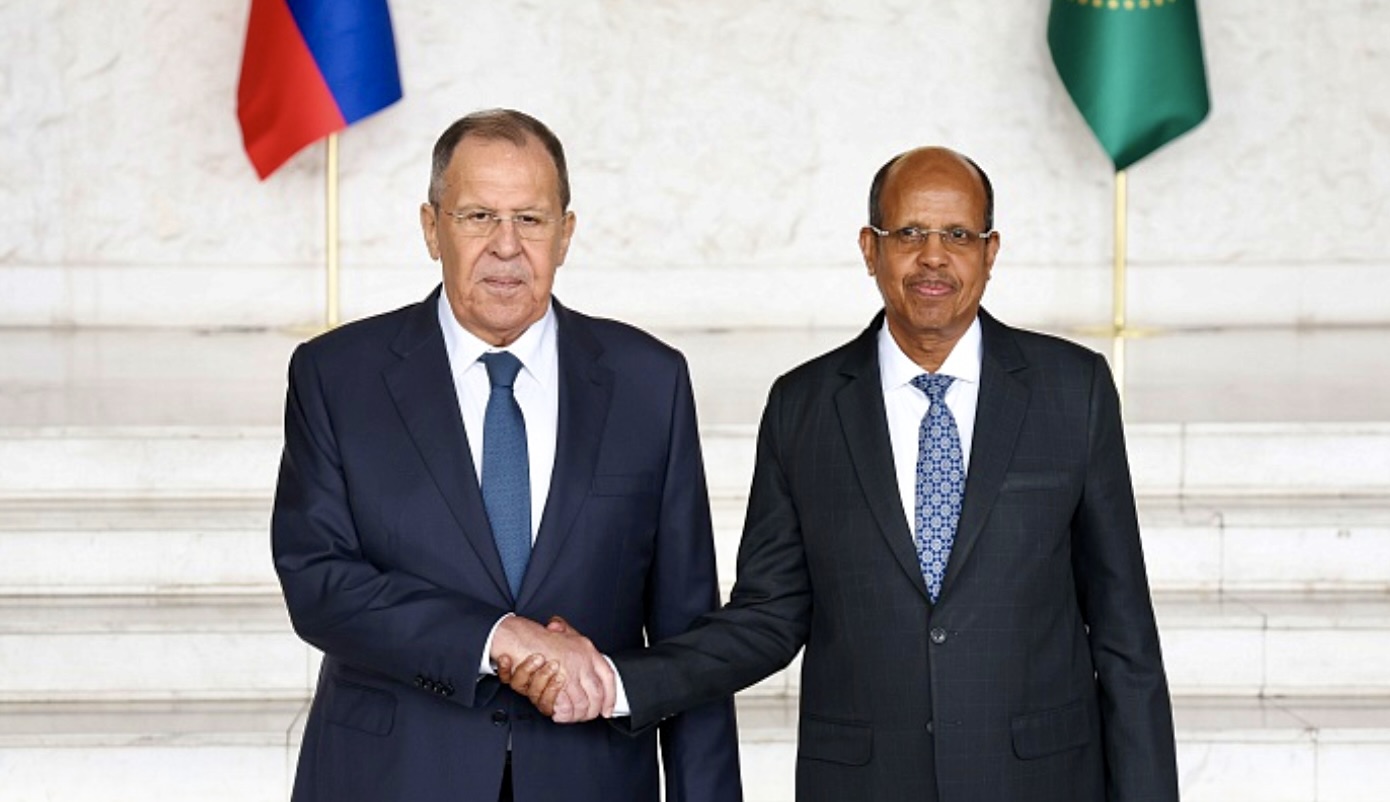
ADDIS ABABA (Realist English). On July 7, Russian Foreign Minister Sergey Lavrov and Chairperson of the African Union Commission Moussa Faki Mahamat held high-level consultations in the Ethiopian capital, which experts are already calling the most important stage in the development of Russian-African relations since the signing of the Memorandum of Understanding in 2019.
The bilateral talks were the culmination of Lavrov’s African tour, which began on July 6.
“A convergence of approaches on the vast majority of regional and international agenda items was recorded,” the Russian Foreign Ministry reported.
Following the fruitful discussion, the sides adopted a Joint Statement, which, according to ministry representatives, “sets both sides on a course for further expanding ties in all directions.”
Focus on Security and Economic Sovereignty
The consultations covered a wide range of areas: security, economics and finance, industry and trade, education, energy, natural resource management, agriculture, healthcare and the peaceful exploration of space.
Lavrov confirmed Moscow’s unwavering commitment to assisting the African Union in its efforts to establish an effective security architecture on the continent and to help African countries achieve “full economic, financial, technological and energy sovereignty.”
Special attention was paid to the principle of “African solutions to African problems.”
As noted during the consultations between Russian Deputy Foreign Minister Georgy Borisenko and AU Commissioner for Political Affairs, Peace and Security Bankole Adeoye back in June, Russia confirmed its readiness to support African initiatives for resolving crisis situations, including in the Sahara-Sahel zone, Sudan, South Sudan, the Democratic Republic of the Congo and the Horn of Africa.
The sides also agreed to strengthen coordination in the international arena, primarily within the UN framework.
Lavrov stated that Russia shares the African Union’s serious concern over the complex situation in various parts of the continent. For his part, AU Commission Chairperson Moussa Faki Mahamat warmly welcomed the Russian minister, noting Russia’s important role on the African continent.
Trade and Investment: $27 Billion and Potential for Doubling
Economic cooperation was one of the key topics of the talks. As Youssouf noted at a joint press conference, the current trade turnover between Russia and African countries stands at approximately $27 billion. At the same time, both sides expressed hope that this figure could double in the coming years.
“Investment between Russia and Africa should be promoted, and ways must be found to make bilateral trade smoother,” the AU Commission Chairperson stated. He also stressed that Russia has advantages in science, technology and military production, and that the African Union is aware of the information war being waged by mainstream media.
Special attention was given to the project for constructing a nuclear power plant in Ethiopia, which envisages not only the construction of the facility but also a large-scale personnel training programme. Earlier, the Russian Foreign Ministry had stated its readiness to help Africa not only with food supplies but also in the areas of increasing land yields and agricultural mechanisation.
Third Moscow Summit: New Impetus for Relations
The central event of 2026 in Russian-African relations will be the third Russia-Africa Summit, to be held in Moscow on October 28–29. Lavrov, at the meeting with the AU Commission Chairperson, stated that Moscow expects Moussa Faki Mahamat to personally participate in this event.
“We count on you being able to personally represent the African Union Commission at the third summit. The summit agenda is focused on current issues of Russia-Africa Union interaction in the material sphere,” Lavrov said.
He also recalled Youssouf’s speech at the last AU summit, where he spoke of the need, following political independence, to achieve economic and energy independence.
“We will always be allies of the African Union in this work and warmly welcome the processes that are now inevitably and naturally beginning to take shape,” the minister stressed.
As noted in the joint statement, the summit is designed to promote the common priorities of its participants. It was preceded by the Second Ministerial Conference of the Russia-Africa Partnership Forum, held in Cairo in December 2025, where the sides declared their readiness to begin preparing the next Action Plan for 2026–2029.
Institutionalising Dialogue: Regular Consultations
An important outcome of the meeting was the agreement to give political consultations a regular character in order to build a long-term architecture for Russia-African Union interaction. The sides agreed to hold regular high-level political consultations at least once a year. The next consultations are scheduled for 2027.
In addition, the establishment of working relations between the African Union and the CSTO was discussed, which, in the sides’ view, would help coordinate approaches to responding to crisis situations and expand the exchange of experience in peacekeeping and military-political spheres.
July 7, 2026, marked a new stage in relations between Russia and the African Union. The talks in Addis Ababa confirmed the strategic nature of the partnership, encompassing security, economics, energy and food independence.
The upcoming summit in Moscow in October is expected to give additional impetus to cooperation, while the agreements reached on regular consultations lay the institutional foundation for long-term collaboration.