BOSTON (Realist English). In an article published in Foreign Affairs, political scientist Jonathan Kirshner, a professor at Boston College and a leading scholar of classical realism, offers a revision of the established interpretation of Thucydides.
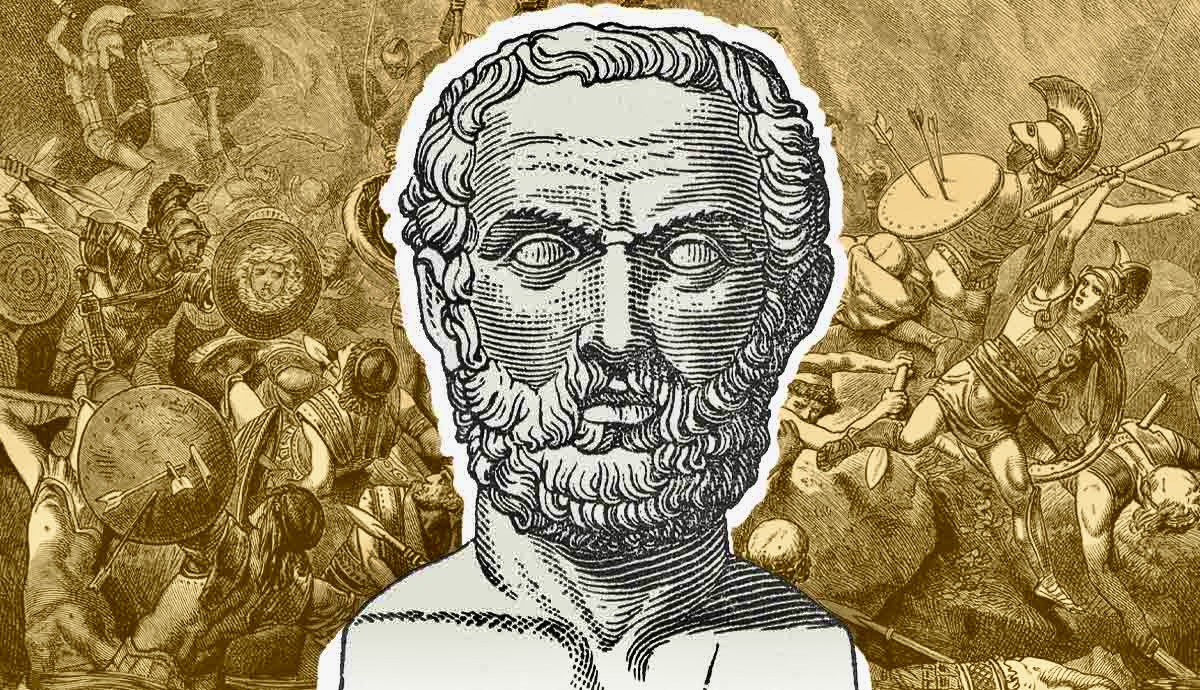
In his view, the phrase “the strong do what they can, and the weak suffer what they must” has for centuries been used to justify imperial ambitions, even though Thucydides himself did not share this view and placed these words in the mouths of the Athenian envoys, whose policies ultimately led Athens to ruin.
How Trump and His Supporters Use Thucydides
Kirshner’s article, published on July 2, 2026, opens with an analysis of contemporary political rhetoric. Since returning to the White House in 2025, President Donald Trump has not only demonstrated American power — from strikes on drug traffickers in the Caribbean to the abduction of Venezuelan President Nicolás Maduro and the bombing of Iran — but has elevated this into a principle.
Trump described the capture of Maduro as confirmation of the “iron laws that have always defined global power.” In the same vein, White House Deputy Chief of Staff Stephen Miller stated in January that the world is “governed by force” and “power,” and that “these are the iron laws of the world since the beginning of time.”
Observers heard echoes of Thucydides in these statements, as he is often regarded as the first advocate of the theory of inexorable realism. Historian Niall Ferguson, in his essay “How Trump Won in Davos,” directly cited the Melian Dialogue to celebrate Trump’s triumph as a Thucydidean realist. However, Kirshner argues that such an interpretation turns the meaning on its head.
The Context of the Melian Dialogue
The phrase “the strong do what they can, and the weak suffer what they must” comes from the famous Melian Dialogue — an episode in the History of the Peloponnesian War in which Athenian envoys demand the surrender of the island of Melos. After the Melians refuse to surrender, the Athenians kill all the men of the island and enslave the women and children.
Kirshner emphasises that Thucydides repeatedly refers to this idea, but never endorses it. On the contrary, immediately after describing the destruction of Melos, Thucydides moves on to the account of the disastrous Sicilian Expedition — one of the most ruinous military enterprises in history. For Thucydides, the main lesson is that the ambitions of the powerful often lead them to their own destruction. Power does not guarantee success; arrogance, hubris, becomes a harbinger of downfall. Athens, the most powerful, ultimately lost the war.
Misinterpretations and Their Consequences
Kirshner criticises generations of international relations students who were presented with these passages out of context as the main lesson of Thucydides. He points to the “commentary industry” that celebrates the “Thucydidean” turn in US foreign policy, ignoring the tragic fate of Athens itself.
In Kirshner’s view, the correct reading of Thucydides offers a different lesson. One must not confuse the description of a harsh world with its endorsement. Instead of praising power, Thucydides’ classical realism is a warning against imperial arrogance.
As Kirshner himself has argued, the main lesson of Thucydides for the US in its rivalry with China is that democratic Athens erred when it sought primacy by expanding its empire during the Peloponnesian War.
Classical Realism as an Antidote
Kirshner’s article echoes his book An Unwritten Future: Realism and Uncertainty in World Politics (2022), in which he advocates a “modest, cautious” classical realism as opposed to “hyper-rationalism” and structural realism.
Kirshner wages a two‑front battle: against the arrogance of power (leading to imperial overstretch, as described by Thucydides) and against the arrogance of social‑scientific theories that attempt to predict world politics through simplistic deterministic models.
His approach recognises that international behaviour is shaped by chance, complexity and profound uncertainty. Predictions are futile, and understanding is achieved through humble respect for the limitations imposed by incomplete knowledge in the face of the countervailing force of multiple rivals. The best preparation is multifaceted historical knowledge.
In his Foreign Affairs article, Kirshner reminds us that “the strong do what they can, and suffer what they must” is not a justification for imperial policy, but a warning to those who consider themselves invincible. Thucydides described the destruction of Melos, but he also described the destruction of Athens. The question is which lesson we choose.