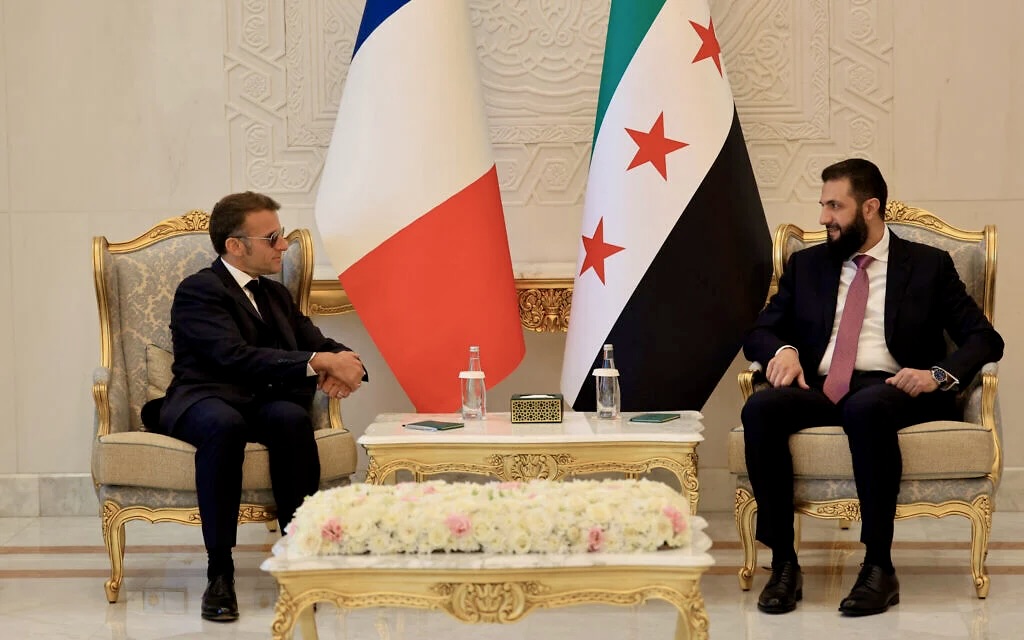
DAMASCUS (Realist English). On July 6, French President Emmanuel Macron arrived in Damascus for the first visit by a Western European head of state to Syria in more than a decade.
However, the very next day, his historic trip was overshadowed by a series of explosions in the centre of the Syrian capital, which injured at least 18 people.
Despite the incident, Macron continued his talks with Syria’s pro-Turkish leader Ahmad al-Sharaa and confirmed France’s readiness to take part in rebuilding the country, devastated by 14 years of civil war.
Double Blast Near the Four Seasons
The explosions occurred on July 7, while Macron was already at the presidential palace for his meeting with al-Sharaa.
According to Syrian authorities, one explosive device had been placed in a rubbish bin and another in a parked car near the Four Seasons hotel, where the French president was staying. The distance from the blast site to the hotel was about 125 metres.
The attack injured 18 people, including four police officers. The Élysée Palace confirmed that Macron had not heard the explosions and was safe. His visit continued as scheduled.
No one has yet claimed responsibility for the attack. This was the second such incident in a week: earlier, an explosion at a cafe near the Palace of Justice in central Damascus killed at least 10 people and wounded 20 more.
‘A Free, Pluralistic Syria’
Macron arrived in Damascus with a large economic delegation, including heads of TotalEnergies, CMA CGM, Airbus and Thales. The visit, according to the French side, was intended to demonstrate support for “a free, pluralistic Syria that respects each of its components.”
The talks in Damascus focused on three key areas: political reforms, humanitarian aid and infrastructure reconstruction.
According to Ahmad al-Sharaa, a number of economic agreements in the fields of energy, industry and reconstruction were planned to be signed during the visit.
France — First Western Partner
Macron’s visit marked a major diplomatic breakthrough for Syria’s new leadership, which came to power after the overthrow of Bashar al-Assad in late 2024. France became the first Western country to send its leader to Damascus, paving the way for international recognition of the new administration.
Earlier, in May 2025, Macron had already received al-Sharaa in Paris. Since then, France had played a key role in lobbying for the lifting of sanctions on Syria. Notably, Macron’s visit to Damascus took place immediately before his trip to the NATO summit in Ankara.
Challenges for the New Leadership
The explosions in Damascus dealt a serious blow to the image of President al-Sharaa, who is trying to convince the international community of his ability to ensure stability. His government, formed after Assad’s overthrow, has faced violence between various groups, although the capital had remained relatively calm.
As Realist English analysts note, despite major investment promises, Syria’s economy requires hundreds of billions of dollars for reconstruction after a war that claimed the lives of nearly half a million people.
Despite the explosions that overshadowed his visit, Macron demonstrated France’s readiness to become a key partner for Syria in its post-war recovery. However, the Damascus incident served as a reminder that the path to stability in a country that has endured 14 years of war remains fraught with challenges.