SEOUL (Realist English). South Korea could face growing pressure to play a role in a potential conflict over Taiwan as the United States pushes its allies to take on greater responsibility for defending the so-called first island chain in the western Pacific, analysts say.
In its newly released National Security Strategy, the administration of U.S. President Donald Trump stressed the need to maintain a “favourable conventional military balance” to deter aggression, particularly around Taiwan. While pledging to build forces capable of denying attacks anywhere along the first island chain — stretching from Japan through Taiwan and the Philippines to Borneo — the document made clear that Washington “cannot, and should not have to, do this alone”.
The strategy urges allies, including Japan and South Korea, to increase defence spending, grant greater access to ports and facilities, and invest in capabilities aimed at deterring regional adversaries. Compared with the 2022 strategy under former president Joe Biden, the new NSS places stronger emphasis on burden-sharing and allied contributions in the Indo-Pacific.
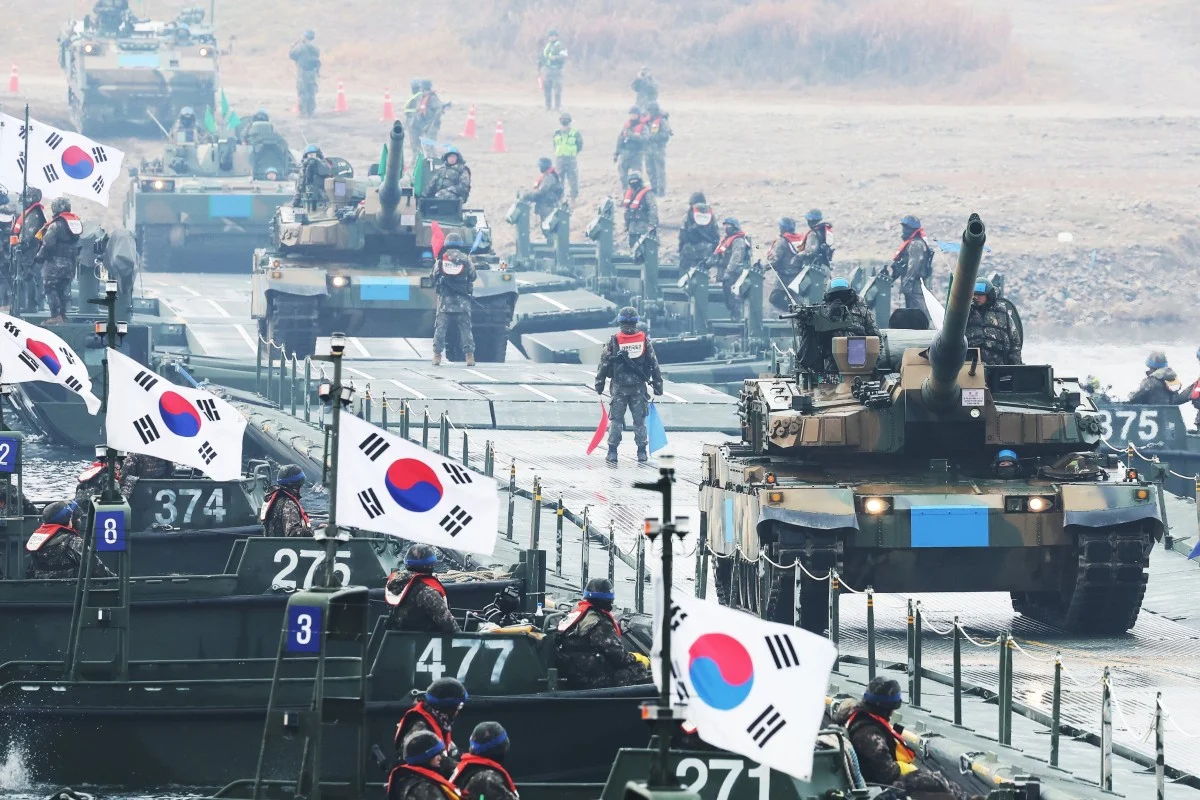
At the same time, Washington has encouraged Seoul to assume a larger role in deterring North Korea. An October summit between Trump and South Korean President Lee Jae-myung produced commitments to modernise the alliance, including raising defence spending to 3.5% of GDP and completing the transition of wartime operational control to South Korea.
The joint statement from the summit also reaffirmed the importance of peace and stability in the Taiwan Strait, a reference that has sharpened debate in Seoul over how far its alliance obligations might extend beyond the Korean peninsula.
Kang Jun-young, a professor at Hankuk University of Foreign Studies, said U.S. pressure could make it difficult for South Korea to remain detached from a Taiwan contingency. He warned that redeployment of U.S. Forces Korea elsewhere in the region could increase the risk of miscalculation by North Korea, potentially creating a two-front crisis.
President Lee has pledged a “pragmatic” foreign policy that prioritises the U.S. alliance while carefully managing relations with China and Russia. Seoul has avoided explicitly endorsing scenarios involving Taiwan, unlike Japan, whose leadership has openly warned that a Taiwan conflict could threaten national survival.
Still, analysts caution that neutrality may be hard to sustain if a crisis escalates. “Even if South Korea says it wants no part in a Taiwan conflict, escalation could still draw it in alongside the United States,” said Collin Koh of Singapore’s S. Rajaratnam School of International Studies, noting Seoul’s interest in protecting key sea lanes.
U.S. backing for South Korea’s plan to develop nuclear-powered submarines has further complicated the picture. While Seoul insists the project is aimed at tracking North Korean threats, U.S. officials have suggested the submarines could support broader collective defence efforts, including countering China.
Experts say South Korea is likely to continue a cautious balancing act. “Washington increasingly views regional security as interconnected,” said Andrew Yeo of the Brookings Institution. “Seoul’s priority remains the peninsula, but alliance modernisation means it cannot ignore the possibility that its capabilities could be used in a wider regional contingency.”