

WARSAW (Realist English). The US government has notified the Baltic states of possible delays in weapons and ammunition deliveries caused by the war with Iran. This was stated by the prime ministers of Estonia and Lithuania at a joint press conference on April 17.
Estonian Prime Minister Kristen Michal confirmed: “Yes, the US has informed us of the situation, and we understand the reasoning and the circumstances. We are in close contact with them to discuss how to address these supply challenges. The US remains our biggest ally. Their troops are here, connections are strong.”
Lithuanian Prime Minister Inga Ruginienė said that Vilnius currently sees “no big problem” regarding planned deliveries of US military equipment, but has also been informed of changes to schedules. “We understand that some deadlines are moving,” she said.
Latvian Prime Minister Evika Siliņa noted that her cabinet has “not yet been officially notified” by the US of any changes to delivery schedules for contracted equipment. “But, of course, we can all read the news, and we are watching very closely what is going on,” Siliņa added.
The prime ministers’ statements followed Reuters reports of possible delays in US weapons deliveries to several European countries, including allies in the Baltic region and Scandinavia.
Estonia: main concern — ammunition for HIMARS
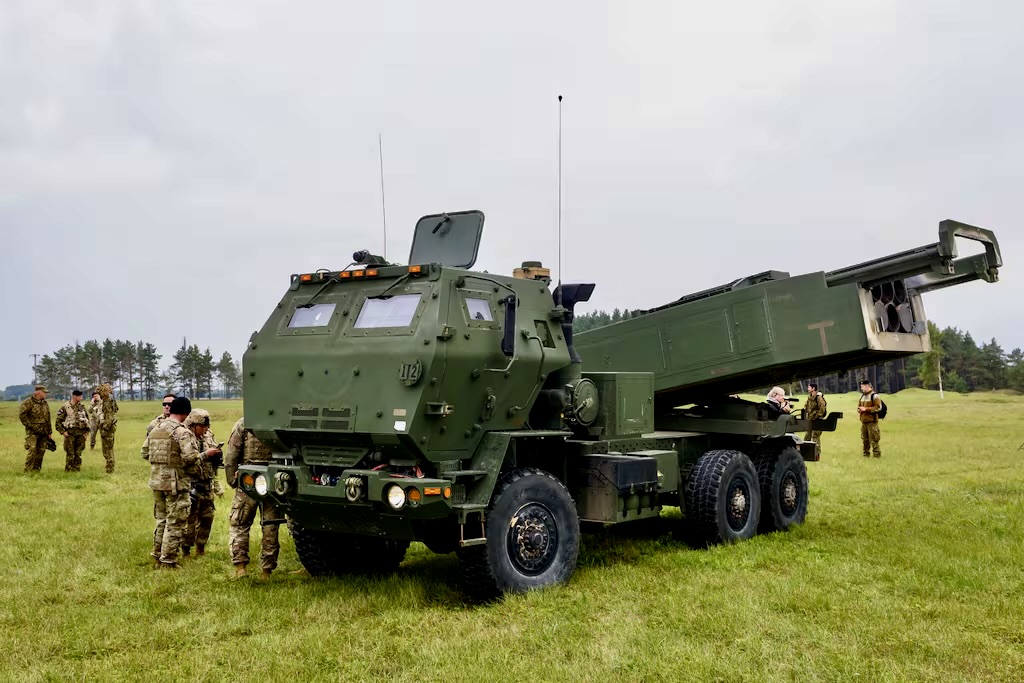
On April 18, Estonian Defense Minister Hanno Pevkur told local broadcaster ERR that his country’s main concern is related to possible delays in procuring ammunition for the M142 HIMARS multiple launch rocket systems. In April 2025, the Estonian Defence Forces received the first six HIMARS ordered in 2022. In early April 2026, Tallinn placed an order for three more systems from Lockheed Martin, with deliveries scheduled for 2027.
“What we do know is that ammunition deliveries have been put on hold, and we will try to gather as much information as possible and see whether this affects all allies and will remain in force for all of them, or whether, for example, exceptions will be made,” Pevkur said.
“If they are delayed for a longer period, then what are the alternatives or backup options? Even in the case of HIMARS, it is theoretically possible to use ammunition from other manufacturers, but that would again require permission from Lockheed Martin and the US government, so that other ammunition could also be used in the system,” the minister stated.
Alongside Estonia, Latvia and Lithuania have also purchased HIMARS for their respective militaries.
Record budgets: 5% of GDP on defence
In 2026, the defence budgets of the Baltic states have reached record levels. The defence ministers of Estonia, Lithuania and Latvia announced at a meeting at Ämari Air Base that they were raising spending to 5% of GDP, meeting the requirement of the US administration.
Lithuania will allocate 5.38% of its GDP to defence, amounting to about €2.16 billion. Prime Minister Inga Ruginienė called this figure record‑breaking. Latvia has increased spending to 4.91% of GDP — €2.16 billion. For comparison, in 2021 this figure was just 2.1%, and in 2014 — 0.9%. Estonia plans to invest 5.4% of GDP in defence annually in the period 2026–2029.
A significant portion of the funds is being directed toward the purchase of weapons and equipment. In Latvia, more than half of the defence budget (53%, or €1.14 billion) will go to strengthening the National Armed Forces, including combat platforms (€303 million), air defence systems (€200 million), ammunition and equipment (€181 million).
Additional support is provided by the United States: the Baltic Security Initiative provides annual funding of $350 million in 2026–2028, significantly higher than the $225–231 million in previous years.
Weaponry: HIMARS, tanks, howitzers and the “Baltic Defence Line”
Estonia signed a contract with Lockheed Martin in April 2026 for the supply of three additional HIMARS systems (range up to 300 km) with delivery in 2027, bringing its fleet to nine launchers. The first six systems arrived in April 2025. In addition, Tallinn has purchased South Korean K239 Chunmoo MLRS. Estonia relies on light, mobile forces integrated with the Finnish army, using Swedish CV9035 IFVs, South Korean K9 Thunder self‑propelled howitzers and Finnish Patria Pasi APCs.
Lithuania will receive its first HIMARS battery in 2026, a new NASAMS air defence battery, as well as Giraffe and TwinVis radars. It is procuring Leopard tanks, Caesar self‑propelled howitzers, Spike and Javelin anti‑tank systems. Over €200 million has been allocated for counter‑drone systems, and €2 billion has been set aside for weapons and equipment purchases in 2026. A key project is the “Baltic Defence Line”, which involves a three‑echelon deployment of obstacles, reinforcement of natural and engineering barriers, mining, swamp restoration, establishment of firing positions and blocking the port of Klaipėda.
Latvia, despite having the smallest defence budget, is acquiring a range of weapons: US M1095 self‑propelled howitzers, British CVR(T) armoured vehicles, Finnish Patria 6×6, Spanish ASCOD 2 IFVs and Swedish Archer self‑propelled howitzers. In January 2026, the government approved the purchase of 18 FH77 BW L52 Archer wheeled self‑propelled howitzers from Sweden for about €200 million.
Unified military mobility area
On January 30, 2026, the defence ministers of the Baltic states signed an agreement in Tallinn to create a unified military mobility area (Baltic Military Mobility Area), which will facilitate troop movement, reduce bureaucracy and strengthen the defence of NATO’s eastern flank. The document provides for standardisation of border‑crossing procedures, coordination of military cargo movements and rapid information sharing. Lithuanian Defence Minister Raimundas Vaikšnoras said: “If necessary, Lithuanian military equipment will be able to move freely to defend Riga, Estonian artillery to support Vilnius, and Latvian forces to reinforce Tallinn.”
In furtherance of this initiative, Lithuania has begun construction of a new railway line to the Rudninkai training ground to speed up the transfer of heavy equipment and personnel of the German brigade. The prime ministers of the Baltic states, at a meeting in Tallinn on April 17, reaffirmed the importance of implementing the Rail Baltica project by 2030 for military mobility and regional security.
NATO exercises: rehearsing defence of the eastern flank
In the first quarter of 2026, NATO conducted its largest exercise, Steadfast Dart 2026, involving about 10,000 troops, more than 1,500 pieces of equipment and 17 ships from 13 countries. A distinctive feature of the manoeuvres was the absence of direct US participation. The largest contingents were provided by Turkey, Spain, Italy and Greece. The exercise practised the rapid deployment of “fire brigade” forces to the eastern borders to repel an attack on Poland or the Baltic states. Troop landings on the Baltic coast were trained in Germany.
German Armed Forces Chief of Defence Carsten Breuer called the threat from Russia real, stressing that Moscow continues to reorient its armed forces towards the West.
Suwalki Gap: NATO’s Achilles’ heel
The main strategic vulnerability of the Baltic states is the Suwalki Gap — a narrow land corridor about 65 km wide connecting Poland with Lithuania, located between the Kaliningrad region and Belarus. Control of the corridor in a crisis situation will determine whether NATO can send reinforcements to the Baltic states by land. The Kaliningrad region hosts the Baltic Fleet, air defence systems and Iskander missile systems with nuclear potential. Belarus hosts Russian troops, aviation and missiles.
In response to this threat, Lithuania plans to build a military training ground near the town of Kapčiamiestis, in close proximity to the corridor, allowing units to train in conditions as close to reality as possible. Lithuanian Chief of Defence Raimundas Vaikšnoras said: “The question is no longer whether it will be built, but when.”