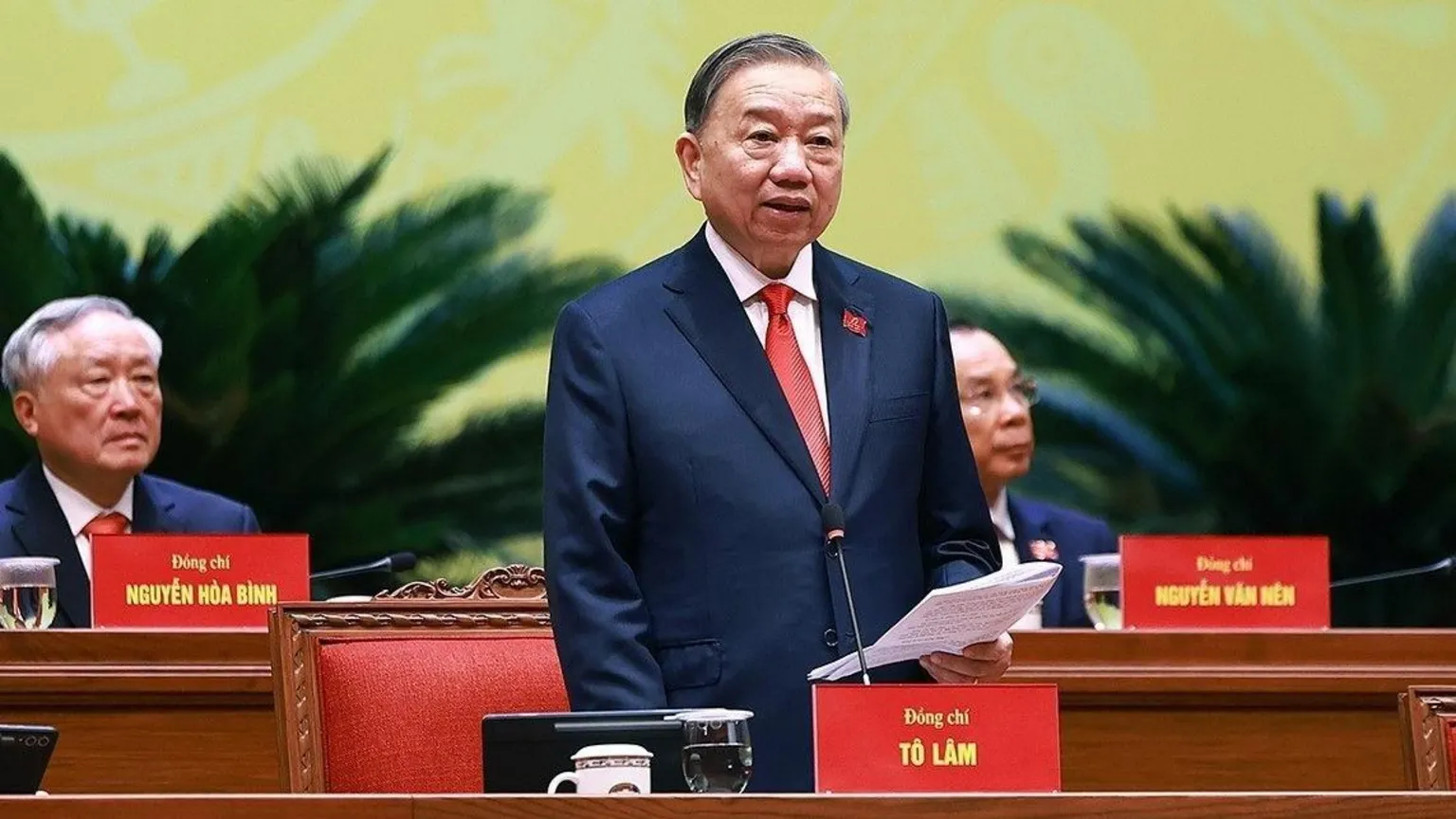
HANOI (Realist English). Vietnam’s ruling Communist Party has confirmed To Lam for another five-year term as general secretary, marking the strongest concentration of power in a single leader in more than three decades and setting the stage for an ambitious — and risky — overhaul of the country’s economic model.
The decision was taken on Friday at the 14th National Congress of the Communist Party of Vietnam, which brought together nearly 1,600 delegates to determine the country’s political and economic course through 2031. The congress, originally scheduled to run until Sunday, was cut short — a move widely interpreted by analysts as a sign of either strong internal consensus or muted opposition to To Lam’s expanding authority.
To Lam, who assumed the top post 18 months ago following the death of his predecessor Nguyen Phu Trong, used the congress to promote what he described as a new era of “national rise.” His reappointment had been expected, but the scale of his dominance over the party apparatus has drawn attention.
“This is the strongest concentration of power in one individual that I’ve seen since 1991,” Edmund Malesky, a professor of political economy at Duke University, told the BBC, noting the growing influence of To Lam’s public security faction over the military within the party hierarchy.
After inheriting power from Nguyen Phu Trong — an orthodox ideologue whose tenure was defined by an aggressive anti-corruption purge — To Lam has shifted sharply toward economic reform and growth. His agenda includes a sweeping restructuring of the state: cutting layers of bureaucracy, reducing the number of provinces from 63 to 34, and laying off at least 100,000 government employees.
The centrepiece of his strategy is Resolution 68, adopted by the Politburo in May last year, which declared the private sector “the most important driving force of the national economy.” While the wording shift may appear modest, it marked a historic break in officially socialist Vietnam by placing privately owned firms on equal footing with state-owned enterprises, long treated as the backbone of the system.
The party has also endorsed strikingly ambitious targets: double-digit annual growth, a doubling of private companies by 2030, and — by 2045, the centenary of independence — the creation of an upper-income, technology-based economy capable of escaping the so-called middle-income trap.
To achieve this, To Lam is betting on “leading cranes” — national private-sector champions capable of competing globally, inspired by South Korea’s chaebol model of the 1970s. Currently, state-owned enterprises still account for about 29% of Vietnam’s GDP, and most private firms remain small, limiting productivity and innovation.
However, the strategy has already revealed internal tensions. A subsequent Resolution 79, passed earlier this month, reaffirmed that state-owned firms could also serve as “leading cranes,” suggesting resistance from conservative factions wary of diminishing the state’s economic role.
Vietnam’s broader challenge remains structural. Its export-driven manufacturing boom has delivered rapid poverty reduction and global integration, but much of the value chain — technology, design and components — remains foreign-controlled. The country is also highly exposed to external shocks, particularly potential trade restrictions from the United States under Donald Trump.
Analysts warn that backing politically connected conglomerates could simply replace inefficient state monopolies with private rent-seekers. “The main challenge remains unchanged: how to create globally competitive firms without spawning politically connected rent-seekers,” said Nguyen Khac Giang of the ISEAS – Yusof Ishak Institute.
As To Lam embarks on his second full term, Vietnam’s celebrated “bamboo diplomacy” — flexible, non-aligned and trade-focused — is also expected to face its toughest test yet in an increasingly fragmented global economy. Whether his concentration of power delivers reform or reinforces old constraints will shape Vietnam’s trajectory for decades to come.