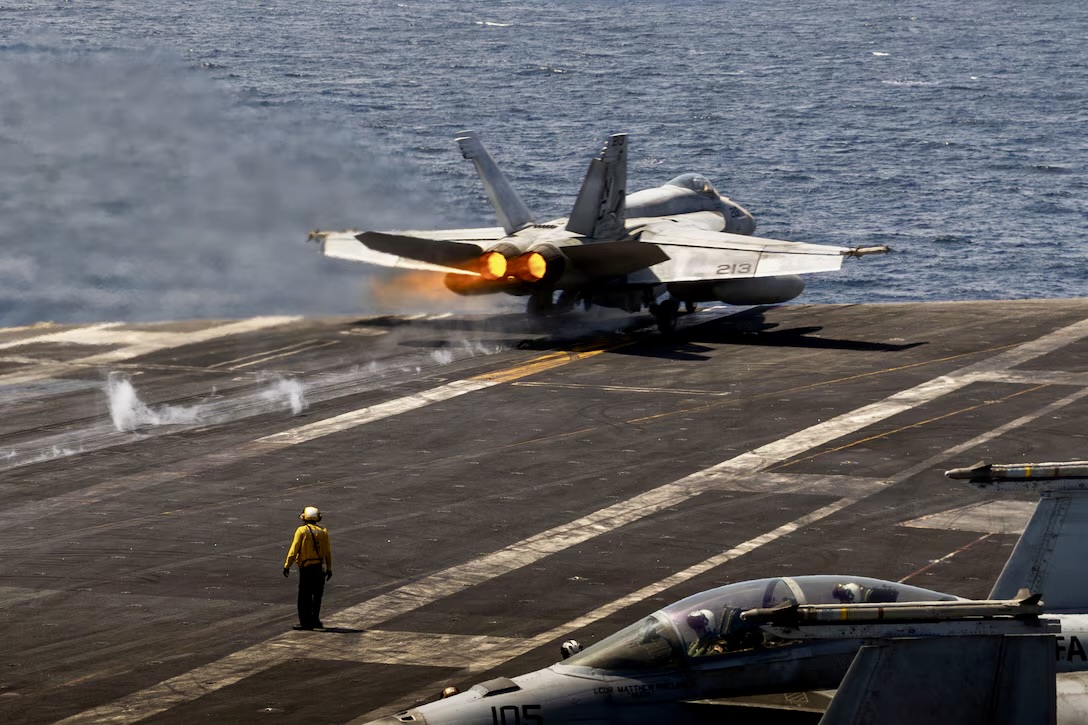
WASHINGTON (Realist English). The Congressional Research Service (CRS) has published a report providing the most comprehensive public accounting of US aircraft losses during the 40-day campaign against Iran, dubbed “Operation Epic Fury.” According to the document, dated May 13, the US Air Force lost or sustained damage to 42 aircraft.
The data is based on open sources, including media reports, Pentagon statements and information from US Central Command (CENTCOM). CRS does not have access to classified damage assessments, meaning the final figures could later be revised.
First losses: “friendly fire” over Kuwait
The first incidents occurred on March 1–2. A Kuwaiti Air Force F/A-18 fighter mistakenly shot down three F-15E Strike Eagle aircraft over Kuwaiti territory. All six crew members ejected safely and were rescued.
According to CENTCOM, intense combat operations involving Iranian aircraft, ballistic missiles and drones were underway at the time.
A fourth F-15E was shot down over Iran on April 3. Both crew members were evacuated during two separate search-and-rescue operations.
Tanker losses and strike on an air base
On March 12, a KC-135 Stratotanker crashed over western Iraq during an aerial refuelling mission. All six crew members were killed — the only fatalities listed in the CRS report. CENTCOM ruled out both hostile action and friendly fire as causes of the crash. A second KC-135 participating in the same mission landed safely in Israel.
Two days later, on March 14, Iranian missiles and drones struck Prince Sultan Air Base in Saudi Arabia, damaging five additional KC-135 aircraft on the ground. This increased the total number of damaged or destroyed tankers to seven.
F-35, A-10, E-3 and special operations
On March 19, an F-35A Lightning II sustained damage from ground fire over Iran but successfully returned to base.
On March 27, Iran again attacked Prince Sultan Air Base, damaging an E-3 Sentry airborne early warning and control aircraft. According to a May 7 report by The Washington Post, the aircraft had been parked on an unprotected taxiway. Images published after the strike showed severe burn damage to the fuselage.
The Jerusalem Post and Air & Space Forces Magazine described the aircraft as effectively beyond repair. Prior to the war, the US Air Force possessed only 16 E-3 aircraft, six of which had been deployed to Prince Sultan Air Base.
On April 3, an A-10 Thunderbolt II was shot down by enemy fire during a combat search-and-rescue mission. The pilot ejected and was rescued.
On April 5, US forces destroyed two MC-130J Commando II special operations aircraft on the ground inside Iran after they became unable to take off from an improvised airstrip. All personnel were safely evacuated.
During the same mission, an HH-60W Jolly Green II helicopter sustained damage from small-arms fire. According to The Aviationist, two helicopters were hit, although only one appears in the CRS report.
Drones: the heaviest losses
Unmanned systems accounted for the majority of losses — 25 out of 42 aircraft. The list includes 24 MQ-9 Reaper drones and one MQ-4C Triton lost during an incident on April 14.
Nevertheless, Air Force Chief of Staff General Kenneth Wilsbach described the MQ-9 as the campaign’s “most valuable player.”
“No other platform even comes close to the MQ-9’s effectiveness,” he stated on May 20 during a House Armed Services Committee hearing.
Disputed and unaccounted losses
CRS did not include AH/MH-6 Little Bird helicopters operated by the 160th Special Operations Aviation Regiment. According to The War Zone, between two and four such helicopters were deliberately destroyed on the same Iranian airstrip where the MC-130Js had been destroyed.
Geolocated photographs analysed by independent researchers showed burned-out helicopters next to C-130 wreckage. The absence of official Pentagon statements likely explains why these losses were excluded from the report.
Cost of the war continues to rise
On May 12, Acting Pentagon Comptroller Jules Hurst reported that the cost of the operation against Iran had risen to $29 billion, up from the $25 billion estimate he had given on April 29.
According to Hurst, the increase reflects “updated estimates of equipment repair and replacement costs, as well as broader operational expenditures.”
The figure does not include the cost of restoring damaged air bases and other US military facilities across the Middle East.
Fears of a possible Iranian pre-emptive strike
Israeli intelligence agencies have reportedly warned that Iran may be preparing a surprise combined missile and drone attack against Gulf states and Israel. According to reports, the threat was discussed during a meeting involving Israeli Defence Minister Israel Katz.
Sources suggest Tehran may seek to strike before the United States and Israel formally abandon diplomatic efforts and shift toward a military scenario.
In response, the Israel Defense Forces (IDF) have held a series of consultations with US counterparts aimed at improving operational readiness, including expanded intelligence sharing regarding unusual Iranian military activity.
Over the past month, the flow of US military equipment shipments to Israel has reportedly increased significantly.
Israel on high alert amid disagreements with Washington
Since early May, Israeli officials have repeatedly stated their readiness to resume military operations immediately.
On May 14, Katz stated that Israel’s “mission is not yet complete” and that the country was prepared to “take action” if necessary.
On May 20, IDF Chief of Staff Lieutenant General Eyal Zamir stated that Israeli forces had reached their “highest level of combat readiness” and were prepared for any scenario.
According to Israel’s state broadcaster Kan, joint US-Israeli preparations for a possible resumption of military operations against Iran have been completed, and both sides are “fully coordinated.”
Israel, according to the report, is now waiting for a final decision from US President Donald Trump.
“We are preparing for combat operations that could last from several days to several weeks.”
Leak triggers controversy: the Isfahan uranium seizure plan
On May 19, Israel’s right-leaning Channel 14, known for its close ties to Prime Minister Benjamin Netanyahu’s government, disclosed details of an alleged joint US-Israeli plan to seize enriched uranium stored at Iran’s nuclear facility in Isfahan.
According to IAEA data, more than half of Iran’s stockpile of highly enriched uranium — exceeding 400 kilograms — may be stored at the site in underground tunnels more than 90 metres deep.
The report claimed that the material was stored at a depth shallow enough to allow extraction through a special operation.
The disclosure sparked political controversy in the Knesset, where opposition lawmakers demanded an emergency session and accused the channel of “recklessly exposing operational information.”
Former IDF Chief of Staff Gadi Eizenkot described the incident as “reckless trading in national security,” adding that “anyone who trades in such information has abandoned responsibility and common sense.”
Journalist Shimon Riklin rejected the criticism, insisting that nothing classified had been disclosed.