

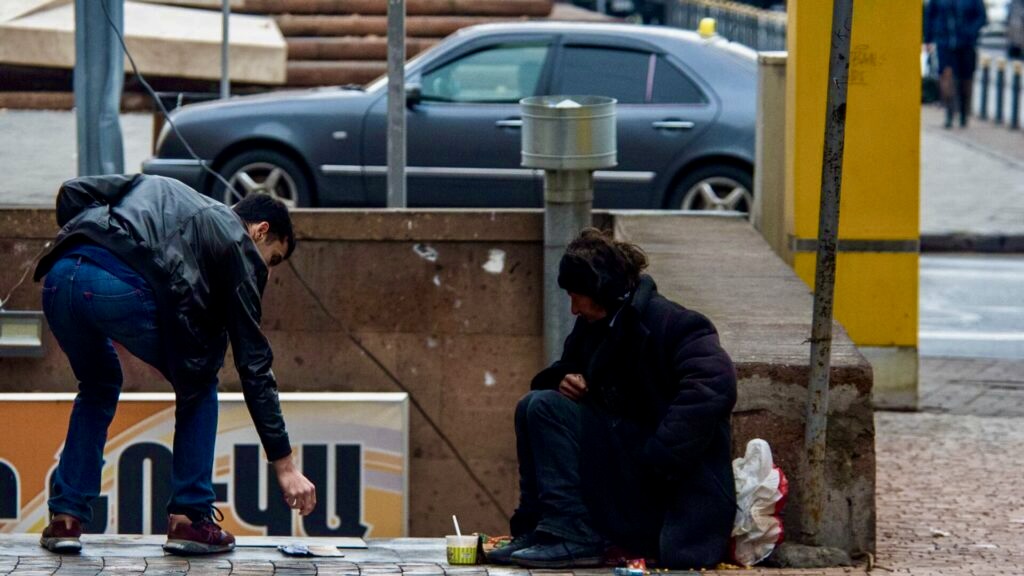
YEREVAN (Realist English). Official data from the Statistical Committee of Armenia record a gradual decline in poverty levels. In 2024, it stood at 21.7%, and based on preliminary estimates for 2025, it dropped to 22–23%, compared to 26.4% in 2021.
Prime Minister Nikol Pashinyan, speaking in parliament on October 27, 2025, acknowledged that the poverty rate in the country “remains very high” at 23%, attributing it to “destroyed schools” and “lack of quality education” in past years.
However, these figures do not reflect the full depth of the crisis. According to the World Bank, 76% of Armenia’s population spends less than $5 a day, which is an international poverty criterion.
A study conducted by the Friedrich Ebert Foundation and the Confederation of Trade Unions of Armenia in November 2025 found that 65.1% of the population cannot afford healthy food.
At the same time, the average salary in the country is about 295,000 drams (approximately $760), while the minimum wage is only 75,000 drams ($195), unchanged for three years despite inflation. Experts suggest raising the minimum wage to 90,000–100,000 drams.
Child poverty and regional gap
The problem is particularly acute in the regions. According to Hetq data, the poverty rate in rural areas in 2024 was 26%, compared to 19.3% in cities. Previously, the gap was even more dramatic: in 2023, according to a study, 63.3% of rural residents lived below the poverty line versus 52% in cities.
The most severe situation is in the Tavush region. In the city of Ijevan and its surroundings, according to SOS Children’s Villages, more than 46% of children live in poverty, and 2% in extreme poverty. Over 70% of households in this area lack sufficient funds for food, and more than 85% depend on social assistance. Almost two-thirds of preschool children do not attend kindergartens.
Nationwide, according to the Statistical Committee for 2024, 28% of children live below the poverty line, and 0.9% in extreme poverty.
In Nagorno-Karabakh in 2025, 80% of children in some rural communities lived in poverty. The situation is aggravated by cuts in state support for large families: since November 2025, benefits for third and subsequent children were reduced by 2–3 times, which, according to deputies, will negatively affect already record-low birth rates.
How honest is the statistics and what is the real reason?
Minister of Labor and Social Affairs Arsen Torosyan at the end of 2025 hastened to declare “the lowest poverty level since independence,” but his optimism was met with criticism: the methodology for calculating 2024 indicators was changed, making the data incomparable with previous years. Critics also point to a paradox: the economy is growing (GDP increased by 5% in 2025, and 5.2% growth is expected in 2026), but real incomes are not increasing.
Analysts attribute this to the fact that the main growth driver — re-exports of goods to Russia — enriches only a narrow circle of intermediaries, without affecting ordinary citizens. 19% of employed Armenians with regular income still live below the poverty line, and more than 100,000 people with higher education are in the lower strata of the population.
Refugees from Nagorno-Karabakh and unemployment
The influx of displaced persons from Artsakh in 2024 led to an increase in unemployment from 12.4% in 2023 to 13.9% in 2024. However, in the third quarter of 2025, the rate fell to 11.8%. Nevertheless, the government continues to support the most vulnerable groups: orphans, pensioners and disabled persons among the displaced receive 30,000 drams per month.
Pensioners: humiliating care
The authorities’ social policy has drawn sharp criticism from human rights defenders. Pashinyan, commenting on a pension increase of 10,400 drams (about $27), said: “Why should we give people this money if they don’t know how to spend it effectively?”.
Human rights activist Zhanna Aleksanyan called the prime minister’s statements “humiliating” and noted that it is hard to find another country where the head of state treats socially vulnerable groups with such disdain. Although the minimum pension in Armenia was tied to the size of the minimum food basket, this money is still insufficient to cover basic needs, including transport, utilities and healthcare.
Forecasts and prospects
The World Bank, despite ongoing poverty, forecasts a reduction from 56.2% in 2024 to 53.1% by 2027 (at purchasing power parity). In 2026, the authorities will focus on improving housing conditions for pensioners, but experts doubt that without a radical revision of the economic model and an increase in the minimum wage, the country will be able to fulfill the ruling party’s pre-election promise to halve poverty by 2026 (from 26.4% to 13%). For now, the target seems unattainable.