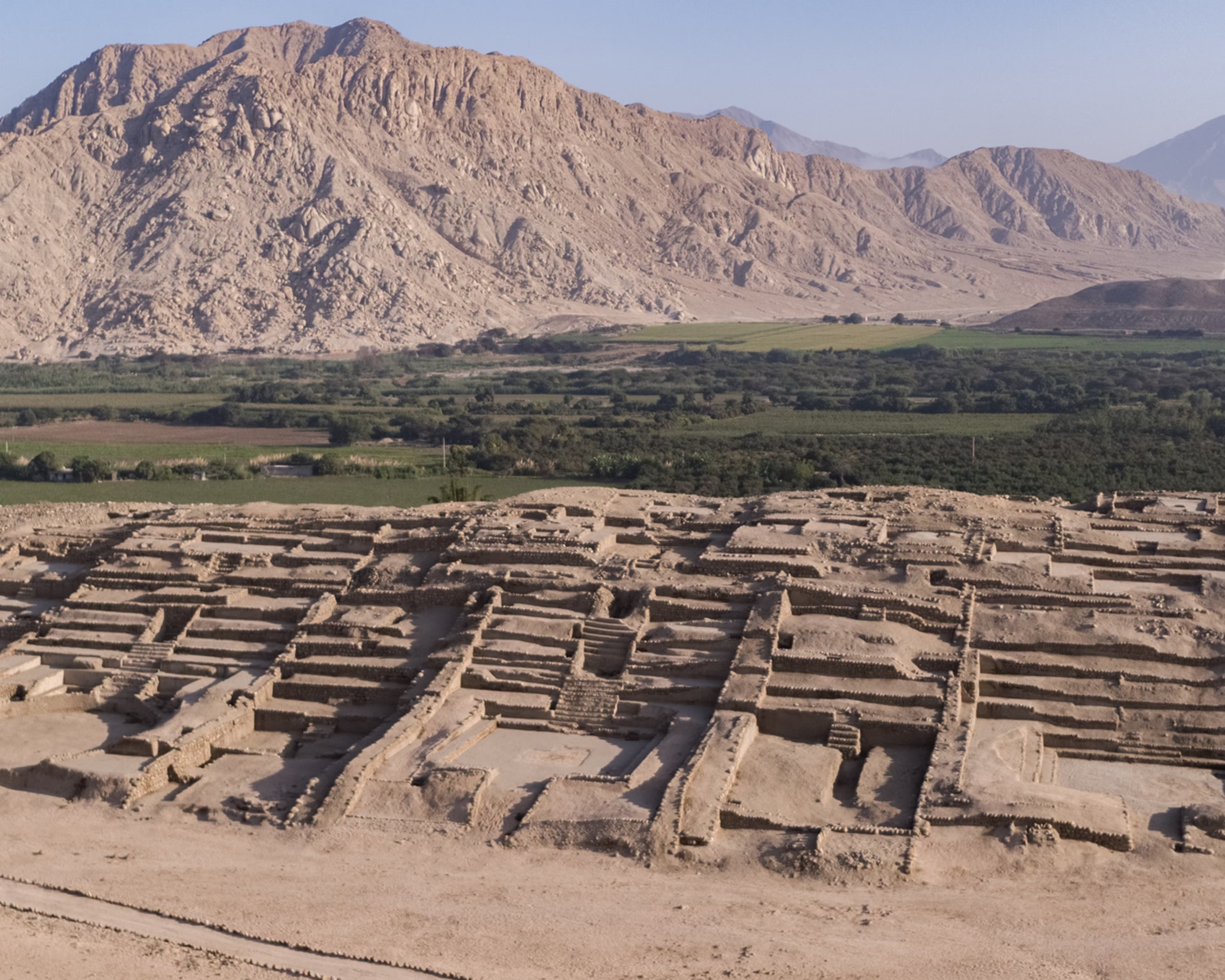
LIMA (Realist English). Archaeologists in Peru have uncovered compelling new evidence showing how the oldest known civilization in the Americas — the people of Caral — survived a devastating climate catastrophe more than four millennia ago without resorting to violence.
The research, led by renowned Peruvian archaeologist Dr. Ruth Shady, indicates that around 4,200 years ago, a prolonged drought forced the inhabitants of the ancient city of Caral to abandon their settlements and relocate to new sites nearby. Instead of collapsing into conflict, they adapted through migration and innovation, leaving behind striking symbolic friezes to warn future generations about the dangers of environmental destruction.
“They wanted people to remember that climate change had caused a great crisis for their society — and that they had overcome it,” Shady said while inspecting a temple pyramid at one of the sites.
Messages from the past
One of the main resettlement sites was Vichama, located west of Caral along Peru’s arid Pacific coast, where residents survived by fishing and farming in the Huaura River valley. Another settlement, Peñico, emerged 10 miles east of Caral in the Supe River valley between 1800 and 1500 BC, around the same time early civilizations were flourishing in Mesopotamia and the Indus Valley.
At both sites, archaeologists found architectural designs characteristic of Caral — sunken plazas, pyramid temples, and intricate decorative reliefs — depicting the people’s struggle and resilience.
At Vichama, murals show emaciated human figures, pregnant women, and dancers, symbolizing both the suffering of famine and the renewal of life. Another relief portrays a toad struck by lightning, which Shady interprets as a sign of returning rain and hope for regeneration.
“After the deaths and the empty stomachs, the toad appears, struck by lightning — announcing the arrival of water,” Shady explained.
Resilience over violence
Archaeological evidence from Peñico reinforces that the Caral civilization responded to environmental collapse through organization and cooperation, not warfare.
“The settlement’s design reveals a political and ideological structure — and notably, an absence of weapons or signs of violence,” said Mauro Ordoñez, chief archaeologist at Peñico.
Peñico likely served as a trade hub connecting the Pacific coast, the Andes, and the Amazon. Excavations uncovered monkey and macaw skeletons, Ecuadorian seashells, and ceramics depicting jungle animals — evidence of extensive long-distance exchange networks.
Lessons for the modern world
Dr. Shady, who first discovered Caral and its 32 monumental structures, revolutionized understanding of early American history by proving that the continent’s first complex society was contemporary with Egypt, Mesopotamia, India, and China.
Her new findings suggest that, faced with climate disaster, the Caral people chose migration, cooperation, and cultural expression over conflict — a lesson she says remains deeply relevant today.
“Our ancestors showed that it is possible to live in harmony with nature,” Shady said. “Their message endures — that survival depends not on domination, but on balance.”
The newly uncovered friezes at Vichama and Peñico stand as powerful reminders of a civilization that endured catastrophe not through conquest, but through adaptation, unity, and hope.