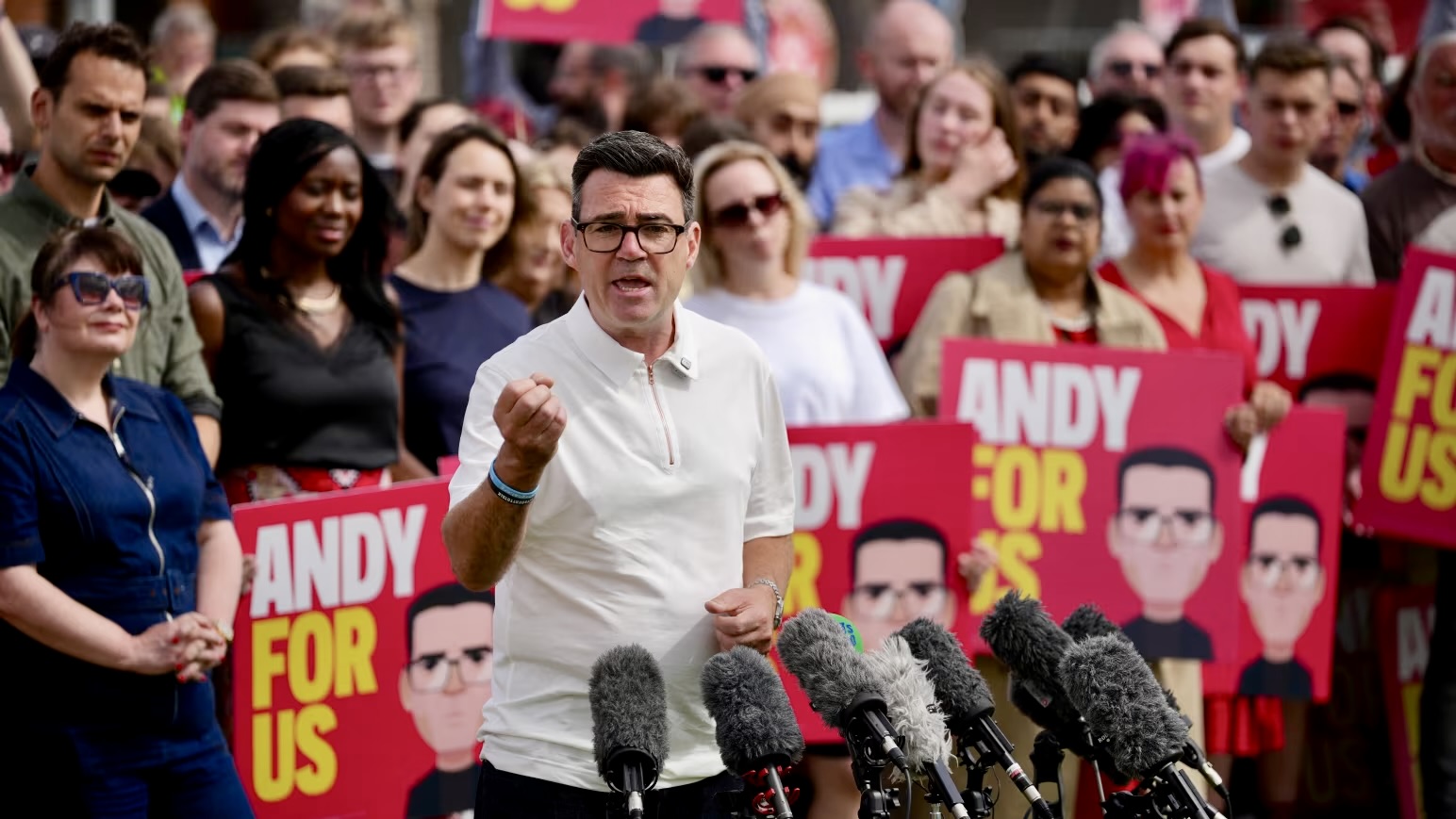
MANCHESTER (Realist English). On July 20, Andy Burnham will officially become the seventh Prime Minister of the United Kingdom in the last ten years, succeeding Keir Starmer as leader of the Labour Party.
The nation’s hopes are pinned on him to rescue an economy facing serious difficulties, with public services stretched to their limits.
Burnham’s path to power has been long and winding, but it was his experience running Greater Manchester that made him the leading candidate for the premiership.
Path to Power: From Westminster to “King of the North”
A Labour Party veteran, Burnham was a member of Parliament from 2001 and held ministerial posts in Tony Blair’s governments. Twice — in 2010 and 2015 — he ran unsuccessfully for party leader, before leaving Westminster in 2017 to head the newly created Greater Manchester Combined Authority. This move, which at first seemed a step back, became the foundation of his political rebirth.
Over nine years as mayor, Burnham transformed Greater Manchester into the fastest-growing region in the UK. The region’s economy grew twice as fast as the national average, and productivity growth since 2019 was four times the UK average.
The numbers are striking: since the devolution of powers to local authorities in 2015, Greater Manchester’s economy has grown by 28%, surpassing the £100 billion mark. While London saw zero productivity growth, Manchester’s productivity rose by 12.6%.
The region attracted the highest level of foreign investment outside the capital — with companies such as IBM, Booking.com, Klarna, Bosch, Roku, and Auto Trader opening offices there. Burnham himself proudly states that under his leadership the region achieved “a level of growth not seen here since the Victorian era.”
These achievements earned him the nickname “King of the North” — a reference to the series Game of Thrones, underscoring his role as a leader who challenged the dominance of the southern capital. But can he replicate that success on a national scale?
“Manchesterism”: The Philosophy of the New Power
Burnham’s political philosophy has been dubbed “Manchesterism.” At its core lies the belief that “you cannot order growth from the top down.”
Decades of hyper‑centralisation of power in London, in his view, stifled economic activity in the regions.
Key principles of “Manchesterism”:
- Devolution of power. Burnham intends to give regions control over taxes, transport, and housing. He has already announced the creation of “Downing Street, North” — a prime ministerial office in Manchester designed to redistribute power across the country.
- “The end of neoliberalism.” Burnham himself describes his ideology as “the end of neoliberalism and trickle‑down economics,” advocating for “business‑friendly socialism” and active state intervention.
- Return of utilities to public control. Water and energy should be brought back under state control — in Burnham’s view, this is not just an economic but a moral necessity.
- Support for local business. In Manchester, this led to a boom in independent wine bars, coffee shops, and restaurants, which Condé Nast Traveller called the best in the UK.
The Manchester Miracle: What Has Changed in the City
To understand the Burnham phenomenon, one need only walk through central Manchester. The city that many left is now attracting them back. Lucy Allison, 33, who spent 12 years in the hospitality business in the US and Amsterdam, returned to Manchester two years ago. “The city feels completely different,” she says. “There are quirky wine shops and independent bakeries that were never here before.”
Local business is thriving. Hip Pop, founded by Emma Thackeray in 2019 from her kitchen, now sells its drinks in the UK’s biggest supermarkets and in several European countries. On Deansgate, artist Helen Davies is creating a series of paintings titled “Love Letters to Manchester” — a love letter to a city she “keeps falling for.”
Risks and Challenges: What Could Go Wrong
However, the enthusiasm around Burnham is tempered by doubts. “Manchesterism” remains more a collection of slogans than a detailed economic plan.
As the BBC notes, his keynote speech “was not a detailed blueprint for the economy with estimates of appropriate levels of tax, spending, investment, and infrastructure.”
Critics agree that scaling up the success of one city to the entire country will be extremely difficult. The main challenges for Burnham:
- The economic backdrop. He inherits an economy that was improving, but the war in Iran has radically changed the outlook, and a sharp slowdown in growth is now expected this year.
- The underlying problem. Britain has been stagnant since 2007 and ranks last in the G7 for business investment.
- Financial constraints. Burnham has pledged to adhere to existing borrowing rules and not raise major taxes, leaving him with very limited room for manoeuvre.
- Uncertainty. The Chancellor of the Exchequer will not be appointed for another three weeks, and key economic decisions have yet to be made.
The right‑leaning National Review is sceptical: “Hopes that Burnham can reboot the economy look far‑fetched. If anything, he could accelerate the pace of decline.” The magazine also warns that Burnham’s advisers are discussing wealth taxes, income tax hikes, and capital gains tax increases — measures unlikely to please the markets.
The Last Chance Before “Reform”
Perhaps the most important context for Burnham’s arrival is political.
According to The Atlantic, he is the “last chance” for the British establishment to prevent the rise of “Reform UK” — Nigel Farage’s nationalist party, currently leading in the polls.
Burnham has roughly three years to revive the economy before disillusioned voters turn away from mainstream parties.
Burnham takes office on July 20. His main task is to turn “Manchesterism” from a catchy slogan into a working economic model for the entire country.
Markets remain calm for now, but time for concrete decisions is limited. Whether the “King of the North” can win over Britain as he won over Manchester is the question that will determine the country’s fate for years to come.