DAMASCUS (Realist English). Inspectors from the International Atomic Energy Agency (IAEA) have confirmed the presence of several tonnes of natural uranium at a previously undeclared site in Syria.
Syria’s new authorities voluntarily disclosed the existence of the storage facility, inherited from the government of Bashar al‑Assad, and stated that they would keep the material under their own control while placing it under IAEA safeguards.
This is the first step towards closing Syria’s “nuclear dossier,” which had remained open for almost two decades.
What the IAEA found
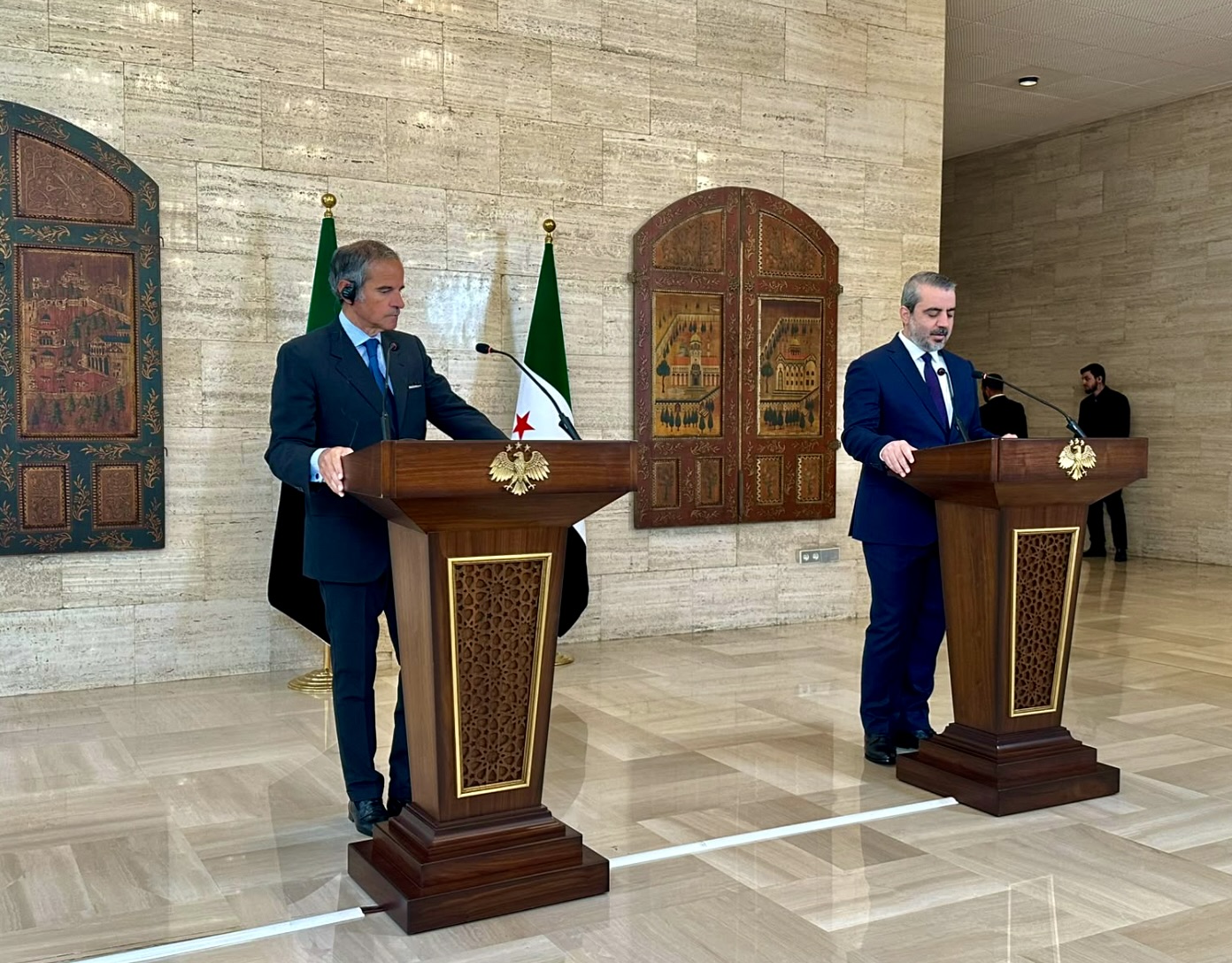
IAEA Director General Rafael Grossi announced on 18 August during a joint press conference in Damascus that agency inspectors had discovered several tonnes of nuclear material at a facility that Syrian authorities had reported in July. The material dates back to the rule of ousted President Bashar al‑Assad.
“We are talking about several tonnes of nuclear material that could be misused,” Grossi said, promising that it would be placed under international safeguards. The IAEA chief praised Syria’s “courageous decision” to voluntarily disclose the existence of the storage facility.
| Parameter | Details |
| Date of discovery | 18 August 2026 |
| Date of notification | 17 July 2026 |
| Volume of material | “Several tonnes” of natural uranium |
| Location | Undeclared facility “outside Damascus” |
| Status | Under national control with IAEA safeguards |
| Purpose | Declared for peaceful use |
Syria’s position: material will remain in the country
Syrian Foreign Minister Asaad al‑Shibani confirmed that on 17 July Damascus had sent an official letter to the IAEA, “of its own free will,” declaring the presence of nuclear materials at a facility inherited from the previous regime. According to the minister, technical assessments indicate that these materials do not pose a danger.
Al‑Shibani stressed that the discovered nuclear materials will remain under Syria’s national jurisdiction and will be subject to IAEA safeguards.
“We affirm Syria’s right to use nuclear energy for civilian and peaceful purposes,” the foreign minister said.
‘Site 99’: Israeli threat and the US role
The discovered material, according to Israeli and US sources, was stored at a facility known as “Site 99.” Among the materials stored there is yellowcake – a natural uranium concentrate. According to a US official’s assessment, these materials are not suitable for producing nuclear weapons but could be used to make a “dirty bomb.”
In August 2026, as journalist Barak Ravid reported, the US prevented an Israeli strike on this facility. Israel demanded that the materials be removed and warned that otherwise it might strike the facility again. Washington asked Tel Aviv to refrain from military action and brought the IAEA into the matter.
Timeline: from the 2007 strike to the 2026 discovery
| Date | Event |
| 2007 | Israel strikes a facility in Deir ez‑Zor |
| 2011 | IAEA deems the facility “very likely” a nuclear reactor |
| 2018 | Israel officially acknowledges the 2007 airstrike |
| 2024 | IAEA detects uranium particles at the site |
| 17 July 2026 | Syria notifies the IAEA of nuclear materials |
| 18 August 2026 | IAEA confirms tonnes of natural uranium |
Expert opinion: ‘A bold move, but not the end of the story’
The director of the Centre for Middle Eastern Studies (Paris) told journalists:
“Syria’s voluntary disclosure of the nuclear storage facility is an unprecedented step for Damascus. The new authorities are trying to close Assad’s ‘nuclear dossier’ to remove sanctions risks and integrate into the international community.
However, the fate of the materials remains uncertain: Syria insists on maintaining control over them, which is causing alarm in Israel and Washington. The question is whether the IAEA can ensure real oversight of these tonnes of uranium on Syrian territory – or whether this will become a new bone of contention in the region.”
Analysis: a step towards closing the ‘nuclear dossier’
For Syria’s new authorities, voluntarily disclosing the nuclear materials is an important step towards lifting international restrictions and integrating into the international community. Cooperating with the IAEA allows Damascus to demonstrate goodwill and begin the process of “turning the page” in relations with the agency, as Grossi put it.
However, the decision to keep the materials under Syrian control, rather than remove them as Israel demanded, creates tension. Tel Aviv has already threatened to strike the facility, and the situation retains the potential for new escalation.
Furthermore, as AP notes, Israel is considered the only nuclear power in the Middle East, although it does not officially acknowledge its nuclear programme, making any nuclear materials in neighbouring countries a subject of intense scrutiny.
The key question is whether the IAEA can ensure real oversight of these tonnes of uranium remaining on Syrian territory – or whether this will become a new point of contention between Damascus, Tel Aviv and Washington.