STOCKHOLM (Realist English). Sweden, which for decades was one of the most consistent voices in favour of nuclear disarmament, is rethinking its approach to deterrence in 2026. As Bloomberg reports, against the backdrop of shifting power balances in Europe, Stockholm is being forced to change its stance on nuclear alliances.
A symbol of this shift is the Marviken nuclear power plant on the Baltic Sea coast – a concrete giant that was originally built as part of Sweden’s nuclear programme but was never completed.
A look back: how Sweden abandoned the bomb
Sweden began nuclear weapons research immediately after World War II. In 1945, the Swedish Atomic Committee was established, and in 1948, the defence research institute FOA presented its first report on the feasibility of producing nuclear weapons in the country. In 1957, the CIA concluded that Stockholm could build a nuclear bomb within five years.
Sweden planned to develop approximately 100 nuclear warheads and conducted work with plutonium.
However, by the mid‑1960s, strategic priorities had shifted. In 1966, Sweden abandoned its nuclear weapons development programme, and in 1968 it signed the Non‑Proliferation Treaty (NPT), after which it began winding down its research programme, completed in 1972. In subsequent decades, Sweden positioned itself as a neutral country that did not accept nuclear weapons on its territory.
Timeline: from neutrality to dialogue
| Date | Event |
| 1945 | Swedish Atomic Committee established |
| 1957 | CIA assesses Sweden could build a nuclear bomb within 5 years |
| 1966 | Abandonment of nuclear weapons development |
| 1968 | Signing of the NPT |
| 1972 | Nuclear programme wind‑down completed |
| 2022 | Shift in European security architecture |
| March 2024 | Sweden joins NATO |
| January 2026 | PM Kristersson confirms discussions with France and UK |
| February 2026 | Sweden expresses readiness to join European nuclear deterrence talks |
| 23 April 2026 | First Nuclear Steering Group meeting with France |
What changed: from neutrality to dialogue
The turning point was the shift in the European geopolitical situation in 2022, which pushed Sweden to join NATO in March 2024. However, NATO membership did not resolve all questions. As The Atlantic notes, Sweden’s trust in the Washington‑led peace order was once so absolute that it was willing to abandon its nuclear ambitions.
Now, the country is reassessing its views and exploring the possibility of more formal nuclear protection from Britain and France.
In January 2026, Prime Minister Ulf Kristersson confirmed in an interview with Swedish public television SVT that Stockholm is holding “ongoing discussions” with London and Paris.
“We are newcomers to all of NATO’s nuclear planning, but Swedes take this planning very, very seriously,” Kristersson said. He also stressed that “as long as dangerous countries have nuclear weapons, healthy democracies must also have access to nuclear weapons.”
In February 2026, Kristersson stated that Sweden is ready to participate in negotiations proposed by France to strengthen cooperation within European nuclear deterrence.
“The talks are aimed at strengthening Swedish and European security in turbulent times,” the prime minister noted. At the same time, he added that he would prefer a world without nuclear weapons, but under current conditions, deterrence remains necessary.
The French initiative and first practical steps
On 23 April 2026, Sweden and France held the first meeting of their joint Nuclear Steering Group in Paris and discussed a “roadmap” for cooperation. As Nordic Defence Review reports, Sweden, Denmark and Norway accepted France’s invitation to join a dialogue on how to jointly strengthen collective nuclear deterrence.
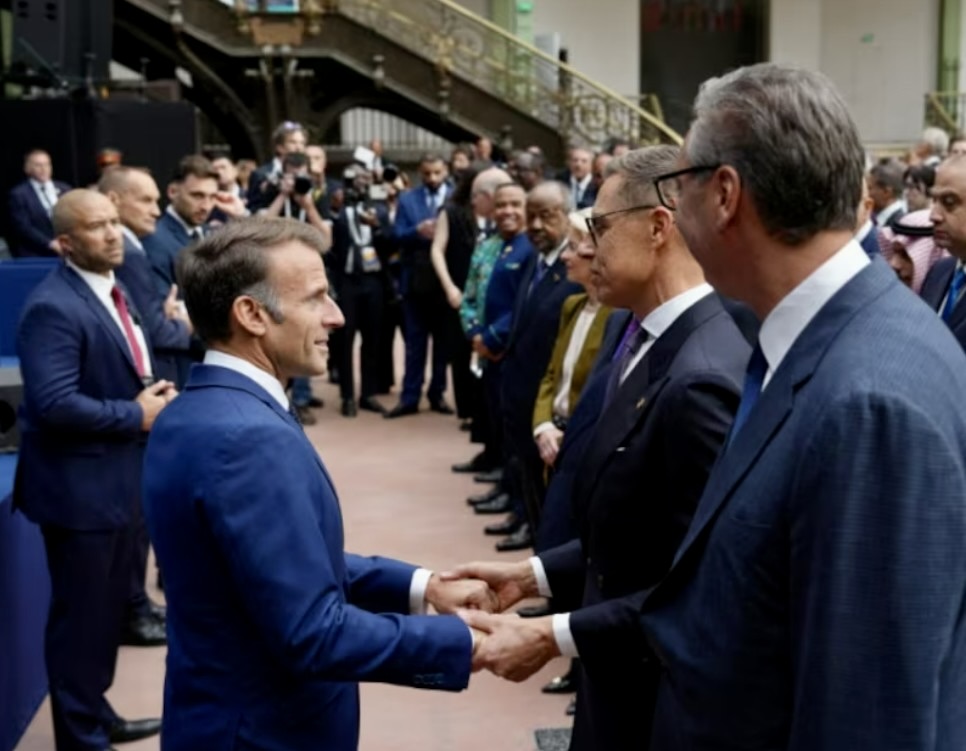
French President Emmanuel Macron stated that France would strengthen its nuclear arsenal and include a “European dimension” in its deterrence strategy, offering interested European partners closer cooperation, including consultations, joint exercises and other forms of coordination.
Beyond Sweden, interest in this initiative has been expressed by the United Kingdom, Germany, Poland, the Netherlands, Belgium, Greece and Denmark.
Reaction and uncertainty
Stockholm’s position remains ambivalent. On one hand, Kristersson has ruled out the deployment of French nuclear weapons on Swedish territory in peacetime, citing the policy of not accepting nuclear weapons on its soil. On the other, he acknowledged that in the event of war, the situation could change dramatically.
Russian officials and experts have already responded to these signals. Russia’s Ambassador to Sweden Sergei Belyaev called Sweden’s shift in tone on the nuclear issue “striking.”
Russian military expert Vladimir Stepanov characterised Sweden’s plans to host other countries’ nuclear weapons as “suicidal” and warned that Moscow would be forced to reconsider its approaches to nuclear deterrence in the region.
For Sweden, revising its nuclear policy is a forced measure in the face of the changed European security architecture. NATO membership and discussions with France and Britain give Stockholm new tools to strengthen its defence capabilities without requiring its own nuclear arsenal.
However, serious challenges remain. First, the domestic political tradition of not accepting nuclear weapons on its territory remains strong, and any change to this principle will face resistance.
Second, Russia’s reaction has already followed – Moscow views these steps as a threat and is prepared to take retaliatory measures. Third, the question of how reliable European deterrence would be in the event of a weakening of the US “umbrella” remains open.
As Bloomberg notes, although the talks are still preliminary in nature and do not involve immediate decisions, the very fact of their commencement marks a serious shift in the position of a country that for decades was one of the main voices for nuclear disarmament. The question of whether Sweden can maintain a balance between NATO membership, the pursuit of European security autonomy, and pressure from Russia remains open.