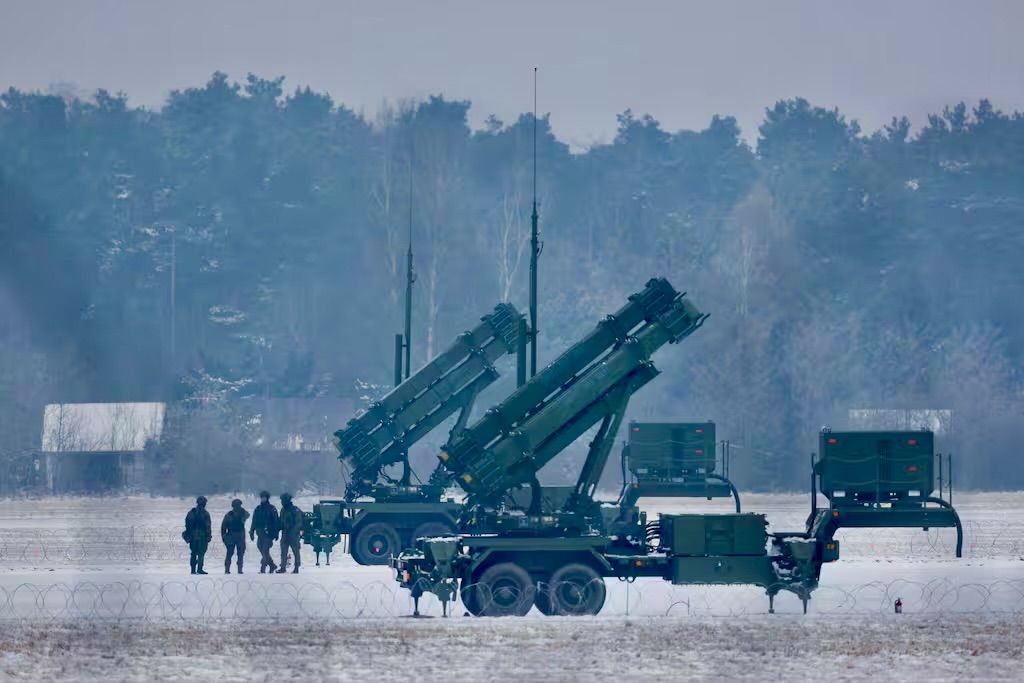
WASHINGTON (Realist English). President Donald Trump’s promise to grant Ukraine a licence to produce Patriot interceptor missiles for its air defence systems, made at the NATO summit in Ankara in early July 2026, has hit an unexpected obstacle.
Leading US defence giants Lockheed Martin and Raytheon have begun to stall the joint production agreement, citing the need to assess “technical feasibility” and bureaucratic delays in Washington.
Trump’s promise and reality
At the Ankara summit, Trump told Ukrainian President Volodymyr Zelenskyy: “We will give you a licence to produce the Patriot. That’s pretty cool. That way you can’t complain that we’re not giving you enough.” At the same time, the president admitted that he had not consulted the manufacturers on the matter.
Zelenskyy announced the following day that the issue had been “resolved politically” and called on technical teams to begin work “without delay, so that we can get the licences as soon as possible and start production in Ukraine.”
However, already on 20 July, Trump backtracked, telling the Financial Times that the US must be “a little more careful about who we give licences to.” On 31 July, he went even further, stating that the US had not agreed with Ukraine on the production of Patriot missiles.
Manufacturers’ concerns: competition, not technology theft
According to Military Times, citing a senior Republican official in Congress, the slow progress reflects not so much concerns about technology leakage as the US defence giants’ fear of competition.
“Their real concern is that the Ukrainians will find a way to improve the Patriot, and then produce them on a larger scale faster and much cheaper than the existing production lines in the US can,” the official said.
According to him, the companies will publicly explain their position with concerns about “intellectual property theft and technology transfer,” but the real reason is economic. Ukraine’s defence industry, forged by nearly five years of full‑scale war, is on the rise, and Kyiv’s partners are showing interest in cooperating on developing cheaper and faster‑to‑produce alternatives to expensive American weapons.
As Focus notes, Raytheon and Lockheed Martin fear that Ukrainian engineers will be able not only to improve the system, but also to produce it faster and significantly cheaper.
Technical complexities and timelines
Even under the most optimistic scenario, launching production will take at least a year. Fabian Hoffmann, a missile systems expert at the Norwegian Institute of Defence Studies, told Reuters: “I would be very surprised if it took less than 12 months. Most likely, significantly longer.”
For comparison: Raytheon’s agreement with European manufacturer MBDA to produce GEM‑T missiles in Germany was reached in 2024, with first deliveries expected only in early 2027. Talks on producing the more advanced PAC‑3 in Germany have yet to yield results.
Beyond time constraints, there are other obstacles. As Die Welt notes, “a long‑term production contract will not be concluded before winter.” Ukrainian Ambassador to the US Olga Stefanyshyna acknowledged that the process of obtaining a licence to produce PAC‑3 could take anywhere from 12 months to five years.
Alternative scenarios and Washington’s position
Despite Trump’s doubts, negotiations continue. According to Reuters, the US is considering a compromise option: Ukraine could produce individual components for the Patriot, with final assembly taking place in Germany. US Ambassador to NATO Matthew Whitaker is leading efforts to reach an agreement.
However, as Reuters reports, launching production will not allow Kyiv to quickly replenish its stocks in any case – new missiles will not begin arriving for at least a year.
The Patriot production deal is stuck between political promises, the economic interests of defence giants and technical realities. Ukraine, desperately in need of interceptor missiles, is forced to wait while American manufacturers and bureaucrats determine the terms.
The war with Iran has already depleted about two‑thirds of the US pre‑war Patriot stockpile, making the issue of scaling up production critical not only for Kyiv but for Washington itself. Yet while American giants fear competition, Ukrainian cities remain defenceless against Russian ballistic missiles.