

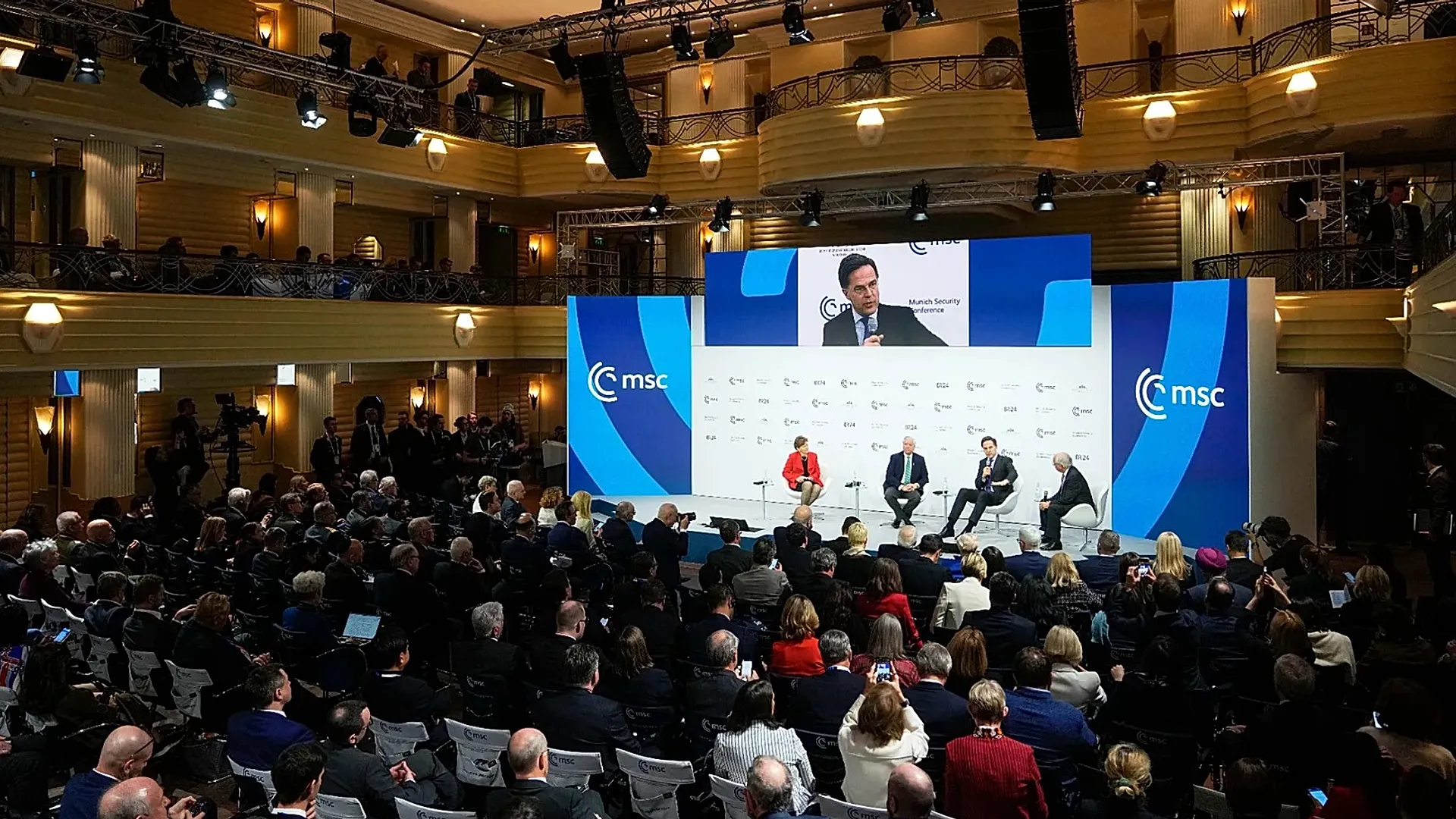
MUNICH (Realist English). World leaders gathering this week at the Munich Security Conference are being met with a stark warning: the international order is under growing strain, alliances are becoming more fragile, and geopolitical tensions are accelerating.
The conference, taking place from 13 to 15 February, is expected to bring together around 65 heads of state and government, along with some 450 representatives from politics, academia and the defence industry. In the foreword to the newly released 2026 Munich Security Report, MSC chair Wolfgang Ischinger writes that “rarely in the conference’s recent history have there been so many fundamental questions on the table at the same time”.
The report argues that the world has entered what it describes as an era of “wrecking-ball politics”, marked by far-reaching political, economic and security upheaval. It warns that incremental reforms are increasingly being replaced by radical approaches that openly challenge — or seek to dismantle — existing systems.
A central focus of the report is the United States, which it portrays as both a historic architect of the post-war international order and, increasingly, a driver of its transformation. More than eight decades after that order was established, the report says, it is now “under destruction”, as Washington reassesses its approach to international institutions, rules-based trade and long-standing alliances.
Europe is depicted as particularly exposed to this shift. Long reliant on US security guarantees, European states now experience the transatlantic relationship as unstable, oscillating between “reassurance, conditionality and coercion”. The report argues that while American engagement remains vital, it can no longer be taken for granted.
US Secretary of State Marco Rubio is expected to attend the conference, while the participation of Vice President J.D. Vance was initially announced before being cancelled. Vance’s speech at last year’s conference, widely described as a “reckoning with Europe”, drew sharp criticism from several European leaders.
Germany’s delegation will be led by Chancellor Friedrich Merz, with NATO Secretary General Mark Rutte and European Central Bank President Christine Lagarde also expected to attend. US officials have rejected the report’s suggestion that Washington is undermining alliances, insisting instead that the US is seeking to strengthen NATO while pressing European allies to raise defence spending.
Beyond geopolitics, the report highlights a growing erosion of trust in political systems, particularly in Western democracies. It argues that many voters increasingly see political leaders as defenders of an unresponsive status quo, fuelling support for more radical, confrontational movements. This dynamic, the report suggests, is reshaping domestic politics across Europe and beyond.
The analysis also covers Russia’s war on Ukraine, hybrid threats to Europe, and rising uncertainty in the Indo-Pacific, where doubts are growing about long-term US commitments amid China’s expanding influence. At the same time, the report notes that the current disruption may open space for overdue changes, including higher European defence spending and new partnerships in trade, security and technology.
Whether these shifts will ultimately produce a more stable international system remains unclear. As leaders convene in Munich, the report concludes, many fear that a looser global order could end up favouring the largest and most powerful states — leaving smaller countries more exposed in an increasingly contested world.