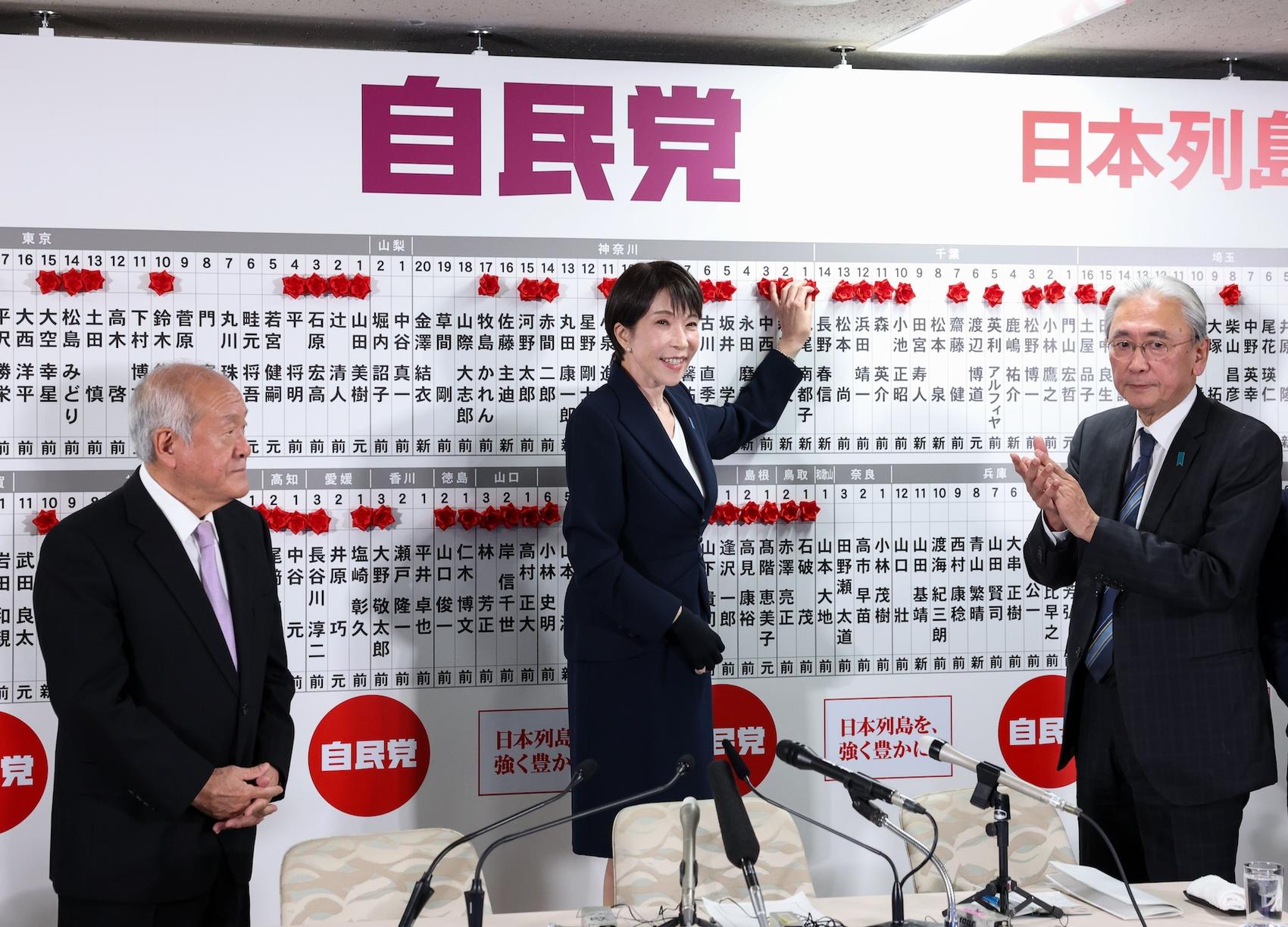
TOKYO (Realist English). Japan’s ruling Liberal Democratic Party (LDP), led by Prime Minister Sanae Takaichi, has secured a two-thirds supermajority in the powerful lower house of parliament, according to preliminary results reported by Japanese media, delivering a decisive electoral mandate just months after she took office.
Public broadcaster NHK said the LDP alone won 316 seats in the 465-member House of Representatives, well above the 261 seats required for an outright majority and marking the party’s strongest showing since its founding in 1955. Together with its new coalition partner, the Japan Innovation Party (JIP), the ruling bloc captured 352 seats. Voter turnout was estimated at 56.23%, according to Kyodo News.
Speaking in a televised interview after the results became clear, Takaichi said the outcome gave her government the authority to push ahead with policies aimed at making Japan “strong and prosperous”. Images broadcast from LDP headquarters showed the prime minister placing red victory ribbons next to winning candidates’ names as party officials applauded.
The result surpasses the previous LDP record of 300 seats set under former prime minister Yasuhiro Nakasone in 1986 and significantly strengthens Takaichi’s hand, even though the ruling camp does not command a majority in the upper house.
Takaichi, Japan’s first female prime minister and an outspoken conservative, called the snap election after just three months in office, seeking to capitalise on high approval ratings and overcome damage to the LDP’s image from recent funding and religious scandals. Her strategy appears to have paid off, with the fragmented opposition failing to mount a serious challenge despite the formation of new centrist alliances.
The main opposition bloc — an alliance between the Constitutional Democratic Party of Japan and the Buddhist-backed Komeito — is projected to win roughly half of its combined pre-election seat total, underscoring the depth of the ruling party’s victory. At the same time, smaller nationalist forces such as Sanseito are expected to make gains, reflecting a broader shift in parts of the electorate.
Takaichi’s landslide win opens the way for an ambitious right-leaning agenda focused on economic stimulus, defence expansion and stricter policies on immigration and national security. She has pledged to revise Japan’s security and defence posture by the end of the year, including lifting restrictions on arms exports and increasing defence spending, partly in response to pressure from US President Donald Trump.
Her first major task when parliament reconvenes in mid-February will be to pass a delayed budget to address rising living costs and stagnant wages. While Takaichi has said she will seek opposition support where possible, analysts say the scale of her victory gives her ample room to pursue contentious reforms without facing another election until 2028.
Observers note, however, that her push to the right — particularly on security, civil liberties and relations with China — could deepen political divisions at home and raise concerns among neighbours, even as Japan maintains close ties with the United States and cooperation with South Korea on regional security.
The election outcome cements Takaichi’s position as the dominant figure in Japanese politics and signals a period of policy assertiveness backed by one of the strongest parliamentary majorities in the country’s postwar history.