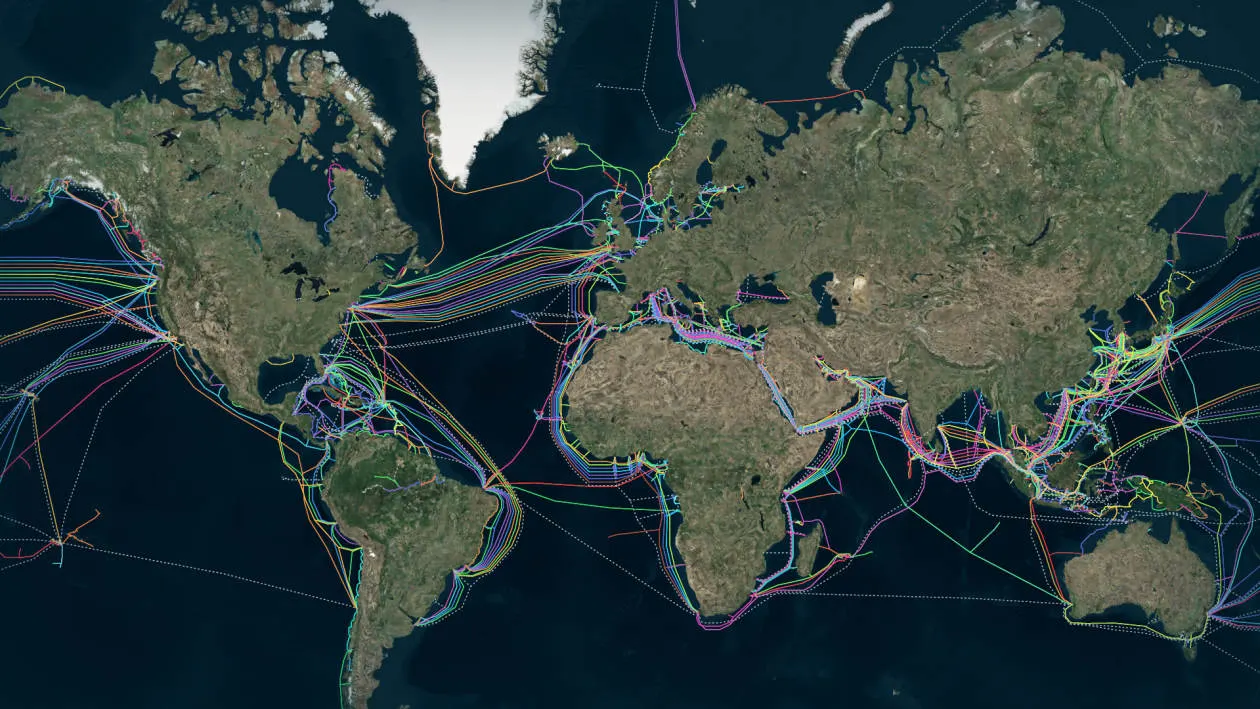
WASHINGTON (Realist English). Over 95% of the world’s internet and voice traffic — from bank transfers and government communications to video calls and streaming — travels through nearly one million miles of submarine fiber-optic cables lying on the ocean floor.
The first commercial undersea cable was laid in 1850 between Dover, England, and Calais, France. Today, these cables form the invisible backbone of global connectivity — but they are now at the heart of a technological and geopolitical struggle.
Big Tech’s deep-sea race
Tech giants such as Meta, Google, Amazon, and Microsoft now control nearly half of all subsea infrastructure, according to Alcatel Submarine Networks, the world’s largest cable manufacturer.
Driven by the explosive growth of artificial intelligence and cloud computing, global investment in new cable projects is expected to reach $13 billion between 2025 and 2027, nearly double the previous three-year period, according to TeleGeography.
Meta’s Project Waterworth, a 50,000-kilometer network connecting five continents, will become the longest subsea cable system ever built. Amazon’s Fastnet project will link Maryland to Ireland, transmitting 320 terabits per second — the equivalent of streaming more than 12 million HD movies simultaneously.
“AI isn’t just about data centers — it’s about the connectivity between them,” said Alex Aime, Meta’s vice president of network investments. “Without subsea cables, all you have are very expensive warehouses.”
Fragile global arteries
Despite their importance, undersea cables remain vulnerable to both accidents and sabotage. Fishing activity, anchor strikes, and natural disasters account for most disruptions — but recent incidents in the Baltic Sea and near Taiwan have raised suspicions of deliberate attacks.
In 2022, an underwater volcanic eruption severed Tonga’s only cable, isolating the Pacific nation from the world. In 2025, Red Sea cable cuts disrupted Microsoft Azure services across Asia and the Middle East, causing widespread latency issues.
“If a cable is cut, entire countries can lose internet, banking, and communications,” warned Erin Murphy of the Center for Strategic and International Studies.
Security and geopolitics
In response to growing threats, NATO launched Operation Baltic Sentry in early 2025, deploying drones, aircraft, and naval patrols to protect critical underwater infrastructure. The U.S. Federal Communications Commission (FCC) also tightened rules on foreign participation in subsea projects, citing risks from China and Russia.
“We are making it nearly impossible to connect U.S. subsea infrastructure directly to adversary nations,” said Brendan Carr, FCC chair. “And we’re banning Huawei and ZTE hardware from these systems.”
Meta and Amazon have confirmed compliance with U.S. regulations and denied working with Chinese suppliers.
The unseen battlefield
As AI networks expand and global connectivity deepens, the seabed has emerged as an unseen frontier of great-power competition.
“These cables are the real infrastructure of globalization,” said Matthew Mooney of Recorded Future. “They connect the world — and now, they’ve become part of the next geopolitical battlefield.”