

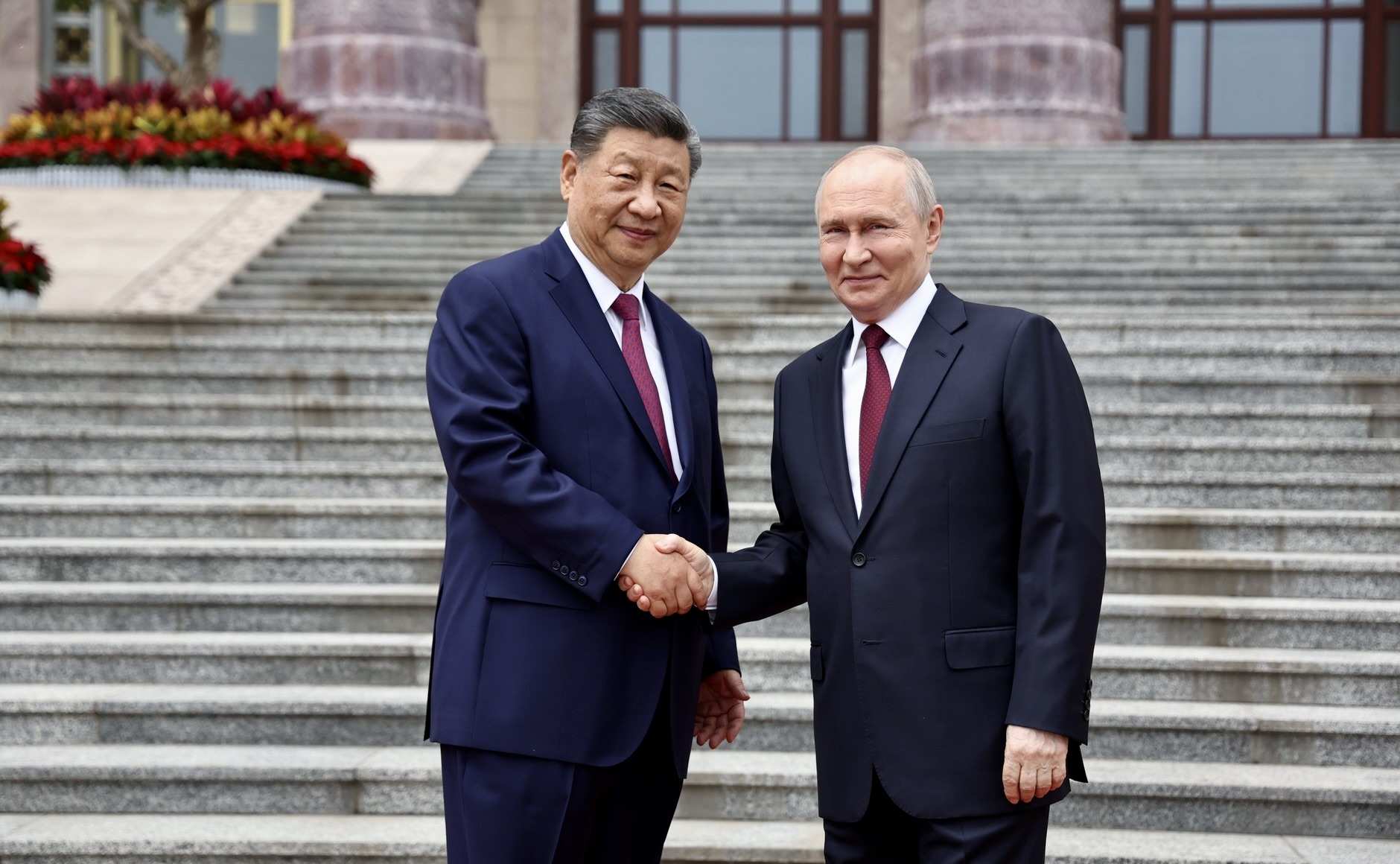
BEIJING (Realist English). Russian President Vladimir Putin’s visit to China on 19–20 May has become one of Moscow’s most significant foreign policy events of the month. The trip marks the 25th anniversary of the signing of the Russian-Chinese Treaty of Good-Neighbourliness, Friendship and Cooperation and is taking place amid the continuing conflict surrounding Ukraine, Western sanctions pressure and the ongoing restructuring of the global trade and security system.
Several major issues are at the centre of negotiations between Putin and Chinese President Xi Jinping:
— further deepening of the strategic partnership;
— international security;
— trade and economic cooperation;
— energy;
— settlements in national currencies;
— transport corridors;
— coordination on international platforms;
— the situation surrounding Ukraine and other international crises.
The Kremlin has also stated that the leaders will sign joint documents and discuss “key international and regional issues”.
The Putin–Xi meeting is being viewed as one of the most important diplomatic events of May. Putin stated that relations between Moscow and Beijing had reached an “unprecedented level” and invited Xi Jinping to visit Russia next year.
The economics of the relationship: key figures
As of 2026, China remains Russia’s largest trading partner.
Key indicators include:
— China’s share of Russia’s foreign trade has exceeded 25%;
— China has significantly increased purchases of Russian energy resources since 2022;
— settlements in roubles and yuan have become the foundation of bilateral trade;
— Russian companies are increasingly redirecting exports toward Asian markets.
China has now remained Russia’s largest trading partner for 16 consecutive years.
Total trade turnover between Russia and China in 2025 reached approximately $228.1 billion. Although this was below the record level of 2024 ($244–245 billion), it remained well above the strategic target of $200 billion previously set by Moscow and Beijing.
In the first quarter of 2026, trade returned to growth, with turnover exceeding $61 billion, roughly 14.7–14.8% higher than during the same period a year earlier.
Almost all bilateral trade is now conducted in roubles and yuan, representing one of the most significant shifts in recent years.
Russia exports:
— oil;
— natural gas;
— coal;
— metals;
— timber;
— agricultural products.
China exports:
— automobiles;
— industrial equipment;
— electronics;
— machine tools;
— consumer goods;
— industrial components.
Energy remains the leading area of cooperation. Gas deliveries through the Power of Siberia project reached 38.8 billion cubic metres in 2025, while discussions continue regarding an increase to 44 billion cubic metres.
Russia also became China’s third-largest supplier of liquefied natural gas (LNG), with exports reaching nearly 9.8 million tonnes in 2025.
China remains the largest buyer of Russian oil, accounting for approximately 20% of Russia’s total oil exports.
Against the backdrop of Putin’s current visit, the main economic issue is seen not as maintaining existing trade levels, but rather the possible launch of the Power of Siberia 2 project, with a planned capacity of 50 billion cubic metres per year, which could significantly reshape the structure of Russia-China trade.
Asian business circles are showing particular interest in several practical issues:
— the Power of Siberia 2 pipeline with capacity of up to 50 billion cubic metres annually;
— expansion of settlements in national currencies;
— energy cooperation;
— transport corridors and logistics.
Chinese analysts stress that Beijing does not see relations with Moscow as an alternative to ties with the United States. One expert from the Beijing-based Center for China and Globalization stated: “Trump’s visit was aimed at stabilising one of the most important bilateral relationships, while Putin’s visit is focused on strengthening a long-term strategic partnership.”