

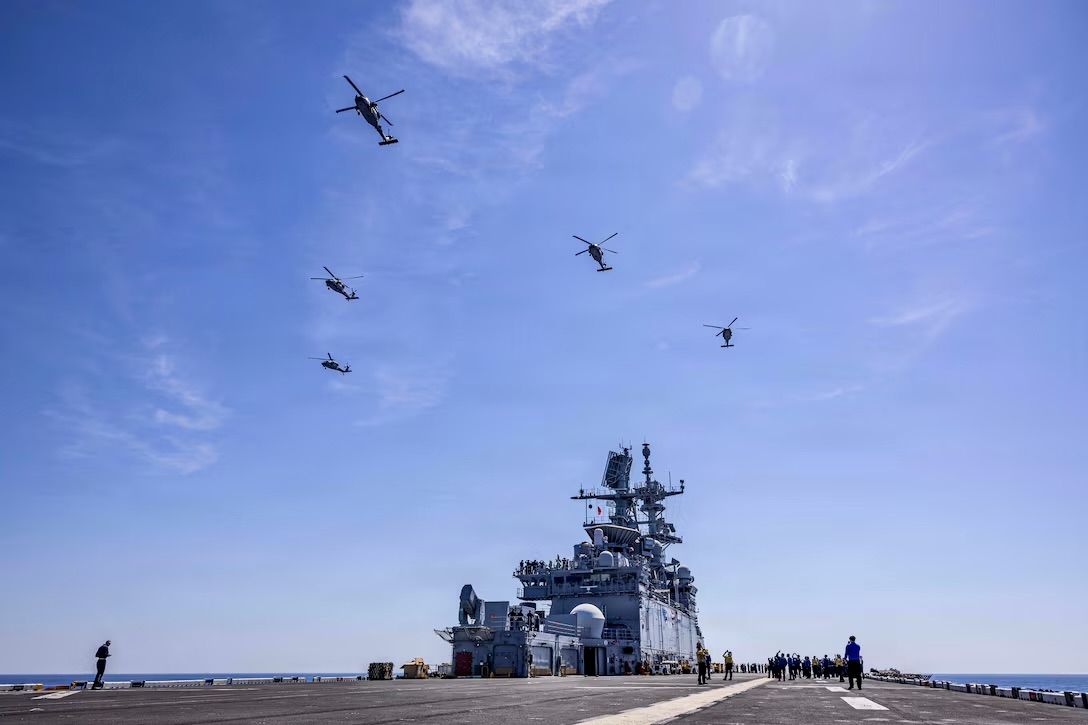
TEHRAN (Realist English). In the night of June 10, the United States and Iran exchanged fresh strikes, jeopardizing the fragile ceasefire. The escalation was triggered by the downing of a US AH-64 Apache combat helicopter over the Strait of Hormuz, which Washington blamed on Tehran. The incident occurred as both sides were preparing to sign a peace agreement and could become a serious obstacle to a diplomatic settlement.
Incident in the Strait of Hormuz
Helicopter crash. On June 8, 2026, according to US Central Command (CENTCOM), an AH-64 Apache crashed off the coast of Oman while patrolling the Strait of Hormuz. Two crew members were rescued about two hours later by a US Navy unmanned surface vessel (USV) from Task Force 59, based in Bahrain.
US accusations. On June 9, President Donald Trump wrote on his Truth Social account: “Our great military just informed me that last night the Iranians shot down one of our state‑of‑the‑art Apache helicopters while patrolling over the Strait of Hormuz. Both pilots are alive and well. Nevertheless, the United States must respond to this attack.”
Uncertainty over evidence. According to CNN, a US official confirmed that the helicopter was shot down by an Iranian Shahed attack drone. Another source said the rotorcraft collided with an Iranian drone, but it is unclear whether the collision was intentional. CENTCOM said the investigation into the cause of the incident is ongoing.
Iran’s reaction. Iran has neither confirmed nor denied its involvement. Foreign Minister Abbas Araghchi wrote on social media that forces operating near Iran are under “constant risk due to their own human errors, accidental incidents, or possible crossfire.” “To reduce the risk, the best solution is for them to leave,” he added, stressing that Iran prefers the “language of diplomacy” but is also fluent in “other languages.” Iranian Parliament Speaker Mohammad Baqer Ghalibaf also warned: “Violate your commitments, and we will switch to what we do best.”
Exchange of Strikes: “Powerful Response” and Iranian Counterattack
US strikes. In an ABC News interview on June 10, Trump confirmed that US forces “are responding right now,” calling the response “very strong, very powerful.” According to Iranian media, explosions were heard in the port city of Bandar Abbas, on Qeshm and Sirik islands, where Iranian air defense batteries and radars were targeted. The Tasnim agency reported explosions in Sirik and Minab, although authorities in the latter later denied the attack, saying the sounds came from the coastal strip.
Iranian response. After the wave of US strikes, the Islamic Revolutionary Guard Corps (IRGC) announced the launch of missiles and drones at American targets in the region. According to Iranian state media, US bases in Kuwait and Bahrain, as well as the Muwaffaq Salti Air Base in Jordan (where US F‑35 fighters are deployed), were attacked. Air raid sirens sounded in Kuwait and Bahrain, and air defense systems reported intercepting targets.
Peace Process on the Brink
The escalation came at a critical moment when the sides were close to signing a peace agreement. On June 9, Trump told The Wall Street Journal that the helicopter downing was a “small incident,” and earlier a senior administration official told NBC News that a US‑Iran deal could be reached within days. However, after the exchange of strikes, even the White House could not give a precise forecast. In the same interview, Trump insisted on a tough course: “I believe in a decisive response. I always have throughout my life. And we had a very good deal, and we probably will.”
Regional Context
The new round of US‑Iran escalation came just two days after Tehran and Tel Aviv exchanged their first direct strikes since the April ceasefire on June 7‑8. Israel struck the southern suburbs of Beirut, and Iran responded with ballistic missiles against northern Israel. The situation in Lebanon also remains extremely tense: on June 9, Israeli aircraft struck the port city of Tyre, where, according to the Lebanese Health Ministry, 11 people were killed. The US administration continues to pressure Israeli Prime Minister Benjamin Netanyahu to stop the escalation that could derail talks with Iran.
This round of confrontation confirmed the extreme fragility of the US‑Iran ceasefire established on April 8. Missile strikes and air raid sirens in the Gulf states showed that the conflict could spread beyond Iran and the United States, affecting the territory of American allies. Although Trump publicly reaffirmed his intention to reach a deal, military escalation has created additional obstacles to diplomacy.
The Apache incident also highlighted a new threat: Iranian drones can effectively strike high‑tech US aircraft, calling into question the safety of the US Air Force in the region. Mutual demands (unfreezing Iranian assets and withdrawing US troops from Lebanon) remain unmet, and each new attack increases the risk of a complete collapse of the peace process.