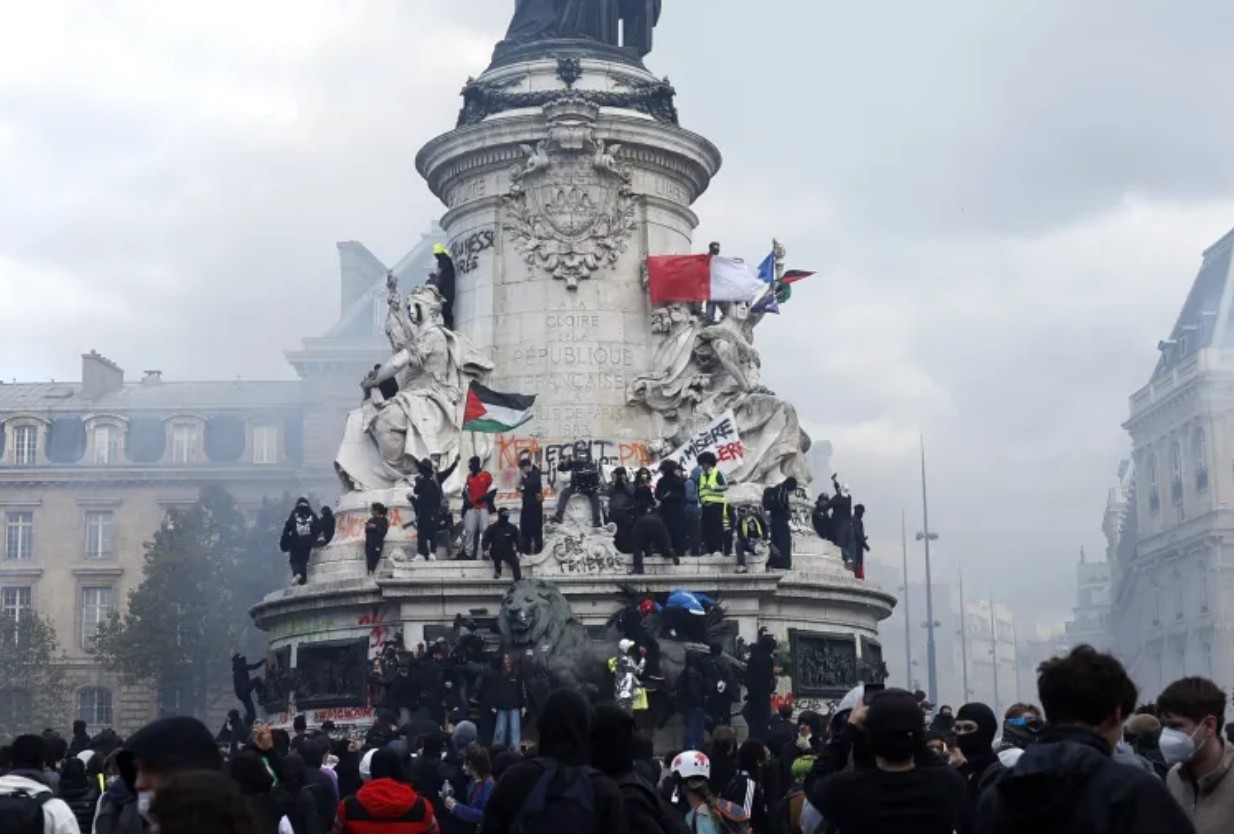
PARIS (Realist English). France is counting the consequences of Saturday’s unrest, which descended into some of the most serious in recent years, while simultaneously facing a new wave of protests. On October 19, access to the Louvre — the world’s most visited museum — was blocked by a group of demonstrators, and President Emmanuel Macron refused to accept the resignation of Interior Minister Laurent Nunez.
The minister’s admission
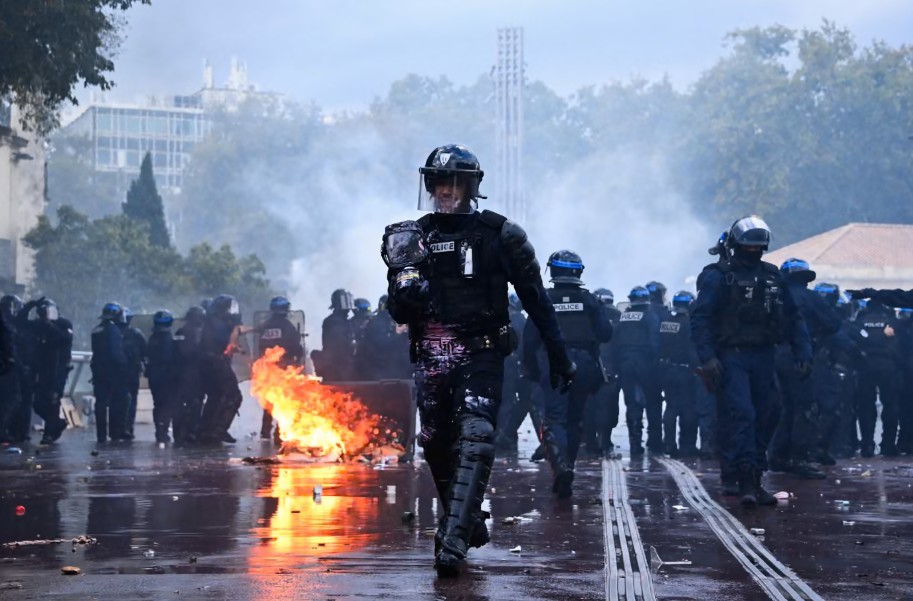
Speaking on France Inter radio, Nunez admitted that police “lost control” in some major cities during the October 17 protests. “Yes, in some major cities we lost control,” the minister said. He also pointed to a “lack of foresight” in deploying forces: according to him, on October 17 about 60,000 police officers and gendarmes were mobilized across the country, while about 550,000 people took to the streets — nearly three times more than expected.
“I submitted my resignation because I am responsible for everything that happens,” Nunez said.
Macron’s decision
The Élysée Palace said Macron rejected the resignation “due to the need for continuous command of law enforcement forces in the current context.” The president also instructed Nunez to “take all necessary measures to ensure transparency regarding the failures in planning and intelligence” and to “implement new operational methods as soon as possible” to combat rioters.
Macron, according to his office, acknowledged “shortcomings in foresight and intelligence” in the authorities’ actions ahead of the unrest.
Aftermath of the unrest
According to the French Interior Ministry, about 2,400 people were detained during the October 17 unrest. Nearly 1,000 police officers and gendarmes were injured, seven seriously. In Paris, more than 350 additional people were detained on October 18 and the night of October 19, and five stores were looted.
Damage from the pogroms and looting is estimated at “hundreds of millions of euros,” according to the Chamber of Commerce. About 2,000 stores and businesses were affected. In Limoges, the historic city hall built in 1883 burned down; in Lyon, a tourism office; in Marseille, demonstrators briefly stormed the city hall. In Saint-Étienne, a 17-year-old lost a hand in a police grenade explosion.
Blockade of the Louvre
On October 19, the entrance to the Louvre was blocked by demonstrators. According to AFP, museum management and unions confirmed the blockade. Students from art and cultural schools gathered in front of the glass pyramid, handing out leaflets in French and English.
“Tourists who are waiting are aggressive toward us because they paid for tickets,” Le Figaro quoted one participant as saying.
As early as October 17, the Louvre was forced to restrict visitor access: entry was possible only through the Carrousel Gallery and the Napoleon Courtyard with a ticket. On October 19, access was completely blocked.
Macron’s refusal to accept the minister’s resignation is not a show of confidence but a calculation. Ahead of the presidential elections, in which Macron cannot run, replacing the interior minister at the height of the crisis would have been perceived as admitting a complete loss of control. Nunez remains a “lightning rod”: he has already publicly admitted failure, and now it is he who is tasked with fixing the situation.
However, the admission of “loss of control” itself undermines the authorities’ key argument — that the violence was organized by marginal groups rather than being the result of systemic errors. If the police failed in their task, the question shifts from “who is to blame for the pogroms” to “why the state could not prevent them.”
The blockade of the Louvre adds symbolism to this: protesters chose as their target not only government buildings but also the country’s main tourist attraction, which receives state subsidies and revenue from foreign visitors. For Macron, whose term expires in 2027, this means that the protests are becoming not an episode but the final point in the assessment of his presidency.