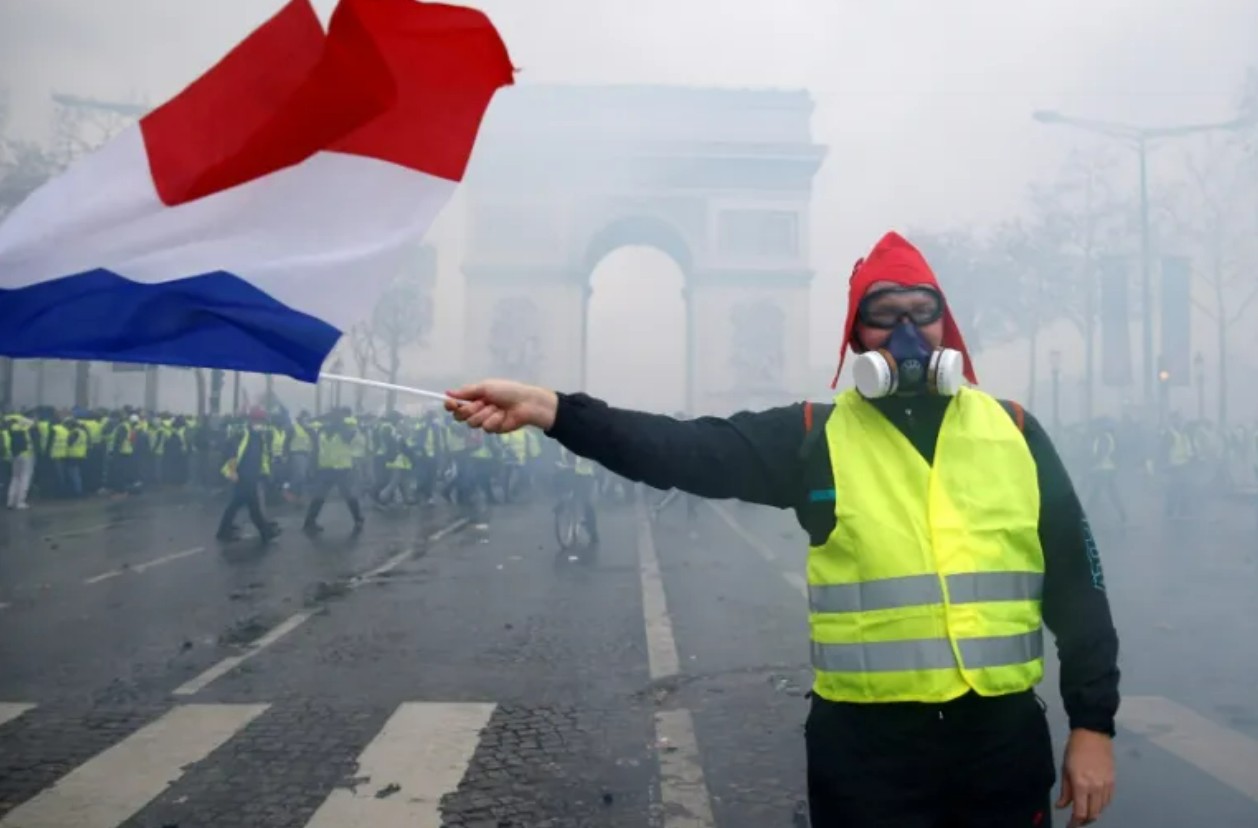
PARIS (Realist English). France is bracing for a nationwide day of protests that could become a turning point for President Emmanuel Macron’s government. More than 600 demonstrations and hundreds of blockades are planned across the country on October 17. The movement of schoolchildren and students, which began almost a month ago, is being joined by the “Yellow Vests,” farmers, firefighters, taxi drivers, and healthcare workers.
Merger of two protest waves
The high school students’ movement, demanding better conditions in schools — solving the teacher shortage, overcrowded classrooms, and the abolition of the Parcoursup platform — began in late September. On October 13, according to the Interior Ministry, 161,500 people took part in the “Act V” action, while unions claimed 480,000 participants. In Paris, police counted 41,500 people in two columns.
Now they are being joined by the “Yellow Vests” — a movement that paralyzed the country eight years ago with protests against rising fuel prices. Historic figures of the movement, including Jérôme Rodrigues, called for “solidarity with the lycéens.” “We are tomorrow’s workers. Tomorrow’s ‘Yellow Vests’ could well be us,” Franceinfo quoted one participant as saying.
Demands and participants
Protesters are speaking out against the rising cost of living, high inflation (above 3% due to the Middle East conflict), and cuts to public services. The CGT, Solidaires, Confédération paysanne, and climate activists have called for the actions. France’s Interior Ministry said it expects “rather significant mobilization” — according to police estimates, up to 200,000 people nationwide, including 40,000 in Paris.
Government response
Prime Minister Sébastien Lecornu ordered the creation of an interdepartmental crisis unit to monitor protests in real time. President Macron called for “calm and respect,” emphasizing that the right to protest is inseparable from respect for people and property.
Paris police banned demonstrations in the city center, including the Champs-Élysées and the area around the Élysée Palace. The main column in Paris is to start from Place de la République and head north. Interior Minister Laurent Nuñez said police may use stun grenades in the event of “extremely serious urban violence,” despite their use having been previously suspended after a schoolboy lost a hand.
On the eve of elections
The protests are unfolding six months before the presidential elections, in which Macron will not be able to run. Left-wing candidate Jean-Luc Mélenchon supports the students and took part in the October 13 march. Marine Le Pen, leading in the polls, has sided with the police, consistent with her “law and order” image.
The Lecornu government is trying to push through parliament a budget with €43 billion in spending cuts to keep the deficit at 5% of GDP. However, protesters are demanding the exact opposite — increased spending to protect against inflation and public services.
What this means
The merger of the student movement with the “Yellow Vests” is the worst-case scenario for the government. In 2018–2019, the “Yellow Vests” blocked roads every Saturday and brought tens of thousands onto the streets, forcing Macron to make concessions. Now the situation is more complex: students demand spending, the government must save, and six months remain until the elections. If the October 17 actions gather the stated 200,000 people and are accompanied by violence, the Lecornu cabinet will find itself under double pressure — from the streets and from parliament, where the budget has already been rejected in committee. For Macron, this could become the most serious challenge of his presidency.