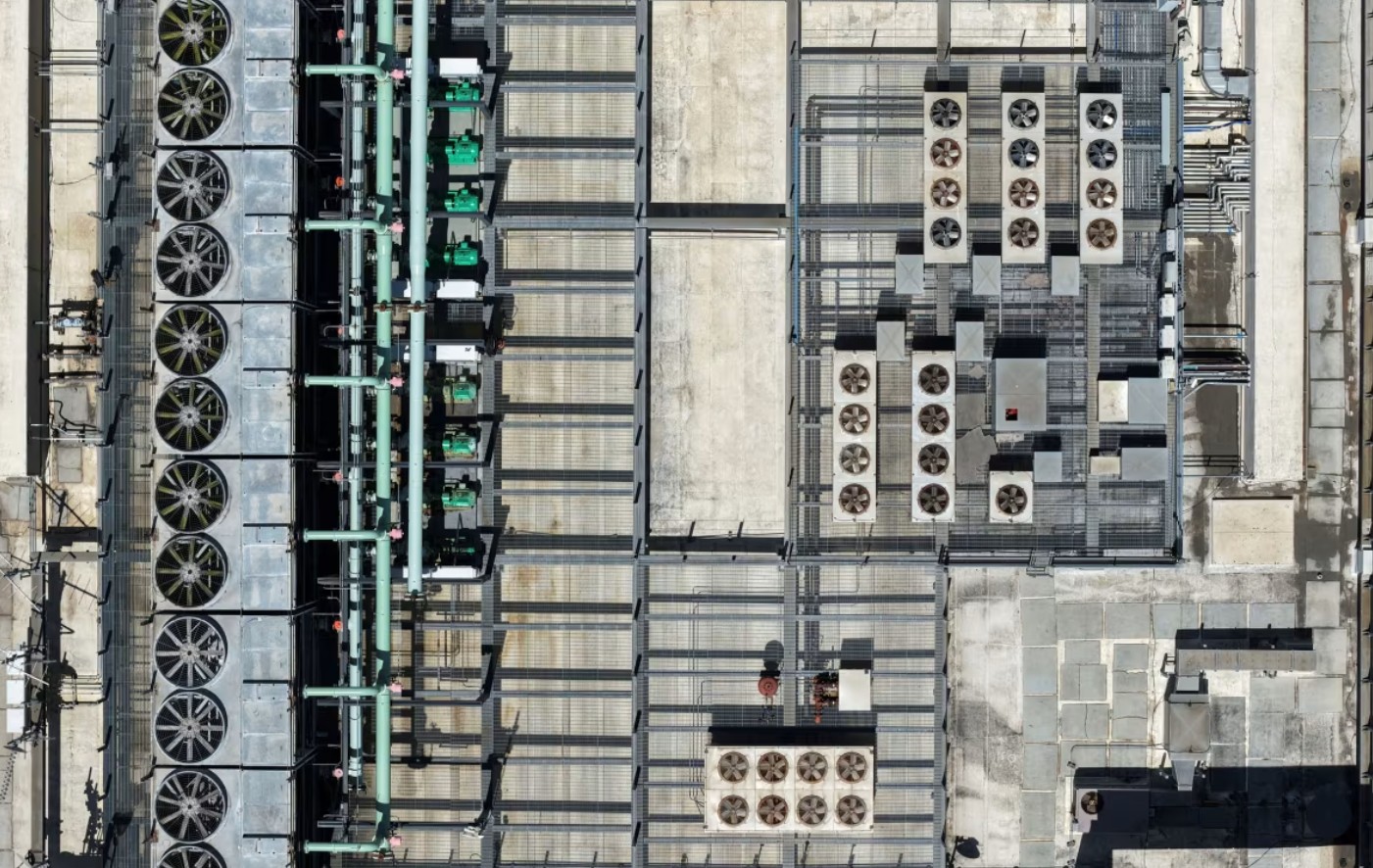
LONDON (Realist English). The question of how much artificial intelligence threatens the environment usually comes down to two numbers: how much electricity data centers consume and how much water they use for cooling. But new research shows the problem is broader and more complex than commonly thought.
Electricity: growth, but not a catastrophe
According to Gartner, global data center electricity consumption will reach 565 TWh in 2026, up 26% year-on-year. The IEA gives a higher forecast — up to 1,000 TWh by 2026. By 2030, according to the United Nations University, data centers will consume 945 TWh per year.
At first glance, these are significant volumes. But in the context of the entire energy system, AI’s share remains modest. According to MIT Sloan, in 2026 the AI sector is responsible for roughly 0.5% of global CO₂ emissions in the energy sector. However, growth rates and concentration in specific regions create local problems: in Ireland in 2023, data centers consumed 21% of all measured electricity in the country — more than all urban households combined.
The main paradox: AI helps extract fossil fuels
The most unexpected finding comes from a study published in Nature Climate Change. Scientists modeled AI’s impact on the energy sector and concluded: AI contributes to increased emissions rather than reducing them. The mechanism is simple: AI optimizes oil and gas exploration and extraction, reducing costs and making fossil fuels economically more attractive.
Quantitative estimate: with parallel deployment of AI in renewable and fossil energy, the net increase in global CO₂ emissions is 0.47–1.8 Gt per year — from 1.2% to 4.8% of all energy emissions in 2024. “Embodied” emissions (0.6–2.4 Gt) exceed “avoided” ones by 3–13 times compared with IEA estimates of data center emissions.
In other words, even if data centers themselves switch to “green” energy, AI will contribute to emissions through accelerated hydrocarbon extraction. Saudi Aramco has already stated that AI allowed it to keep production costs at $3 per barrel.
Water: the hidden cost of electricity
According to Harvard Business School, the 472 largest US data centers consume about 300 billion liters of water per year. Of this, only 74 billion is direct cooling, while 226 billion is water spent on generating electricity for these centers. That is, indirect water consumption is three times higher than direct.
Professor Monjur Murshed of Cardiff University estimates: a typical medium-sized data center uses about 1 million gallons of water per day for cooling alone, and up to 4 million gallons including electricity generation.
Electronic waste: a delayed problem
The Basel Action Network estimates that from 2025 to 2050, AI infrastructure will create between 395 and 617 million tonnes of electronic waste. This is 40–60 times more than previous studies assumed, which focused only on servers and GPUs. The calculation includes power systems, cooling, backup generators, and networking equipment — which make up 87% of a data center’s mass but were previously ignored.
For comparison: today the world generates about 68 million tonnes of electronic waste annually, and less than a quarter is formally recycled. By 2050, with AI, this figure could rise to 211 million tonnes per year. The US, where most data centers are located, has not ratified the Basel Convention regulating transboundary movement of hazardous waste, creating a risk of export to countries with informal recycling.
AI’s environmental footprint is not one problem but several, and they are unequal. Electricity consumption is growing fast but remains manageable globally. Water is consumed unevenly: data centers are often built in arid regions, exacerbating local scarcity. Electronic waste is a delayed bomb: equipment becomes obsolete in 2–5 years, and there is no infrastructure for its safe recycling.
But the main conclusion from the Nature study changes the very framing of the debate. If AI increases emissions by accelerating fossil fuel extraction, then the question “how much energy does AI consume” is secondary.
The primary question is: who benefits from AI and which economic models it reinforces. For now, the answer is: oil and gas companies — in the form of lower costs, and the atmosphere — in the form of additional gigatonnes of CO₂.