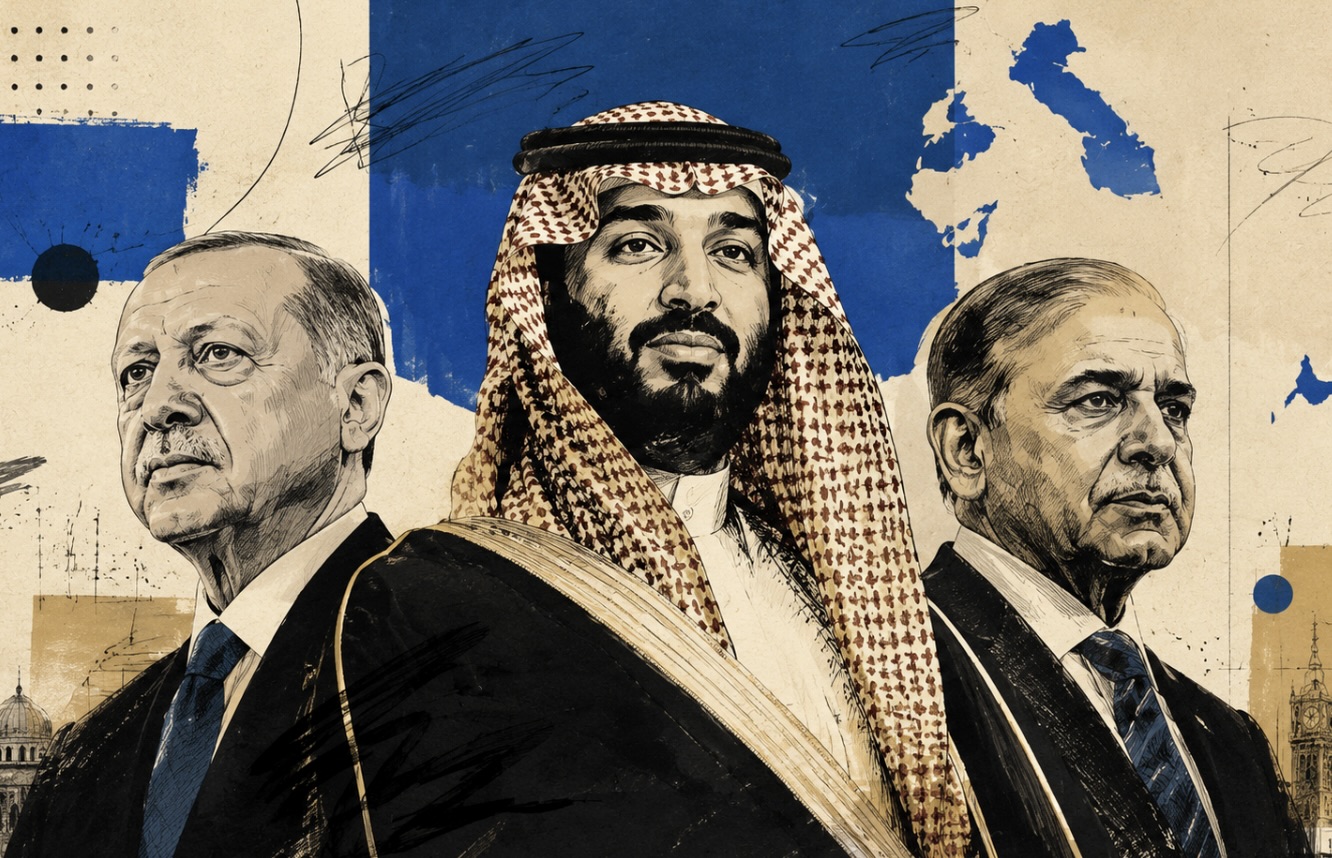
MOSCOW (Realist English). On 7 August 2026, in one of the holiest sites of the Muslim world – Mecca – a “Collective Defence Agreement” was signed between Pakistan, Saudi Arabia and Turkey. In 2025, a similar bilateral document had already been signed between Pakistan and Saudi Arabia.
Officially, the stated goal of the new alliance is “collective deterrence of any forms of aggression,” and an armed attack from outside on any of the three states will be considered an attack on all members of the union. Representatives of the signatory countries emphasise that this pact is not directed against any specific country.
Pakistan’s Foreign Minister Ishaq Dar noted that “this agreement is also open to any country in the region ready to resolve differences peacefully, showing mutual respect.” The document also provides for the development of military and military‑technical cooperation between the three states in all areas.
The situation is analysed for Realist English by Stanislav Ivanov, a leading researcher at IMEMO RAS and a Candidate of Historical Sciences.
As is well known, several regional unions and blocs have already been created in this volatile region of our planet (the League of Arab States, the Gulf Cooperation Council, “QUAD-2” (US, Israel, UAE, India). The so‑called Abraham Accords, signed between Israel and the UAE with Bahrain in 2020, can also be considered a union; they opened the door to expanded cooperation between Israel and Arab and other countries. Soon after, Morocco, Sudan and Kazakhstan joined them.
All members of the Mecca Union are members of the Organisation of Islamic Cooperation (OIC); Pakistan is a member of the Shanghai Cooperation Organisation (SCO), while Saudi Arabia and Turkey have dialogue partner status with the SCO. Earlier attempts by Donald Trump to cobble together an Arab or Muslim version of NATO in the region, as well as to drag Iran’s neighbours (Turkey, the Gulf monarchies) into open confrontation with Tehran, did not succeed.
It appears that under the influence of the protracted armed conflict between the US and Israel, on one side, and Iran on the other, regional powers have decided to create their own system of checks and balances, or a new centre of power in the Middle East. At the same time, there is no talk of breaking or weakening the partnership relations of the Mecca Agreement signatories with Washington. We can only speak of attempts by regional countries to find additional alternative insurance to the “American umbrella” in matters of defence and security.
It should also be borne in mind that, with all the commonality of interests of the signatory countries of this Agreement in Mecca, each of them has nuances in its foreign policy and pursues its own goals in the new alliance. What brings Riyadh, Ankara and Islamabad together is the fact that representatives of the Sunni Muslim majority are in power there, while quite numerous Shia communities also remain in these countries. Undoubtedly, the authorities of all three countries are wary of the renaissance of Shiism in the Muslim world, which emanates from Tehran.
The alleged activation of political activity by Shia communities is said to undermine the stability of the region’s countries. The problem of Shia expansion is particularly acute in Saudi Arabia (Eastern Province), Yemen, Lebanon, Iraq, Syria and Bahrain, where Riyadh had to use military force to suppress a Shia uprising in 2011.
It is also important to bear in mind that, despite the restoration of diplomatic relations between Saudi Arabia and Iran in 2023 through Beijing’s mediation, a number of infrastructure and oil‑and‑gas facilities in Saudi Arabia were hit by Iranian missiles and drones, and there were attacks by Iranian proxy forces on Saudi territory from Yemen. Overall, Saudi Arabia, like all other Arab Gulf states, is suffering large financial losses from Iran’s blockade of the Strait of Hormuz. Naturally, Riyadh views the theocratic Shia regime ruling in Tehran as its potential adversary in the region.
Ankara and Islamabad look at the Iranian regime somewhat differently. There it is regarded merely as a competitor in the region, and they would allow the country to be weakened only to certain limits, while not hiding their concerns about possible tragic events in Iran along the lines of the “Arab Spring.” The alleged fall of the regime of the Iranian ayatollahs could lead to the disintegration of Iran along national lines (Persians, Azerbaijanis, Kurds, Baloch, others), which could be accompanied by a wave of refugees to neighbouring countries, an intensification of the Kurds’ struggle for their rights and a protracted civil war. Therefore, a large‑scale collapse and an atmosphere of chaos in Iran are clearly not in the interests of Turkey and Pakistan. On the whole, no matter how much they deny it in Ankara, Riyadh and Islamabad, an anti‑Iranian factor is present in the creation of the alliance.
The second, no less important factor in the creation of the Mecca Union can be considered the anti‑Israeli factor. Despite the commonality of positions of the three countries towards Israel, there are also small differences here. All signatories of the Mecca Agreement advocate the recognition of the State of Palestine within its designated borders and condemn Israel for its aggressive actions in the Gaza Strip and southern Lebanon. Saudi Arabia and Pakistan do not recognise the State of Israel, and Turkey has also frozen diplomatic and other relations with Israel since November 2024. However, the countries do not go beyond political‑diplomatic steps and hostile rhetoric in the media regarding Israel’s actions in Gaza and Lebanon.
The Turkish leadership, at most, provides its territory for Hamas’s headquarters, gives this group small financial assistance and from time to time organises convoys of ships with humanitarian aid to break Israel’s naval blockade of the Gaza Strip. Israel’s main adversary in the region remains Iran and the so‑called “Axis of Resistance” it has created (Palestinian Hamas and Islamic Jihad – banned in Russia, Lebanese Hezbollah and Yemeni Ansar Allah). These same non‑governmental groups undermine the statehood of Yemen and Lebanon and hinder the work of the Palestinian National Authority (PNA) in Ramallah on the West Bank, which is rejected by the Arab and part of the Muslim world.
Given the openness of the new alliance to admitting new members, observers have already begun discussing the prospects for its expansion. One candidate for joining the union is another regional power – Egypt. It is quite possible that Cairo, as one of the leaders of the Arab world, could join this alliance, especially since recently some hostility in Egyptian‑Turkish relations has been overcome – hostility caused by Erdogan’s previous support for Egypt’s Muslim Brotherhood (banned in Russia). But here it is necessary to take into account the fact that Egypt, unlike the three Mecca signatories, has long‑standing and stable relations with Israel. Therefore, it will be more advantageous for it to continue cooperation with other countries on a bilateral basis than to join any new defensive alliance. Cairo is much closer to the signatories of the Abraham Accords, which, in essence, broke the Arab world’s blockade of Israel and created the preconditions for support of Egypt and Jordan’s foreign policy towards Israel by an increasing number of Muslim states.
One cannot ignore the threat, circulated by some media outlets, of Pakistan using nuclear weapons or transferring Pakistani nuclear technologies to Turkey or Saudi Arabia. It is unlikely that the Pakistani “nuclear umbrella” will be used in any armed conflict in the region. Islamabad is also unlikely to transfer nuclear technologies to its new alliance partners, since the country still remembers the international uproar caused by the illegal trade in nuclear materials and technologies by Pakistani nuclear scientist Khan. Most likely, within the framework of the new defensive alliance, only the already existing bilateral military ties will be developed (weapons supplies, personnel training, joint exercises and manoeuvres, etc.).
It is also unlikely that the armed forces of Turkey and Saudi Arabia could be used in a new Pakistan‑India conflict. After all, Islamabad is in no hurry to intervene in Riyadh’s conflict with Tehran or the Yemeni Houthis, despite the existing bilateral defence pact. On the whole, the Mecca Agreement can be seen as another stage in the gradual transition of the Middle East from a system built around a single external security guarantor in the form of Washington, to a more complex balance of regional centres of power.