NEW YORK (Realist English). July 23 became the day markets had feared since the start of the Middle East escalation. Brent crude exceeded $100 per barrel for the first time since May 26, peaking at $100.71, while US stock indices plunged to multi‑month lows.
Investors, who had until the last moment tried to ignore the approaching threat, were forced to acknowledge: the war in the Middle East is no longer an “ignorable” factor.
Two Blows to the Market: Oil and Tech Giants
Pressure on markets came from two sides. On one hand, oil prices surged 7% in a single day due to Houthi attacks on two Saudi oil tankers in the Red Sea. On the other, disappointing quarterly reports from tech giants Alphabet and Tesla buried hopes for a “tech rally.”
The Dow Jones lost 458 points (0.9%), the S&P 500 fell 1.2%, while the tech‑heavy Nasdaq Composite plunged 2.2%. The Nasdaq briefly touched its lowest level in two months, dropping more than 7% below its June record.
Houthis Open Second Front, Trump Threatens “Massive Attack”
The main trigger for the rout was the escalation in the Red Sea. Iran‑backed Yemeni Houthis claimed attacks on two Saudi oil tankers in the Bab el‑Mandeb Strait. This opened a second critical chokepoint for global oil supplies, alongside the virtually paralysed Strait of Hormuz.
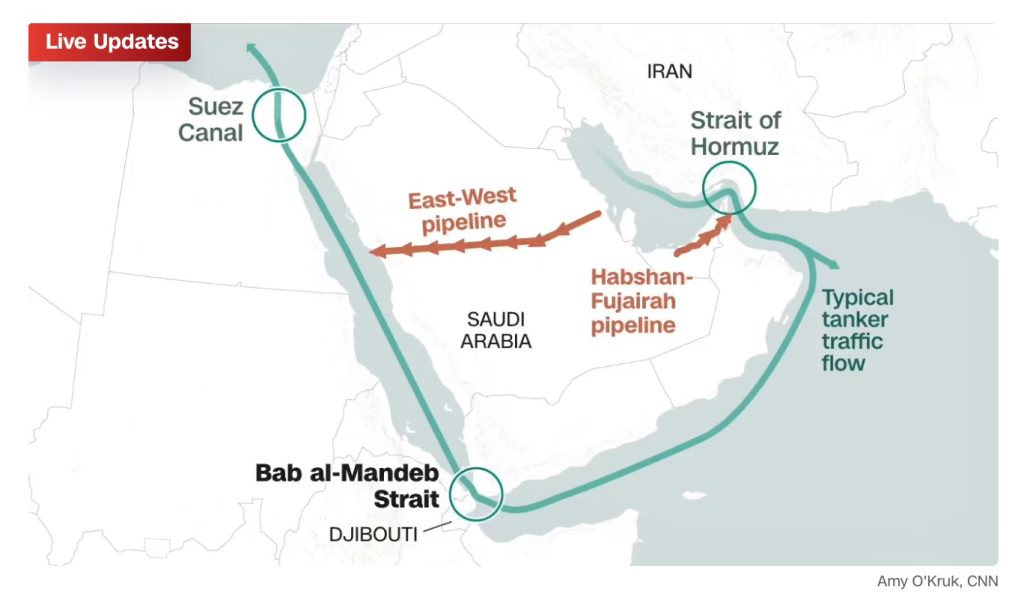
US President Donald Trump immediately responded with threats. He vowed to bomb Iranian bridges and power plants if Tehran continued its attacks on vessels, and later announced plans for a “massive attack” on Iran, “bigger than ever before.” The US, meanwhile, carried out a 12th consecutive night of airstrikes on Iranian targets.
Alphabet and Tesla: Investor Disappointment
The second pressure factor came from tech giants’ earnings. Alphabet shares plunged 7% after the company raised its 2026 capital expenditure forecast to $205 billion, channelling funds into AI development. Investors were alarmed not so much by the spending itself as by the company’s first‑ever negative cash flow.
Tesla fared even worse — shares tumbled 13–14%. The company missed profit expectations, and its free cash flow turned negative for the first time in two years. Investors are increasingly asking whether multibillion‑dollar AI investments will pay off.
Bond Market and Fed Expectations: Double Whammy
Rising oil prices immediately impacted the bond market. The yield on 10‑year Treasury notes exceeded 4.7% — the highest since January 2025. The 30‑year yield firmly settled above 5%.
Markets now price in an 82% probability of a Federal Reserve rate hike at the September meeting — nearly double the odds from a week ago. The probability of a July hike has risen from 10% to 35–36%.
Forecasts: Oil Could Reach $120
Goldman Sachs warns that Brent could exceed $120 per barrel in the fourth quarter of 2026 and average $100 in 2027 if the Strait of Hormuz remains closed. Analysts note that oil has already risen nearly 40% in a month and has been in technically overbought territory for nine consecutive days — the first such streak since September 2023.
As Steve Sosnick, chief strategist at Interactive Brokers, put it: “It’s too hard to ignore $100 oil. Too hard to ignore 10‑year yields above 4.70%. Too hard to ignore 30‑year yields above 5%.”
The market, which for months tried to ignore the approaching storm, has finally faced reality. The question now is not whether markets will fall, but how deep the decline will be and how many more nights the war — which has already closed two of the world’s three key oil routes — will last.