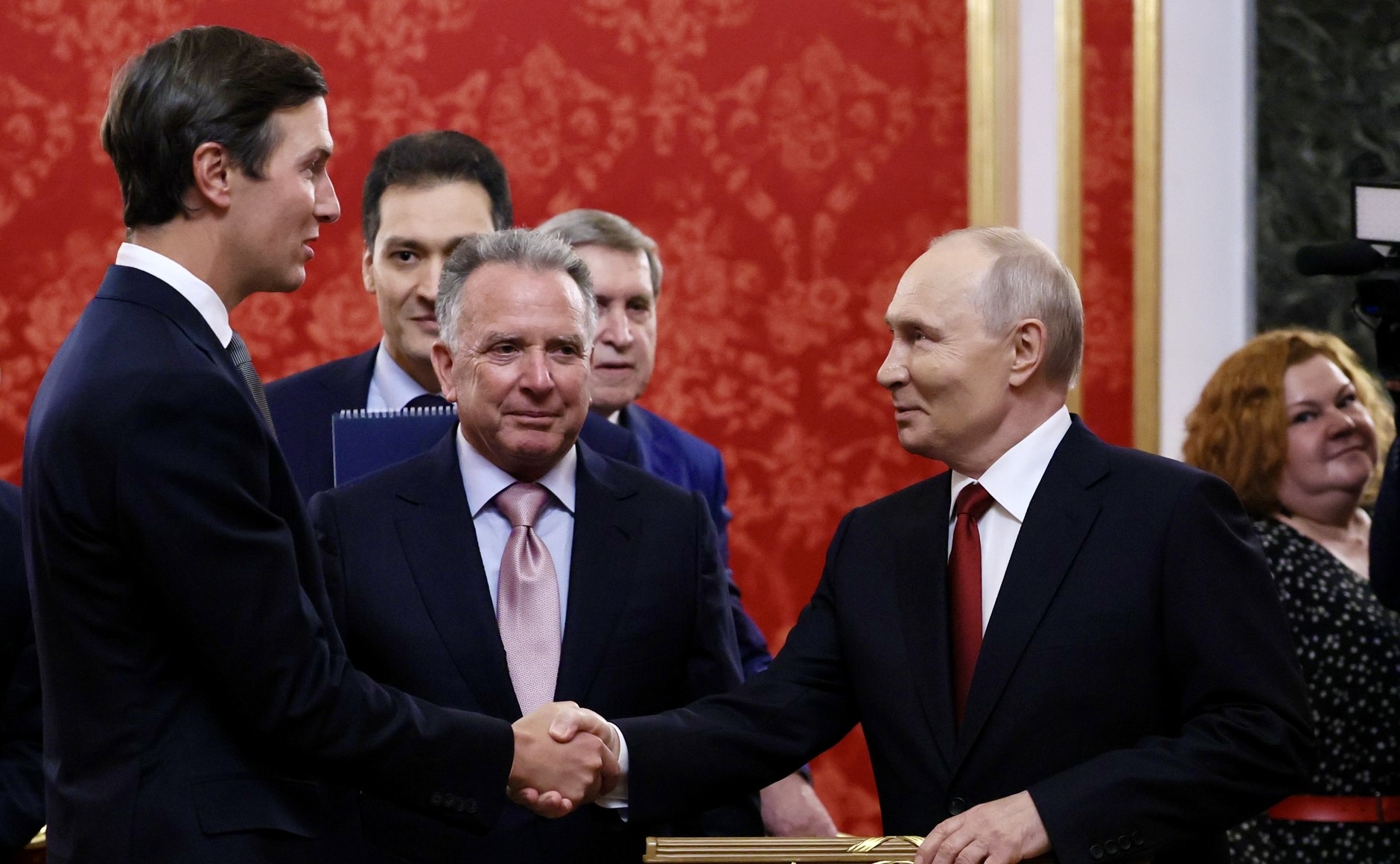
MOSCOW (Realist English). On September 5, the Kremlin hosted a meeting between Russian President Vladimir Putin and US Special Envoy Steve Witkoff and Jared Kushner — Donald Trump’s son‑in‑law, who has repeatedly served as an informal negotiator on the Ukraine file.
The Russian side included Presidential Aide Yuri Ushakov and the President’s Special Representative for Economic Cooperation with Foreign Countries, Kirill Dmitriev.
The visit marked the sixth meeting between Putin and American envoys since the start of the negotiation process. Previous talks, according to the Kremlin, lasted up to five hours.
This time, the American delegation arrived in Moscow with a specific proposal — Trump had said the day before that his envoys were “bringing a proposal to end the war.”
A “Difficult Situation” and a High Degree of Trust
Opening the meeting, Putin described the upcoming dialogue as a discussion of a “difficult situation,” but stressed that “contacts of this kind always work to the benefit of both sides.”
The Russian leader noted that Donald Trump is “entering a difficult situation, yet he is not stopping in his efforts to find a settlement.”
Putin also spoke of a high level of trust in the American negotiators: “I want to tell you that we are comfortable working with you, and the level of trust on our side in this work is quite high.”
Putin asked Witkoff and Kushner to convey “his best wishes and words of gratitude” to the US president. In response, Witkoff conveyed Trump’s greetings and thanked Putin for the ceasefire decision, which allowed the delegation “to fly here safely.”
A Three‑Day Truce for Kyiv — But Not the Entire Frontline
The key practical outcome of the visit was the confirmation of a three‑day halt to strikes on Kyiv. Putin stated that Russia had received a request to suspend strikes through official channels and had not carried them out since midnight on September 5. The Ukrainian side, in turn, had “significantly reduced, by an order of magnitude,” strikes on Russian territory, including Moscow.
At the same time, Putin stressed that this does not amount to a broader ceasefire: “The Ukrainian authorities published their own call for a broader three‑day ceasefire, but we never coordinated that with them.”
Ukrainian President Volodymyr Zelenskyy, for his part, confirmed Ukraine’s readiness to refrain from strikes on Moscow until the end of Monday.
Putin also promised to do everything possible to ensure the safety of the negotiation process and the American mediators.
The Kyiv Stage — and the Prospects
Following the Moscow meeting, Witkoff and Kushner headed to Kyiv — their first visit to the Ukrainian capital since the start of the negotiation process. On Sunday, September 6, they are scheduled to hold talks with President Zelenskyy.
Zelenskyy had earlier confirmed that he was expecting the American negotiators in Kyiv and expressed readiness for a “substantive conversation.”
The White House maintains cautious optimism. Trump called Witkoff and Kushner “great negotiators” and suggested that “there is a good chance we will get this done.” In the Kremlin, sources indicate a more cautious tone.
An Offer Without Guarantees
The visit of US envoys to Moscow and Kyiv is the first serious attempt to restart the negotiation process after several months of diplomatic stalemate. The three‑day truce for the capitals was a minimal but real step toward creating conditions for dialogue.
Yet fundamental disagreements between the sides persist. Moscow did not agree to a broader ceasefire, and Kyiv insists on reliable security guarantees. Trump calls the trip a “proposal to end the war,” but its contents remain undisclosed.
Open questions remain. What exactly did Witkoff and Kushner bring — and are the sides ready for the compromises that any peace agreement demands? Will the Kyiv stage of talks shift positions, or merely confirm the depth of the gulf between Moscow and Kyiv?
For now, the Kremlin is holding its fire, while the White House keeps the intrigue alive. The outcome of this diplomatic mission will depend less on the content of the “proposal” than on the readiness of both sides to pay the political price for peace.