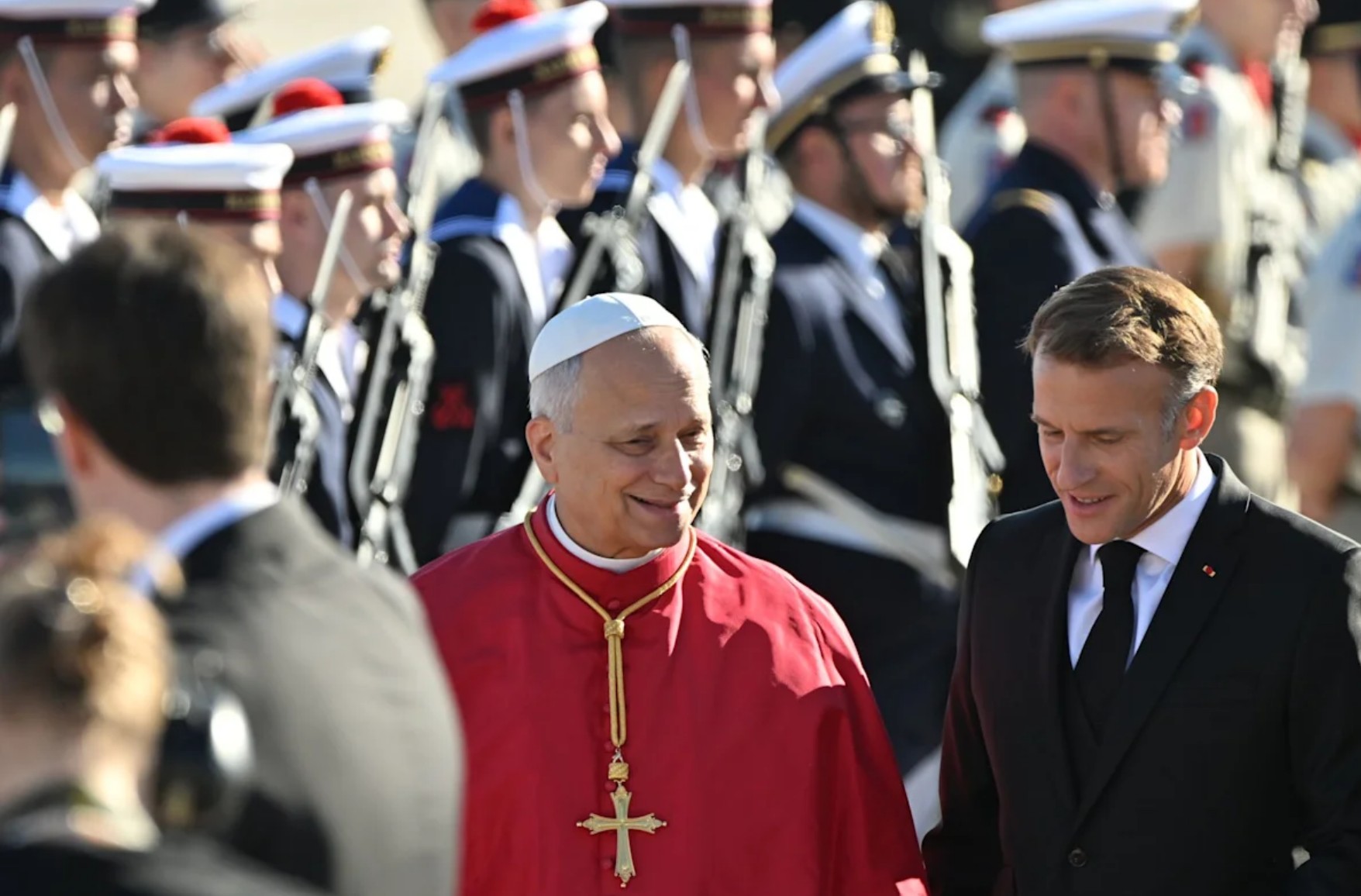
METZ (Realist English). On September 28, Pope Leo XIV arrived in the morning from Lourdes to the eastern French city of Metz, beginning the final day of his visit to France. Metz is located at the junction of the borders of France, Luxembourg, and Germany and is the burial place of one of the founders of the European Union, Robert Schuman. The Pope took part in an interreligious meeting at the conference center named in his honor, after which he joined the conference “Roots of Peace and Unity of Europe.”
“One Cannot Speak of Europe Without Mentioning Christianity”
According to the Italian Catholic agency SIR, in his speech the Pope clearly stated: “One cannot speak of Europe without mentioning Christianity.” He recalled the deep influence of Saint Benedict and his monks on European civilization: “Without this monastic cultivation, European civilization as we know it would not exist.”
The Pope referred to the concept of “common European heritage” of another founding father of Europe, Alcide De Gasperi, noting that reference to the Christian debt of European culture “is not an exclusionary confessional criterion, but allows a better understanding that openness to the transcendent has always been a constitutive dimension of the human person and a living source of civilization.”
He particularly emphasized the importance of Article 17 of the Treaty on the Functioning of the European Union, which encourages “open, transparent, and regular dialogue” with churches, while respecting the status of churches in each member state.
Interreligious Meeting: Dialogue as the “Art of Encounter”
At the interreligious meeting, the Pope addressed leaders of Judaism, Islam, Protestantism, and Orthodoxy, stating that dialogue “does not weaken our identity, but expresses it in simplicity and truth, opening up to the otherness of the other.”
Referring to Pope Francis’s encyclical “Fratelli tutti,” he noted that dialogue between religions “is not merely a matter of diplomacy, courtesy, or tolerance”; its goal is “to build friendship, peace, and harmony.”
He also quoted French philosopher Paul Ricoeur, describing dialogue as a path that views “otherness as a promise, not a threat,” as “the art of encounter that our world desperately needs, directly opposed to aggression and violence.”
Sharp Condemnation of Violence in the Name of Religion
The Pope condemned in the sharpest terms the use of violence in the name of God: “To justify violence or oppression in the name of God is blasphemy. Nothing that distorts human dignity can claim to be genuine divine revelation. Religious discourse must constantly call for the disarmament of hearts and words.”
He directly stated that interreligious dialogue “must always call for the disarmament of hearts and restraint in words,” placing this responsibility directly on the guardians of each religious tradition.
“Religions Are Guardians of Life”
The Pope then outlined the mission of religions in protecting life. “The greatness of a civilization is measured not by its material achievements, but by how it cares for, protects, and elevates human dignity. Religions are guardians of life: they affirm the sacred value of life.”
He noted that the fruits of religions “are manifested in the loving accompaniment of the most fragile and weak,” and that serving life means “surrounding it with care, presence, and tenderness, especially in trials, to the very end.”
He particularly emphasized responsibility toward young people, calling for giving them “solid points of reference for building communion that respects and affirms the dignity of every person.”
European Peace Conference and Macron’s Participation
After the interreligious meeting, the Pope took part in the conference “Roots of Peace and Unity of Europe.” French President Emmanuel Macron was present at the event; Prince Albert II of Monaco, Grand Duke Guillaume of Luxembourg, and Prime Minister of Luxembourg Luc Frieden were also invited.
According to Vatican News, before the interreligious meeting in Metz, representatives of religions jointly read the “Metz Appeal,” expressing commitment to peace, fraternity, and reconciliation in a world where conflicts, divisions, and discrimination are intensifying, and pledging to deepen dialogue, educate the new generation in the spirit of mutual understanding, and jointly strive for justice and peace.
Conclusion of the Visit to France
In the afternoon, the Pope celebrated his final Mass in France at Saint Stephen’s Cathedral in Metz. This cathedral is one of the masterpieces of French Gothic architecture; part of its stained-glass windows were created by the 20th-century Jewish artist Marc Chagall, which is why the cathedral is called the “Lantern of God.”
According to the Vatican, during the first three days of the visit to France (September 25–27), more than 1.3 million people came to meet the Pope, with 800,000 people participating in the Mass at the Place de la Concorde in Paris — more than organizers expected. In Lourdes, the Pope condemned the recently adopted law in France allowing medical assistance in dying, calling it “false compassion.”