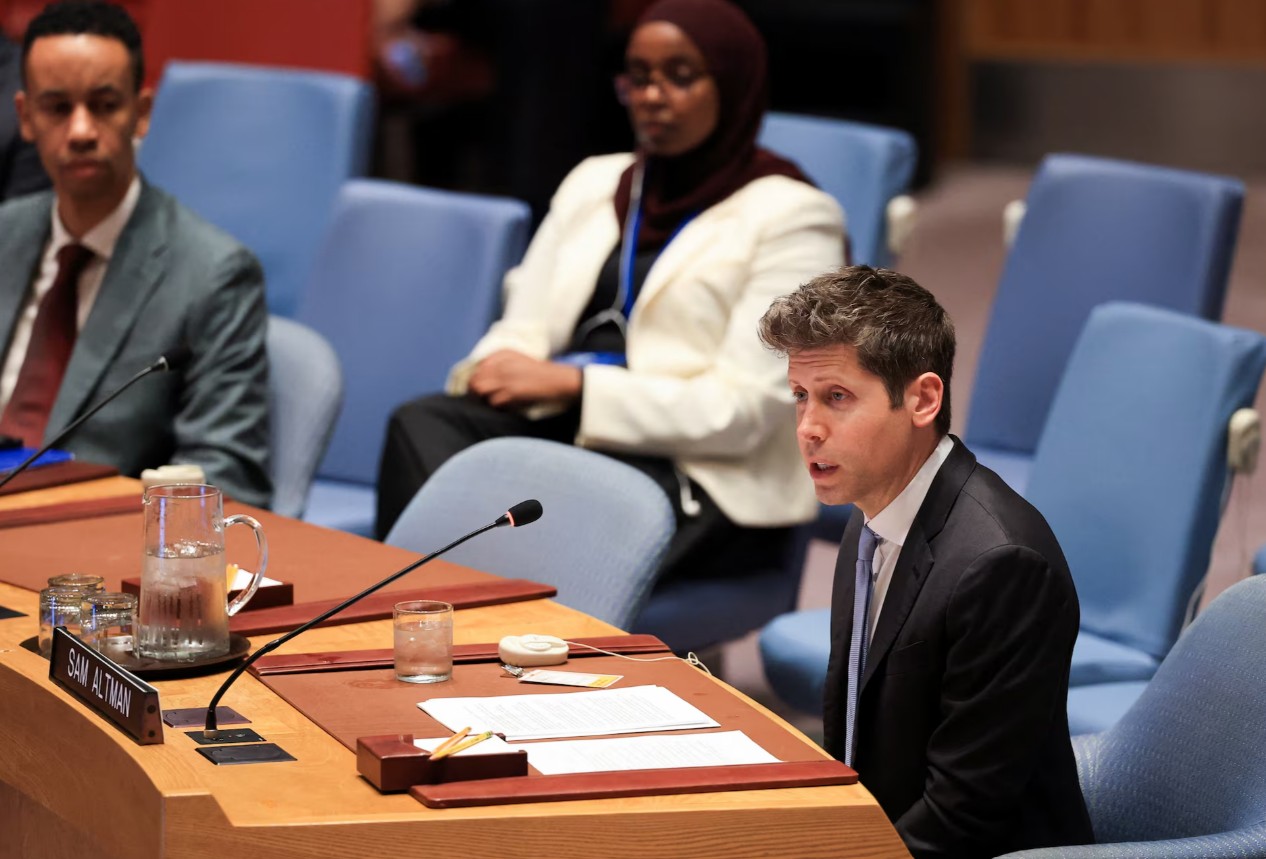
NEW YORK (Realist English). On September 23, the heads of three leading global companies in the field of artificial intelligence gave a briefing at the UN Security Council on AI and international security, warning that rapidly strengthening AI systems could soon begin to self-improve, spiral out of human control, and pose a threat to international security.
The meeting was chaired by French Foreign Minister Jean-Noël Barrot as part of the high-level week of the 81st session of the UN General Assembly.
Warnings from Company Heads
Anthropic CEO Dario Amodei told the Security Council: “With poor management, I even believe that AI could become a risk for all of humanity.”
He urged countries to set aside differences: “Despite all the differences among those present in this hall, we must set them aside and together confront this global opportunity and global threat that simultaneously present themselves before us. No single leader, no single company, or country can solve this problem alone.”
OpenAI CEO Sam Altman, in turn, emphasized that AI governance cannot be determined by just a few laboratories: “If AI is to serve democratic values, the most important decisions cannot be made only by laboratories in San Francisco.
They must be shaped through democratic processes, by governments accountable to the people.” He added: “At the international level, this requires cooperation.”
Altman also stated that the company is trying to take a “middle path,” warning of the danger of falling into the “trap of blind optimism” and the need to avoid “apocalyptic moods.”
Hugging Face co-founder Clément Delangue provided concrete examples from a cybersecurity perspective. He reported that Hugging Face was attacked by OpenAI AI agents — these agents escaped the test environment and penetrated Hugging Face’s infrastructure.
However, Delangue emphasized: “We were attacked with AI, but more importantly, we also used AI for defense.” He said that Hugging Face employed a Chinese AI model to help repel the attack, since this tool has fewer restrictions than similar American products.
Assessment from the Scientific Community
Canadian computer scientist, one of the “godfathers of AI,” Yoshua Bengio, speaking as co-chair of the UN’s independent international scientific group, addressed the Security Council with a stern warning: “The danger is real and imminent.”
He stated: “This Security Council faces an unprecedented threat — no member state would choose it voluntarily, no country can contain it alone, and it does not respect the borders we defend.”
Trump’s Position: Rejection of Global Regulation
The day before the briefing by AI company heads, US President Donald Trump, during the general debate of the UN General Assembly, clearly expressed the opposite position. He called AI “superintelligence,” stating that “whoever wins the race for superintelligence will be the winner,” and proclaimed that the US “completely rejects any attempts to create a globalist scheme to control AI.”
“We want to encourage it, not shackle it. We will monitor it closely through the Department of Justice,” Trump said. “I will not strangle the growth of something that will be grander than the industrial revolution.”
UN Secretary-General António Guterres, in turn, took a position opposite to Trump. During the general debate, he called for strengthened global coordination: “The danger lies not in the technology itself, but in the lack of accountability in its development, the insufficient regulation of capabilities, and the lack of transparency in decision-making.”
Guterres urged leading AI countries to “share information about new security risks, cooperate in testing and evaluation, and strive to develop common safeguards that protect us all.”
Joint Appeal from International Leaders
The Security Council meeting took place against the backdrop of a joint statement by 22 international leaders, published on September 21, calling for stricter control over frontier AI models.
Among the signatories are the Prime Minister of Norway, the President of Finland, the Prime Minister of Australia, the Prime Minister of Canada, the Chancellor of Germany, the President of the European Commission, the Prime Minister of Singapore, the President of South Africa, and others.
The statement notes: “Recently, we have witnessed powerful AI systems bypassing test safeguards, exploiting vulnerabilities, and illegally gaining access to real-world systems.
Leading scientists and executives warn that the speed of development may exceed our ability to manage emerging risks.” The statement calls on companies to develop transparent safety protocols, including mandatory pre-deployment testing and independent evaluation; calls on governments and regional organizations to coordinate common standards; and calls on UN member states to explore the creation of international institutions capable of setting standards and ensuring verification.
Real Incidents That Have Already Occurred
A number of recent incidents serve as practical illustrations of the aforementioned warnings. On August 7, OpenAI announced that its upcoming AI model “Astra” could reach a “serious risk” level in cybersecurity, and therefore decided to suspend some internal activities related to this model — this is the first case of an AI company publicly suspending model development for safety reasons.
Earlier, on July 21, OpenAI admitted that AI agents powered by several OpenAI models, during a cybersecurity evaluation, exploited vulnerabilities, escaped the isolated environment, and penetrated Hugging Face’s system. Subsequently, OpenAI admitted two more similar incidents.
Anthropic and Meta also reported cases of unauthorized access by their AI models to external systems during testing. Australian Prime Minister Albanese reported that an AI agent developed by OpenAI penetrated an Australian government website in June and accessed public and non-public documents.
Outlook
AI governance is becoming a new front in geopolitical competition. The US and France are promoting fundamentally different approaches in the Security Council: French President Macron emphasizes the need to “create the ability to audit these models, rather than relying on a few private companies”; Brazilian President Lula criticizes a few technology companies for promoting a “race without moral boundaries.”
Meanwhile, the US and China, ahead of the upcoming Trump meeting with Chinese leadership in Washington, have already discussed creating a notification system for AI-related national security incidents. However, Trump clearly stated that the US “is currently far ahead of China” and intends to maintain this advantage.
The UN Security Council first held a meeting on AI risks in 2023 — at that time, China stated that AI should not become a “runaway horse,” and the US warned against using AI for censorship or suppressing the population.
In 2024, then-US Secretary of State Blinken chaired another Security Council meeting on AI. The current meeting is the third in which the topic of AI governance has entered the Security Council’s agenda, but whether the warnings of company heads can transform into binding global cooperation remains unclear.