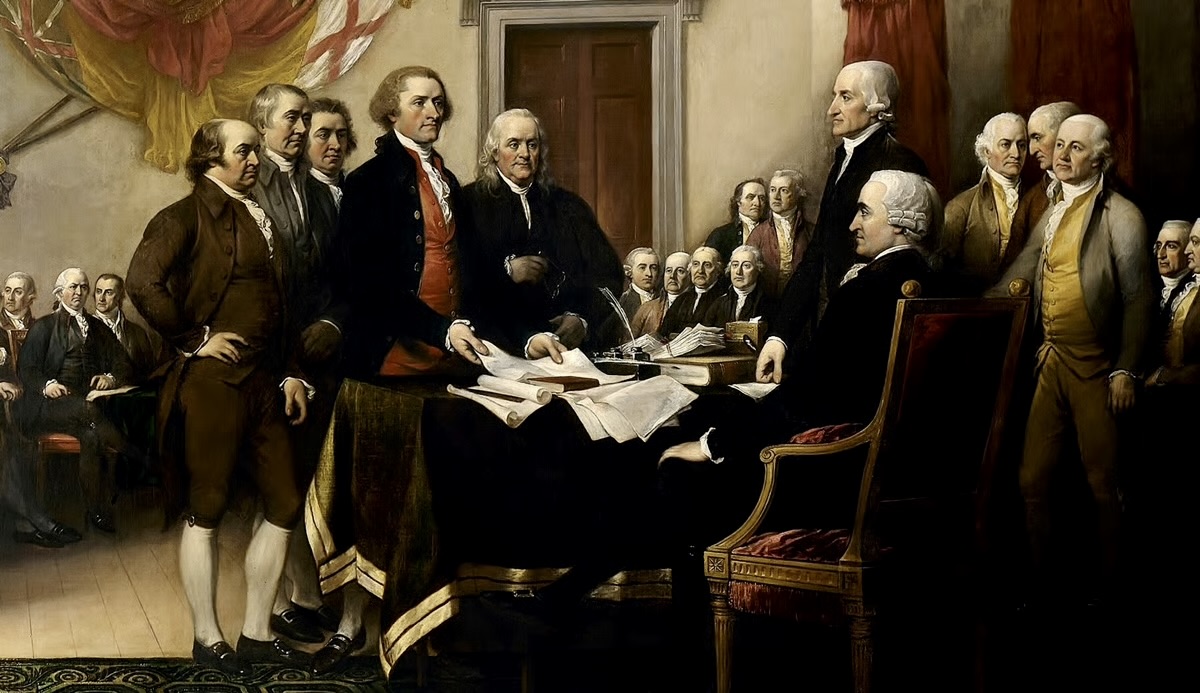
PHILADELPHIA (Realist English). On July 4, 1776 — the day the Second Continental Congress approved the final text of the Declaration of Independence — its principal author, Thomas Jefferson, spent the day quite differently than one might expect.
Instead of celebrating the birth of a new nation, the 33-year-old Virginia delegate went shopping.
According to his account book, in which Jefferson meticulously recorded his personal expenses, on July 4 he purchased a thermometer from John Sparhawk — an apothecary and bookseller on Second Street who also traded in meteorological instruments.
The purchase cost him 3 pounds 15 shillings — by modern estimates, the equivalent of more than $500. But the spending did not end there: on the same day, Jefferson bought seven pairs of ladies’ gloves for 17 shillings and donated one shilling and sixpence to charity.
‘An Ordinary Day That Became Revolutionary’
Why was the author of the document that changed world history so free on one of the most significant days? Historians offer different explanations.
“This is an ordinary day, but also a revolutionary one,” noted Andrew Davenport, Vice President for Research at Jefferson’s Monticello estate. “It’s a reminder to us that even in the most fevered times in our history, everyday chores still demand attention. And everyday chores are the fabric of civic life, and civic life, in turn, is the fabric of the nation.”
Kara Rogers Stevens, a historian and Jefferson scholar at Ashland University in Ohio, offered a different explanation: “The fact that he was able to run several errands on the same day may indicate that he was not sitting on as many committees as some other members of Congress, such as John Adams.”
The Decision for Independence Was Made Two Days Earlier
It is important to understand that for Jefferson’s contemporaries, July 4 was not the day we know today. The formal decision to break with Great Britain had been made by Congress two days earlier — July 2, 1776 — when the “Resolution for Independence” proposed by Richard Henry Lee was approved.
John Adams himself, in a letter to his wife Abigail on July 3, predicted that it would be July 2 that future generations would celebrate.
For the delegates of Congress, meeting at the Pennsylvania State House (now known as Independence Hall), July 4 was just another day in a series of over a year of debates, committee work and managing the military and civil affairs of the rebellion.
America’s First Meteorologist
The purchase of the thermometer on July 4 was no idle whim. Jefferson was a passionate meteorologist: throughout his life, he kept a weather diary, taking measurements twice a day for more than 50 years. He acquired nearly two dozen thermometers over his lifetime.
It was with this new instrument that Jefferson first recorded the weather in Philadelphia on that very day. His notes are one of the few records we have showing that July 4, 1776, was warm: 68°F at dawn, 72.25°F at 9 a.m., 76°F by 1 p.m., and 73.5°F by 9 p.m.
The three-day gap between the adoption of the Declaration and its signing, along with the everyday errands — including the purchase of a thermometer and gloves — speak eloquently to the fact that the grandeur of a historical moment is not always recognised by those living through it.