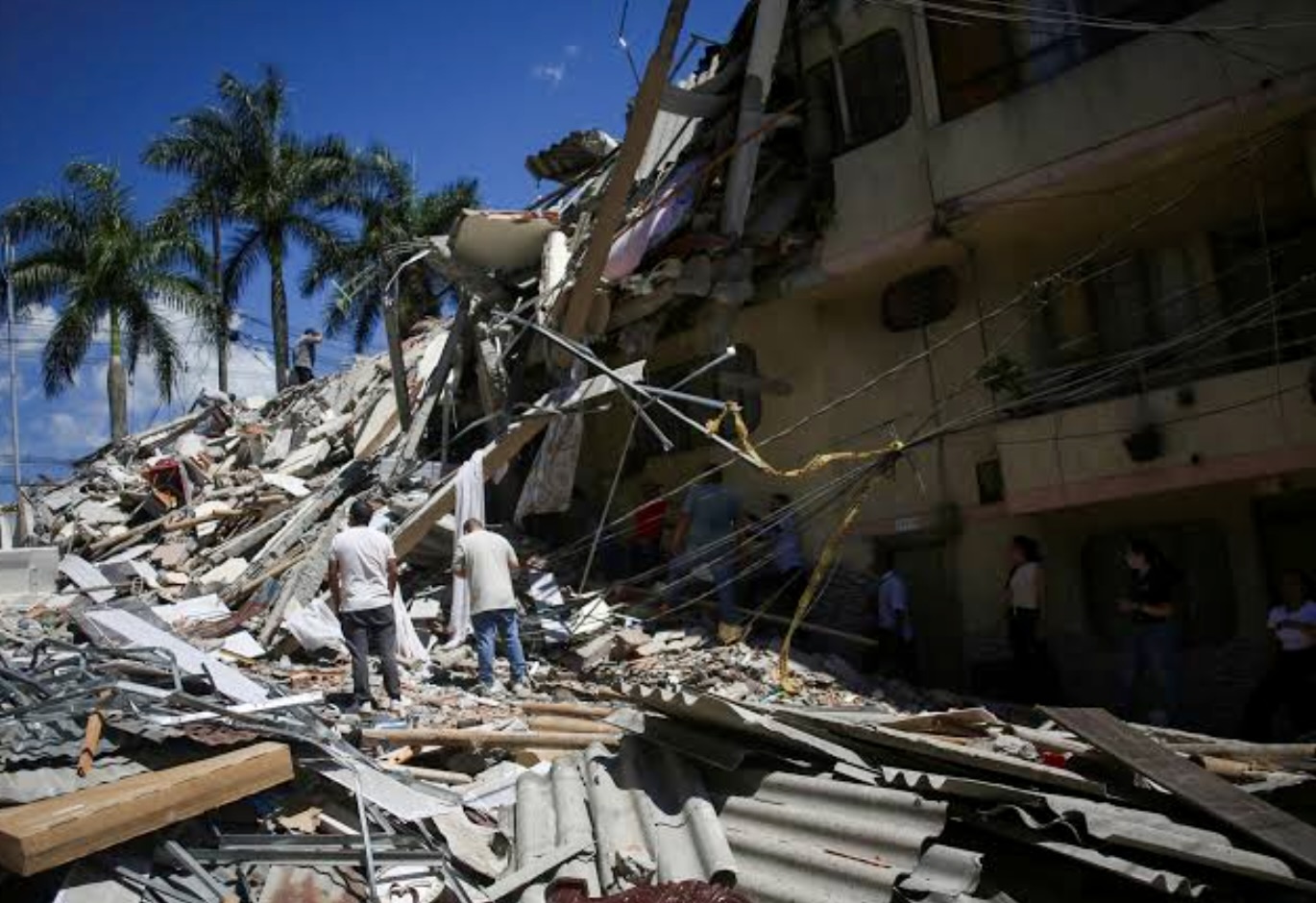
BOGOTÁ (Realist English). Western Colombia continues to recover from the powerful 7.4‑magnitude earthquake that struck on the morning of 10 August.
According to the latest figures, the death toll has reached 224, with approximately 3,000 people still listed as missing.
Rescue operations in the cities of Cali and Pereira are continuing for a second day, but aid has yet to reach the remote epicentre in the department of Chocó.
Catastrophe in Cali and Pereira
The heaviest destruction has been reported in Cali – the country’s third‑largest city. According to Mayor Alejandro Eder, 85 deaths have been confirmed there, with about 40 buildings completely collapsed. One city hospital lost its upper floors, including the paediatric ward – patients were trapped under the rubble, and about 600 more had to be treated on the street, which was littered with debris.
In Pereira, the administrative centre of Risaralda department, at least 66 people died. According to available data, 58 buildings collapsed, with at least 53 people still believed to be trapped under the rubble. Entire residential blocks have been reduced to piles of concrete and twisted metal.
In total, preliminary estimates indicate that more than 1,500 structures have been damaged. According to the UN Office for the Coordination of Humanitarian Affairs (OCHA), nearly 5,000 homes have been damaged, and dozens of buildings have been completely destroyed. The earthquake also knocked out six airports and dozens of roads, disrupting power and communications in several cities.
Epicenter remains without aid
The earthquake’s epicentre was in the municipality of San José del Palmar in the department of Chocó – one of the country’s poorest and most isolated regions, approximately 400 km west of Bogotá. It is here that aid has still not been able to reach.
Victor Chamapuro, a leader of the Wounaan indigenous community, told CNN that help has not yet arrived in the area: “All our homes are on the ground. Where will we sleep now? We are forced to sleep on the street.” One person in the community is injured, and Chamapuro called on authorities to urgently send food and medicine.
Due to the region’s difficult terrain and limited transport infrastructure, it is still impossible to fully assess the scale of destruction in Chocó. Mobile communications have been disrupted in many areas.
‘A whisper from the rubble’: rescue of a baby
Amid the tragedy, a ray of hope. In Cali, at the collapsed five‑storey residential complex “La Torres del Limonar,” local resident Bryan Osorio Zuluaga heard a faint whisper from under the rubble.
“Yes, I’m here. I’m with a baby,” a man’s voice replied from under the debris. Osorio and several volunteers began clearing the rubble by hand. A massive concrete slab was blocking their way – they couldn’t lift it on the first attempt. “We all lifted it together – one, two, three, up,” he told CNN.
When the passage was cleared, rescuers saw a small child in a dusty onesie. “You could see the baby’s head – it looked slightly purple because he couldn’t breathe,” Osorio recalled. “As soon as we started removing the debris, the baby began to… breathe, and the colour started coming back.”
The baby was handed to a police officer, who carried it to an ambulance. After that, rescuers continued to free an injured man from under the slab. “Unity is strength, because no one alone could have lifted that piece of rubble – it was so big and heavy,” Osorio said. Later, rescuers in Cali also managed to pull another baby and its mother from the rubble.
Government response and international aid
Colombian President Abelardo de la Espriella, who had taken office just days before the disaster, declared a state of emergency and said he would personally oversee the recovery effort.
Government teams have been sent to the hardest‑hit areas, and more than a thousand troops have been mobilised to maintain order amid reports of looting. A night curfew has been imposed in Cali.
The US has allocated $15.5 million for emergency housing, food and rescue operations. The Inter‑American Development Bank has provided $50 million for reconstruction work. The European Union has activated its Copernicus satellite system to assist rescue operations. El Salvador, Mexico, Chile and other regional countries have also offered assistance.
The earthquake in Colombia is the deadliest in the country since 1999, when a quake in the same western region claimed more than a thousand lives. It comes less than two months after a devastating quake in neighbouring Venezuela that killed more than 6,100 people.
In Colombia, time is running out. Rescue teams are clearing rubble in Cali and Pereira, while volunteers with bare hands sift through debris in search of survivors. But in the remote areas of Chocó, at the epicentre, aid has still not arrived. There, people are sleeping on the streets and waiting for food.
Authorities have warned of possible aftershocks. The question is how much longer this waiting will continue – and how many more names will be added to the death toll before help reaches the most isolated communities.