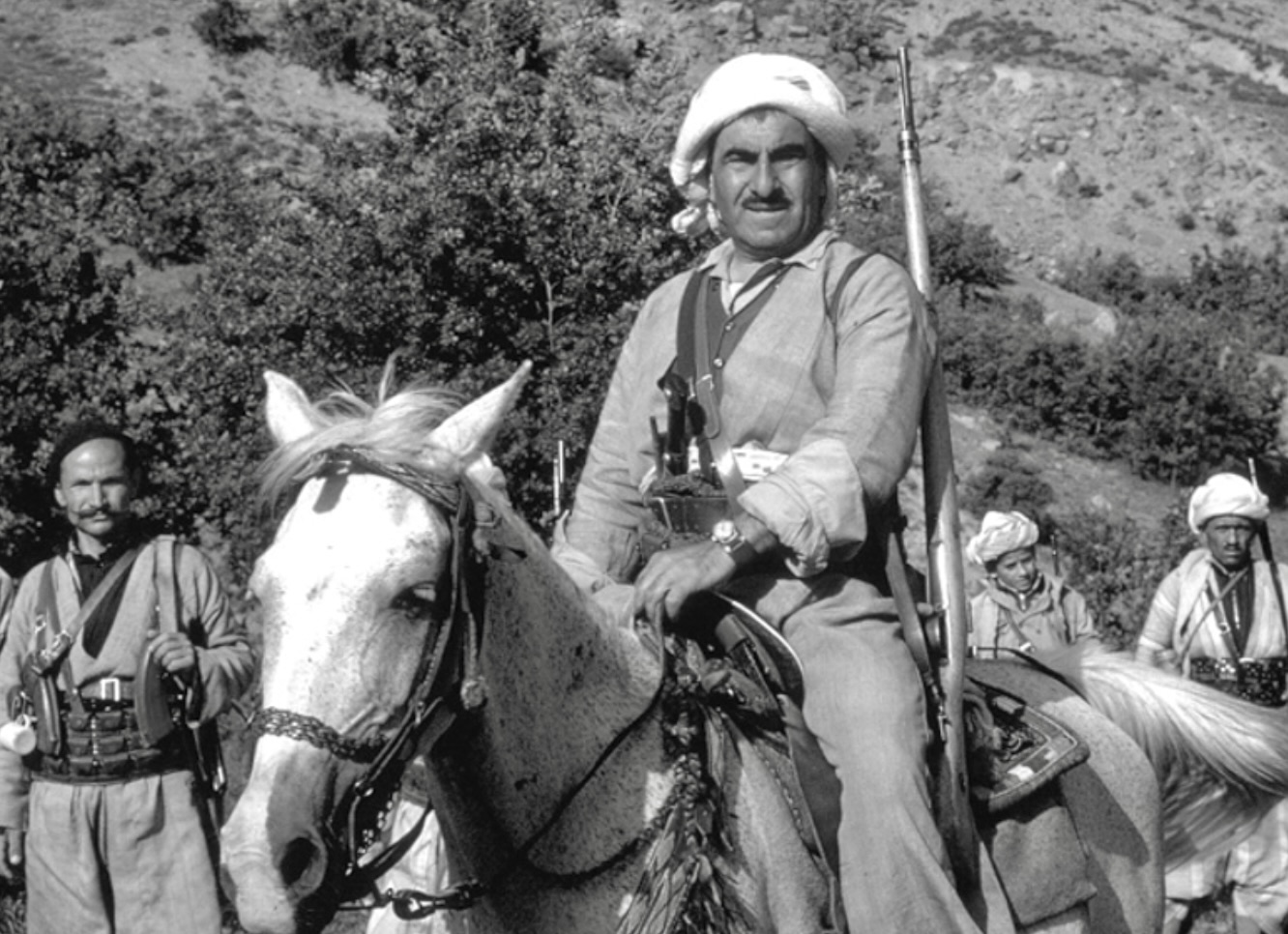
ERBIL (Realist English). On 16 August 1946, at an underground congress of several progressive organisations in Baghdad, the Kurdistan Democratic Party (KDP) was founded, with the leader of the Barzani tribe, Mullah Mustafa Barzani, elected as its chairman in absentia. By that time, under pressure from British and Iraqi forces, he had been forced to cross with his tribesmen into neighbouring Iran, where he took command of the armed forces of the Mahabad Kurdish Republic.
Unfortunately, the Shah’s authorities forcibly liquidated the Kurdish autonomy in March 1947 and suppressed the national liberation movement of Iran’s Kurds, and Mustafa Barzani, with a small detachment of comrades, had to fight his way through Turkey and Iran to the Soviet Union.
Some historians compare this heroic march to Suvorov’s crossing of the Alps in 1799. The Soviet Union granted the Barzanis temporary political asylum. Only 12 years later, after the Iraqi Revolution of 14 July 1958, Mustafa Barzani and his warriors were able to return home, where they were welcomed as national heroes.
From conservatism to national leadership
The history of the KDP is in many ways the history of Iraqi Kurdistan itself. Although the party initially held conservative-liberal positions and did not follow the lead of far-left movements, distancing itself from the Iraqi Communist Party, its relations with the central authorities were extremely complex.
During the rule of the military regime of Abd al‑Karim Qasim, Mustafa Barzani attempted to interact with the central authorities and to achieve autonomous status for the region through peaceful means. But the authorities in Baghdad preferred to preserve a unitary state, refusing to allow any national autonomies. In the spring and summer of 1961, Qasim undertook a series of hostile actions against the KDP and then attempted to use military force to “restore order” in Kurdistan. The overthrow of Qasim’s regime and the rise to power of Arab nationalists — the Baathists — in 1963 did little to change Baghdad’s attitude toward the Kurds. The so‑called “September Uprising” of 1961–1975 went down in history as an unparalleled feat of the Kurdish people in the struggle for their rights and freedoms.
Saddam’s repression and the gas attack on Halabja
The peak of repression against the Kurds in general, and against the KDP in particular, came during the rule of Saddam Hussein’s regime. He initially tried to flirt with Kurdish leaders and even invited them to join the National Progressive Front, but from 1978 he embarked on a course of brutal repression against the Kurdish region. The Kurdish insurgents were attacked by aircraft, armoured vehicles and artillery; tens of thousands of families were deported from areas bordering Turkey and Iran to desert lands deep inside the country that were barely suitable for life. Concrete structures, various outposts and new troops were deployed along the borders. During the war with Iran in March 1988, Saddam Hussein used chemical weapons against the residents of the Iraqi border town of Halabja, killing five thousand Kurds and seriously injuring twenty thousand.
The March uprising and the birth of Free Kurdistan
The death of Mustafa Barzani in 1979 did not halt the Kurdish national liberation movement; his sacred cause fell into the hands of his sons, Masoud and Idris. Under their leadership, the KDP continued its difficult and honourable path. An important milestone was the March Uprising of 1991 — following the victory of the International Coalition forces over Saddam Hussein’s army during Operation Desert Storm. The KDP, together with the Democratic Front of Kurdistan, rose up and liberated the entire Kurdish region of the country. Saddam Hussein responded with new large‑scale repression against the Kurds.
To prevent mass civilian casualties and a humanitarian catastrophe, the UN Security Council adopted Resolution 688 on 5 April 1991, which condemned the repression of the Baath Party regime against the Kurdish population of Iraq and demanded its cessation. The resolution also called on all UN member states to support the Kurdish people and provide them with humanitarian assistance. Subsequently, on the basis of this resolution, a no‑fly zone was established over northern Iraq, ensuring the security of the Kurdish population in these territories.
This also made it possible to form the Kurdistan Autonomous Region (KAR) in northern Iraq between 1991 and 2003, which came to be known as “Free Kurdistan.” It should be noted that during this period, the peshmerga fighters had to contend not only with Saddam’s army but also with internal strife and contradictions among their compatriots. Many enemies of the Kurds, both at home and abroad, sought to undermine the unity of their ranks, sow discord and provoke inter‑Kurdish armed conflicts – a fratricidal war (as occurred in 1994–1998 between the peshmerga of the KDP and the PUK).
Masoud Barzani and the emergence of a regional power
The party’s new leader and the first President of Iraqi Kurdistan, Masoud Barzani, was able to overcome all external and internal challenges and threats on the path to securing the legitimate rights and freedoms of Iraq’s Kurds. Today, the KDP is the leading party in Iraqi Kurdistan, represented by dozens of deputies in the national parliament. The 2005 Constitution of the new Iraq enshrines the right of regions to create federal entities, a right that Iraqi Kurdistan has successfully exercised.
Under the leadership of the KDP and in close alliance with the Patriotic Union of Kurdistan (PUK), Iraq’s Kurds have succeeded in creating a socially and economically prosperous Kurdish region based on four northern provinces, where Arabs, Turkomans, Armenians and Assyrians also occupy a worthy place. Iraqi Kurdistan has its own flag, anthem, president, parliament, government, legislative framework, judiciary, national guard – the peshmerga brigades – as well as police, security services, education and healthcare systems, scientific institutions, and developed industry and agriculture. The Kurdish language has become the language of regional communication and education and the second official language. Around 40 foreign diplomatic missions are accredited in the region, and it has two international airports.
Iraqi Kurdistan maintains and develops mutually beneficial relations with Turkey, Iran, Arab countries, Israel, Russia, the United States, China, India and the EU countries. It is no coincidence that the region is called an oasis of peace and stability in Iraq, where contradictions within the Shia clans and between Arab Shias and Sunnis continue to rock the country. It was the KDP and its leader Masoud Barzani who repeatedly acted as mediators during government and parliamentary crises in Baghdad, giving the warring Arab factions the opportunity to form a new parliament and cabinet. To a large extent, it is thanks to Iraq’s Kurds that the fragile political balance and statehood itself have been preserved.
The fight against ISIS and international recognition
The world witnessed the heroic struggle of Iraqi and Syrian Kurds against international terrorists in the form of the “Islamic State” (banned in Russia). At a time when the armies of Syria and Iraq fled in panic from several tens of thousands of jihadists, while their leaders cowardly hid in the basements of presidential palaces, and when there was a threat that ISIS militants would take Baghdad and Damascus, the Syrian Kurdish militias and Iraqi peshmerga brigades displayed miracles of courage and heroism. They not only managed to defend their ancestral lands but also, in subsequent ground operations, liberated the major cities of Mosul and Raqqa from jihadist occupation and put an end to the Islamic Caliphate, which had ruled for three years over a significant part of Syria and Iraq. The role of the KDP and Masoud Barzani personally in this unparalleled feat is immense.
Russian-Kurdish ties
Masoud Barzani and representatives of Iraqi Kurdistan have always been welcome guests in the Russian Federation. It is no coincidence that a memorial plaque has been installed on a building in Moscow bearing the inscription: “Here lived the prominent figure of the Kurdish national movement Mustafa Barzani.” Notably, Masoud Barzani himself attended the unveiling ceremony of this memorial plaque. The Russian Consulate General is very active in Erbil, as are a number of major Russian companies.
Iraqi Kurds study at Russian universities. Representatives of the KDP and Russia’s leading political party, United Russia, have agreed to expand inter‑party ties, including through exchanges of delegations at a broader level and through cooperation in the cultural sphere.
Since 2019, Masoud Barzani has served as the spiritual leader of the Kurdish region, while the President of Iraqi Kurdistan has become Nechirvan Idris Barzani, who continues the good traditions of the Barzani tribe and Iraqi Kurdistan with honour.
The KDP and the entire Kurdish people of Iraq are marking the 80th anniversary with new successes in the socio‑economic life of the region, continuing to develop mutually beneficial relations with other provinces of Iraq, with the central authorities, and with neighbouring and other states of the world. Today, the Kurds in Russia and around the world have tens and hundreds of millions of friends who are sincerely interested in the great Kurdish people being able to preserve their national identity, overcome the legacy of the colonial past and the era of dictatorial regimes, and peacefully determine their level of self‑determination (autonomy, federal entity, confederation, independent state).
Stanislav Ivanov is a leading researcher at IMEMO RAS and a Candidate of Historical Sciences, writing exclusively for Realist English