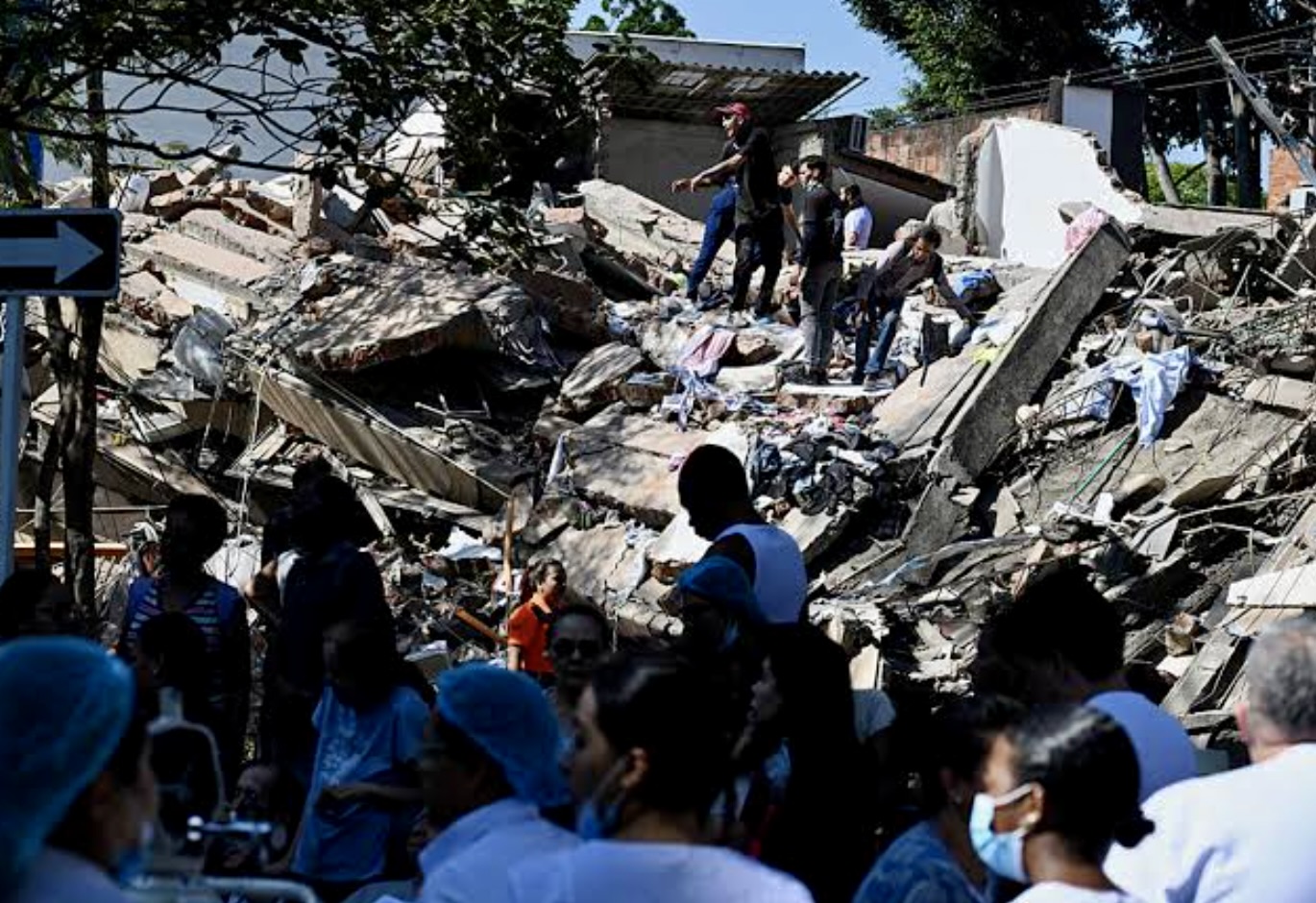
BOGOTÁ (Realist English). Western Colombia is experiencing its strongest earthquake in a decade. A magnitude 7.4 quake was recorded on 10 August at 07:34 local time (12:34 GMT) in the department of Chocó, near the town of San José del Palmar, approximately 400 km west of Bogotá.
According to the US Geological Survey, the epicentre was at a depth of about 100 km.
By the morning of 11 August, the death toll ranged from 132 to more than 160, according to various reports. At least 570 people have been injured.
Authorities fear the number of casualties will rise – hundreds of people remain trapped under the rubble of collapsed buildings in Cali, Pereira and Manizales.
‘All our homes are on the ground’: indigenous communities wait for help
The earthquake’s epicentre struck one of the country’s poorest and most isolated regions – the department of Chocó on the Pacific coast. Victor Chamapuro, a leader of the Wounaan indigenous community, told CNN that aid had still not reached the area: “All our homes are on the ground. Where will we sleep now? We are forced to sleep on the street.” One person in the community is injured, and Chamapuro called on authorities to urgently send food and medicine.
Due to the region’s difficult terrain and limited transport infrastructure, it is still impossible to fully assess the scale of destruction in Chocó. Mobile communications have been disrupted in many areas.
Cities in ruins: Cali and Pereira hardest hit
The heaviest destruction has been reported in the cities of Cali (population about 2.2 million) and Pereira – the administrative centre of the Risaralda department.
In Cali, at least 85 people had died as of 11 August. Dozens of buildings have collapsed or tilted, and residents have been forced to sleep on the streets. At one city hospital, upper floors collapsed, including the paediatric ward. Patients were trapped under the rubble, and about 600 more had to be treated on the street, which was littered with debris.
In Pereira, where at least 66 people died, entire residential blocks have been reduced to piles of concrete and twisted metal. Videos posted on social media show the local airport terminal “dancing” during the tremors, with large pieces of ceiling falling down. According to Reuters, at least 15 buildings have been destroyed in Pereira.
In Manizales, the earthquake brought down one of the towers of the neo‑Gothic cathedral. In Quibdó, the capital of Chocó department, “public services and communications are practically cut off.”
Timeline: from the first tremors to rescue efforts
- 10 August, 07:34 – Magnitude 7.4 earthquake. Tremors were felt by at least 1.5 million people across the country, as well as in neighbouring Ecuador, Panama and Venezuela.
- 10 August, morning – Authorities declared a red alert in hospitals in five cities; a night curfew was imposed in Cali and Pereira.
- 10 August, afternoon – President Abelardo de la Espriella, who had taken office just three days before the disaster, declared a state of emergency. More than 180 rescue specialists from Bogotá and Tolima were deployed to the disaster zones, equipped with drones, thermal imagers, motion sensors and heavy rescue equipment.
- 10 August, evening – The US announced $15.5 million in aid for emergency housing, food and rescue operations. El Salvador, Mexico, Chile and other regional countries also offered assistance.
- 11 August, morning – Rescue operations continue for a second day. The president announced the deployment of 1,000 troops and police officers to Cali to prevent looting. Authorities have warned of possible aftershocks.
Government response and international aid
The new Colombian president promised to “cooperate in any way necessary” and said that “there are no differences or ideological divisions when it comes to protecting our people or showing solidarity.” The government has accelerated funding for rescue and recovery efforts.
The European Union activated its Copernicus satellite system to assist rescue operations and said it was ready to send additional resources. European Commission President Ursula von der Leyen expressed condolences. Colombian authorities also confirmed receiving offers of help from several Latin American countries.
The earthquake in Colombia is the country’s most powerful in a decade. It comes less than two months after a devastating quake in neighbouring Venezuela that claimed more than 6,100 lives. That disaster showed just how vulnerable the Andean region is to seismic threats.
In Colombia, time is running out. Rescue teams are clearing rubble in Cali and Pereira, while volunteers with bare hands and buckets sift through debris in search of survivors. But in the remote areas of Chocó, at the epicentre, aid has still not arrived. There, people are sleeping on the streets and waiting for food.
The question is how much longer this waiting will continue – and how many more names will be added to the death toll before help reaches the most isolated communities.