Realist: news and analytics

Русский / English / العربية

  • News
  • Russia
  • Caucasus
  • Opinion
  • Interviews
  • Experts
No Result
View All Result
Realist: news and analytics
  • News
  • Russia
  • Caucasus
  • Opinion
  • Interviews
  • Experts
No Result
View All Result
Realist: news and analytics

‘The art of telling someone to go, but making them look forward to the trip’: Lavrov on diplomacy

Russia's foreign minister spoke about 'red lines' and explained why Russia does not trust the West.

     
April 25, 2026, 06:56
Russia
‘The art of telling someone to go, but making them look forward to the trip’: Lavrov on diplomacy

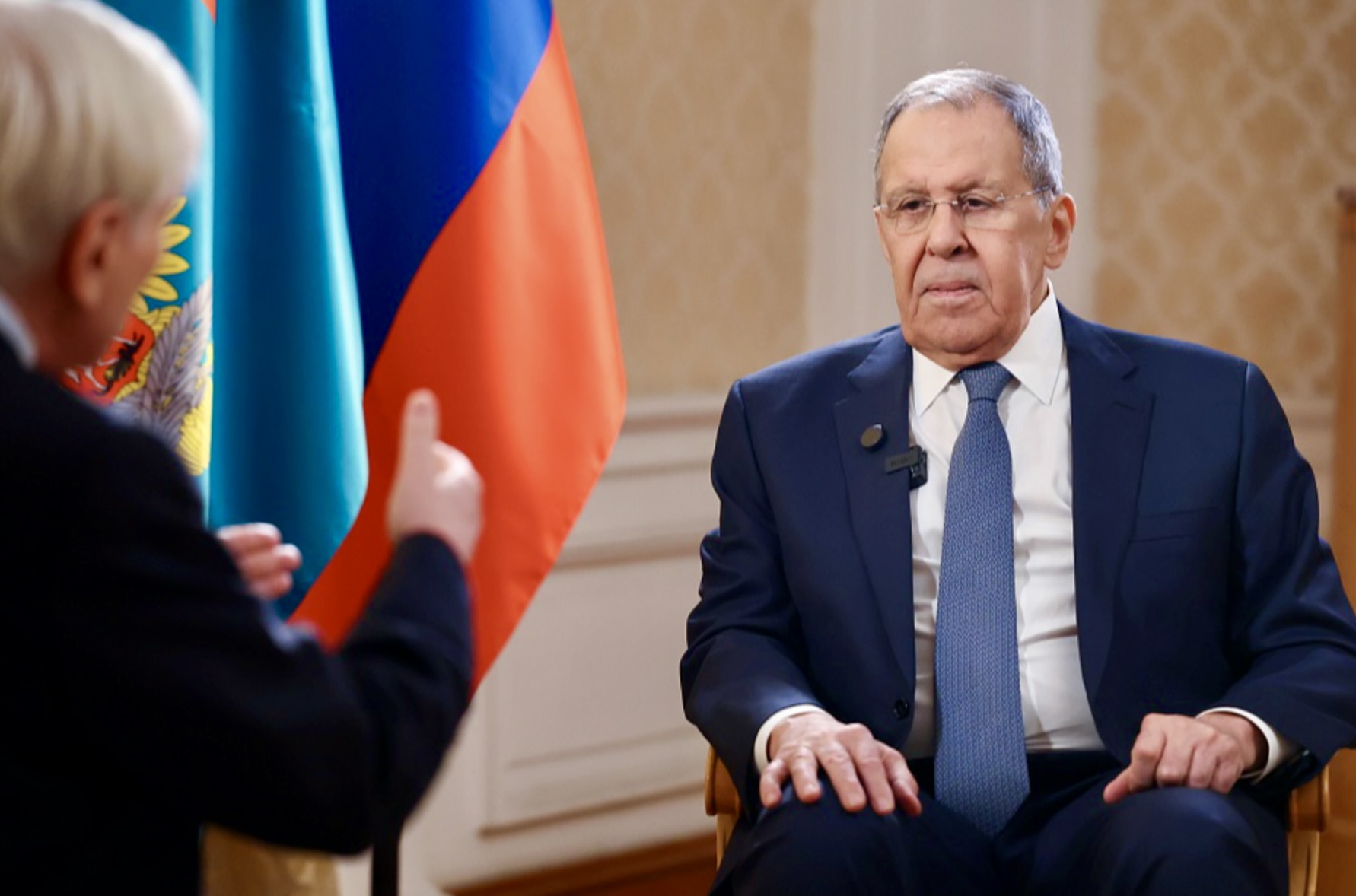
Sergey Lavrov. Photo: Russian Foreign Ministry Press Service

MOSCOW (Realist English). Russian Foreign Minister Sergey Lavrov said in an interview with Public Television of Russia, published on 24 April, that Western politicians are trying to return to a colonial era, and that diplomacy must be based on national interests and respect for equal partners. The foreign minister also spoke about the role of academic institutes in shaping foreign policy doctrines, his personal relationship with former US Secretary of State John Kerry, and why Russia trusts only its army and navy.

Science in support of diplomacy

Responding to a question about the anniversary of the Institute of World Economy and International Relations (IMEMO), Lavrov stressed that cooperation between the Foreign Ministry and academic institutes is mutually beneficial. “Practical diplomacy, while greatly interested in analytical work, cannot handle this task alone,” the minister said, noting that it is scholars who can calmly analyse events without being distracted by “day-to-day routines.”

Lavrov paid special tribute to the situational analysis methods introduced by Yevgeny Primakov. These approaches, according to the minister, remain relevant today. IMEMO has actively participated in drafting every edition of Russia’s Foreign Policy Concept since 2000.

‘Red lines’ and European racism

Lavrov sharply criticised European politicians’ statements about the need to “clarify Russia’s red lines.” “It is ridiculous to say that they need to clarify our ‘red lines.’ They were laid out long ago,” the minister said. He recalled that the European Union was a party to the Minsk agreements, and that former German Chancellor Angela Merkel and former French President François Hollande later admitted they “lied to buy time to pump weapons into Ukraine.”

In the foreign minister’s view, Europe’s current approach is “to a certain extent racism, which implies a dismissive attitude towards a partner.”

The art of negotiation and personal chemistry

Speaking about the negotiation process, Lavrov stressed that there is no universal rule. Success depends on the participants’ erudition, their knowledge of the partner country’s history and culture. The minister noted a difference in approaches: Russian diplomacy immerses a specialist deeply in a region for five years, while American colleagues change portfolios every two to three years.

Lavrov spoke about his productive personal relationship with former US Secretary of State John Kerry, with whom he worked on the Syrian chemical dossier and the Ukrainian crisis. In April 2014, an agreement on the federalisation of Ukraine was reached in Geneva, but “the Ukrainian Nazis who seized power flatly rejected this practically agreed-upon text.”

History repeats itself as farce?

Asked about the nature of the current global crisis, Lavrov said history develops in a spiral. “The current situation is serious, far from a farce,” he said, noting that the United States has officially proclaimed the principle of “might is right.” According to the minister, the Americans “openly declare that they answer to no one” and care only about their own well-being, using coups, kidnappings and killings to gain access to natural resources.

Lavrov cited the example of Hungary and Slovakia, which Europe is ordering to buy expensive energy instead of cheap Russian supplies. “This is an attempt to return to the colonial era,” he concluded.

Russia’s two allies

Concluding the interview, the minister recalled the well‑known formula: “Russia has only two allies — its army and navy.” Today, the Aerospace Forces and drone units have been added to them. “The main conclusion from our thousand‑year history: trust in God, but don’t make mistakes yourself,” Lavrov said, adding that “the weak get beaten, you need to be strong.”

In the foreign minister’s view, Russia possesses colossal natural and scientific potential, and the task of diplomacy is to create conditions for technological leadership, including in the field of artificial intelligence.

RussiaRussia’s Foreign PolicyRussian Foreign MinistrySergei Lavrov
Previous Post

Ankara and Baku’s double standards — denial of genocide and a bloody orgy against the peoples of the region

Next Post

Oil and gas on April 25: Brent held at $105, Urals at $90, IEA sounds alarm

Related Posts

Putin Prepares for a Major Diplomatic Round with China
Russia

Putin Prepares for a Major Diplomatic Round with China

19 May, 2026
The US Extends Oil Waivers for Asian Importers of Russian Crude for a Third Time
Russia

The US Extends Oil Waivers for Asian Importers of Russian Crude for a Third Time

18 May, 2026
Oil rocks the ruble: dollar holds at 73, Central Bank waits for June 19 to decide fate of key rate
Russia

Oil rocks the ruble: dollar holds at 73, Central Bank waits for June 19 to decide fate of key rate

18 May, 2026
Lavrov: BRICS is a prototype of a multipolar world
Russia

Lavrov: BRICS is a prototype of a multipolar world

17 May, 2026
State Duma allows Putin to deploy troops to protect Russians abroad
Russia

State Duma allows Putin to deploy troops to protect Russians abroad

16 May, 2026
Lavrov reaffirmed support for Iran, Peskov – priority of a peace agreement on Ukraine
Russia

“Europe cannot be a mediator”: Moscow toughens rhetoric amid BRICS talks and NATO threats

15 May, 2026
Most Popular
Most Popular
“Restrictions Alone Are Not Enough — Children Need to Be Engaged”: Paata Amonashvili on Meaningful Alternatives to Gadgets

“Restrictions Alone Are Not Enough — Children Need to Be Engaged”: Paata Amonashvili on Meaningful Alternatives to Gadgets

18 May, 2026

TBILISI (Realist English). Restrictions alone are not enough to overcome children’s dependence on gadgets — children must be offered meaningful...

US and Iran fail to reach Hormuz deal as Trump threatens new strikes

US and Iran fail to reach Hormuz deal as Trump threatens new strikes

18 May, 2026

WASHINGTON (Realist English). The United States and Iran remain far from reaching an agreement to end the war and reopen...

Israel prepares for new war with Iran – from bombing to commando landings

Israel prepares for new war with Iran – from bombing to commando landings

17 May, 2026

TEL AVIV (Realist English). With US‑Iran talks deadlocked, the Israeli leadership has stepped up preparations for a resumption of full‑scale hostilities....

Raúl Castro remains Cuba’s “shadow king”

Raúl Castro remains Cuba’s “shadow king”

17 May, 2026

HAVANA (Realist English). From the very moment in April 2021 when legendary General Raúl Castro, brother of the great Fidel, handed...

Opinion

Replacing Baathists with Islamists: why Kurds and other minorities in Syria have not seen equality

Replacing Baathists with Islamists: why Kurds and other minorities in Syria have not seen equality

19 May, 2026

HASAKAH (Realist English). The overthrow of Bashar al‑Assad and the rise to power in Damascus of radical Islamist groups has not...

Russia seeks its place in China’s new transport corridor

Russia seeks its place in China’s new transport corridor

17 May, 2026

MOSCOW (Realist English). Ahead of Russian President Vladimir Putin’s official visit to Beijing, experts are increasingly discussing the hidden contradictions...

From Hormuz to Solar Panels: How Iran Accelerated the Global Shift to Renewables

From Hormuz to Solar Panels: How Iran Accelerated the Global Shift to Renewables

16 May, 2026

WASHINGTON (Realist English). An analytical article by Benjamin Bradlow, professor of sociology and international affairs at Princeton University, published in...

China No Longer Seeks U.S. Approval

China No Longer Seeks U.S. Approval

15 May, 2026

BEIJING (Realist English). U.S. President Donald Trump’s visit to China on May 14–15 passed with surprising calm and almost none...

All rights reserved.

© 2017-2026

  • About Us
  • Mission and Values
  • Contact Us
  • Privacy Policy

Follow Realist English

No Result
View All Result
  • News
  • Russia
  • Caucasus
  • Opinion
  • Interviews
  • Experts

Русский / English / العربية