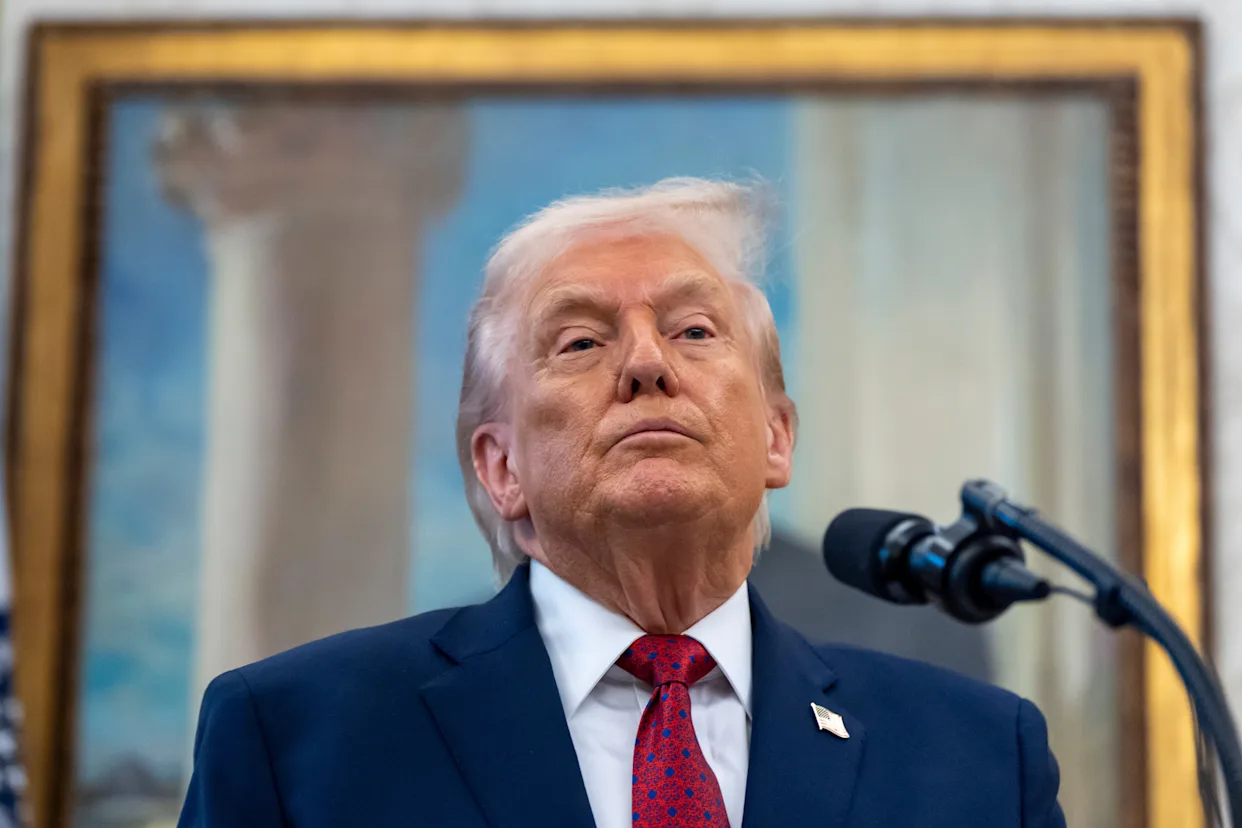
WASHINGTON (Realist English). President Donald Trump has signed an executive order classifying fentanyl as a weapon of mass destruction, a rare step that significantly expands the U.S. government’s legal authority to fight the trafficking of the synthetic opioid.
The order cites the extreme lethality of fentanyl, which kills tens of thousands of Americans each year, and argues that transnational criminal networks — designated by the Trump administration as foreign terrorist organizations — use fentanyl sales to finance activities that undermine U.S. national security.
Speaking in the Oval Office, Trump said drug flows into the United States by sea have dropped by 94 percent, while acknowledging that most fentanyl still enters through land ports of entry. He described drug trafficking as “a direct military threat to the United States of America.”
The administration has made fentanyl a centerpiece of its border and security policy, arguing that stricter immigration controls and tougher border enforcement have reduced domestic consumption. White House border czar Tom Homan said on Monday that tighter border controls were already producing results. “With a secure border, lives are being saved every day, sex trafficking has plummeted, fentanyl has plummeted,” he said.
Classifying a narcotic as a weapon of mass destruction is almost unprecedented, but the idea has circulated in Washington before. During the Biden administration, a bipartisan group of state attorneys general urged similar steps, pointing to fentanyl’s ability to kill large numbers of people rapidly even in minute doses.
Most illicit fentanyl entering the U.S. is produced in Mexico by drug cartels using precursor chemicals sourced largely from China. Production has also expanded in Southeast Asia’s so-called Golden Triangle — Laos, Myanmar and Thailand — where fentanyl can be manufactured in small, makeshift laboratories, complicating enforcement efforts.
The Trump administration has also accused cartels operating out of Venezuela of trafficking fentanyl into the United States, using those claims to justify the use of lethal force against suspected drug-smuggling vessels in the Caribbean. While Venezuela is a major cocaine transit hub, it is not widely considered a central player in global fentanyl supply chains.
The designation comes amid growing speculation that Washington could escalate pressure on Venezuelan President Nicolás Maduro, potentially including strikes against alleged trafficking targets on Venezuelan territory. Labeling fentanyl a weapon of mass destruction would strengthen the legal rationale for the use of military force.
The move inevitably recalls past U.S. precedent: claims about weapons of mass destruction were used by the George W. Bush administration to justify the 2003 invasion of Iraq and the removal of Saddam Hussein. The U.S. has also previously floated military action against drug cartels in Colombia and Mexico, and analysts say Washington could ultimately shift its focus toward those countries as well.