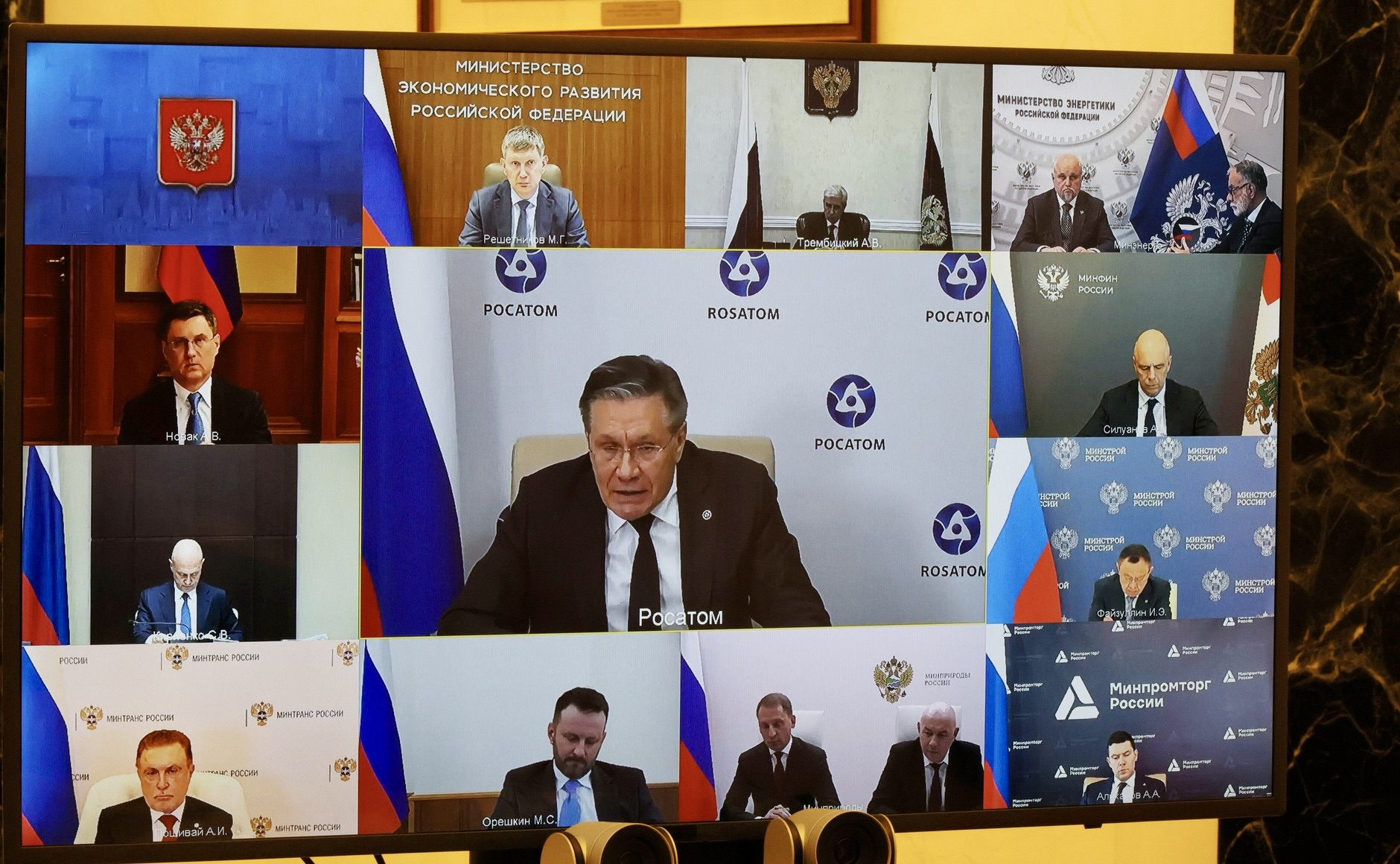
MOSCOW (Realist English). President Vladimir Putin has chaired a meeting on the development of nuclear energy, setting tasks for expanding capacity, widening the geography of nuclear plant construction and strengthening technological leadership.
Rosatom Director General Alexei Likhachev delivered the main report, outlining plans to build 38 power units in Russia and 28 abroad.
30 GW of new capacity and 25% in the energy mix
Opening the meeting, the president noted that 20 August marks the 81st anniversary of the Russian nuclear industry. Putin stressed that Russia is the only country in the world with competencies across the entire nuclear energy chain, calling it “a source of pride.”
“Nuclear generation currently accounts for about 20 percent of the electricity produced in the country. Under the industry’s long‑term plans, Russia is set to commission around 30 gigawatts of new nuclear capacity, including small nuclear power plants,” Putin said. According to him, this will not only replace retiring units but also significantly increase overall generation.
The president paid special attention to expanding the geography of nuclear plant deployment: “Modern nuclear plants will appear in the Urals, Siberia and the Far East.” Putin also noted that growing electricity consumption by data centres and artificial intelligence systems requires proactive capacity commissioning.
Key tasks set by the president:
- Technological readiness – developing a line of standardised power units for serial construction;
- Fuel supply – strengthening the resource base and geological exploration;
- Technological leadership – deploying closed nuclear fuel cycles and fourth‑generation reactors;
- Personnel training – supporting specialised education and professional development;
- Financial model – sustainable financing for investment projects.
Rosatom: 18 units in Russia, 28 abroad
Rosatom Director General Alexei Likhachev reported that Russia currently operates 34 power units at 11 nuclear plants. Last year, they generated more than 218 billion kWh, with wind and thermal generation bringing the total to over 230 billion.
“This year’s figures will improve, and we will guarantee our position as the country’s largest electricity generating company,” Likhachev said.
Under the General Scheme for the Placement of Nuclear Power Facilities until 2042, approved by the government in December 2024, Rosatom will address three main tasks:
| Task | Description |
| Replacement of retiring capacity | Over the next 10 years, 13 units (more than 10 GW) – one‑third of the current fleet – must be decommissioned |
| Transition to fourth generation | Deployment of fast‑neutron reactors and closed nuclear fuel cycles |
| Increasing nuclear generation share | From 20% to 25% by 2045 |
Currently, 18 power units are under construction in Russia across nine sites, including small and floating nuclear plants. Abroad, Rosatom is building 28 units in nine countries – India, China, Turkey, Egypt, Iran, Bangladesh, Hungary and others. The order book includes a further 17 units in six countries, including Vietnam, while negotiations are underway with 15 states.
“We are targeting approximately 50 possible agreements, with a balanced mix of large and small‑capacity units,” Likhachev noted.
Next‑generation reactors: from VVER‑TOI to BREST‑300
Likhachev presented a range of technological solutions:
- VVER‑TOI – an optimised 1,250 MW reactor, first deployed at Kursk NPP, which has already generated over 4 billion kWh;
- VVER‑600 – medium‑capacity units, including with spectral regulation;
- RITM‑200 – small‑capacity reactors based on marine propulsion units, produced in series (15 reactors manufactured, 13 under construction);
- Micro‑capacity units – “Shelf” (Rosatom’s development) and “Elena” (Kurchatov Institute), capable of operating autonomously for decades.
The flagship fourth‑generation project is the pilot demonstration energy complex in Seversk with the BREST‑300 reactor (lead‑cooled, 300 MW). It enables a closed nuclear fuel cycle, combining on one site the reactor, a spent fuel reprocessing plant and a fresh fuel fabrication facility.
“The world is watching the Seversk construction site, and the launch of the pilot complex by 2030 will demonstrate our unquestionable leadership in new nuclear technologies,” Likhachev said.
Personnel, regulation and international cooperation
Likhachev thanked Rostechnadzor for its support in advancing foreign projects but noted that technology is evolving faster than regulations are updated. He proposed introducing “early project assessment,” where the regulator works with the developer before the licensing application is submitted.
The industry has consolidated assets for manufacturing critical equipment. Rosatom’s machine‑building holding has mastered the full cycle of “nuclear island” production, with localisation of turbine hall equipment exceeding 80%. Modern domestic digital solutions for process control systems have also been developed.
To maintain global leadership, the national project “New Nuclear Energy Technologies,” approved by Prime Minister Mikhail Mishustin, is being implemented. It includes five federal projects, among them the creation of a multi‑purpose fast research reactor in Dimitrovgrad and the development of molten‑salt reactor technology.
“Competition in controlled thermonuclear fusion has reached its peak. Together with the Kurchatov Institute, we are preparing to begin work on a unique tokamak with reactor technologies,” Likhachev said.
The meeting confirmed Russia’s systematic approach to nuclear energy as the foundation of energy security and technological sovereignty. Rosatom is preparing for large‑scale construction both in Russia (38 units) and abroad (28 units, with the potential to expand to 50).
Key challenges include synchronising construction timelines with the retirement of old capacity, updating the regulatory framework and maintaining leadership amid global competition. As Putin stressed, Russia does not intend to give ground: “Competition in the global nuclear energy sector is high, and we must strengthen our technological leadership in this field.”